

3 Group 8 Metal Systems
3.1 Ruthenium Catalysts
3.1.1 Synthesis of (Pre)catalysts
Synthetic routes to hydrogenation (pre)catalysts involving ruthenium-based
PNP-type complexes are summarized in Scheme 7. Complex (
Ph PN
H P)RuHCl
(CO) was first developed by Takasago International Corporation with a trademark
name of Ru-MACHO [32, 54]. It was originally isolated as a mixture of syn and anti
(referring to the relative configuration of NH and RuH ) isomers from the reaction of
Ph PN
H
P with RuHCl(CO)(PPh 3 ) 3 performed in refluxing toluene, although minor
modifications to the procedures could lead to the anti isomer only [55, 56]. The
presence of two isomers is deemed to be unimportant for the hydrogenation reactions
because catalyst activation by a base (Scheme 3) removes the NH hydrogen. The
synthetic approach has been successfully extended to other
R PN
H
P ligands [55–57]
including the one bearing chiral phospholane rings [58]. Substitution of the chloride
in Ru-MACHO,
iPr
RuHCl, and
Cy
RuHCl for BH 4
À and H
À has been accomplished through the addition of NaBH 4 [32, 56, 59] and NaBEt 3 H [56, 60], respectively. The latter reaction with the sterically crowded
tBu RuHCl, however, produces
a five-coordinate ruthenium hydride, likely due to a facile H 2 elimination from the
initial product
tBu RuH 2 [56]. The phenyl analog
Ph RuH 2 synthesized from the
NaBEt 3 H method has a low purity because of rapid decomposition [56]. It can
alternatively be synthesized from Ru-MACHO and KO
t Bu (or KN(SiMe 3 ) 2 ) under
H 2 , though contaminated with ~5% of Ru-MACHO [21].
Other ruthenium precursors have been used to prepare PNP-type hydrogenation
(pre)catalysts. The reaction of Ru(COD)(2-methylallyl) 2 with
tBu PN
H P under 5 bar
of H 2 produces a mixture of
tBu RuH 2 (H 2 ) and
tBu RuH(H 2 ) (Scheme 7, Method B)
[61]. Pure
tBu
RuH(H 2 ) can be obtained by stirring the mixture under argon, and its
reaction with a primary alcohol also affords
tBu RuH as a result of alcohol dehydrogenation and decarbonylation [62]. Using ( p-cymene)RuCl 2 (NHC) (NHC ¼ 1,3dimethylimidazol-2-ylidene) as the ruthenium source provides an opportunity to
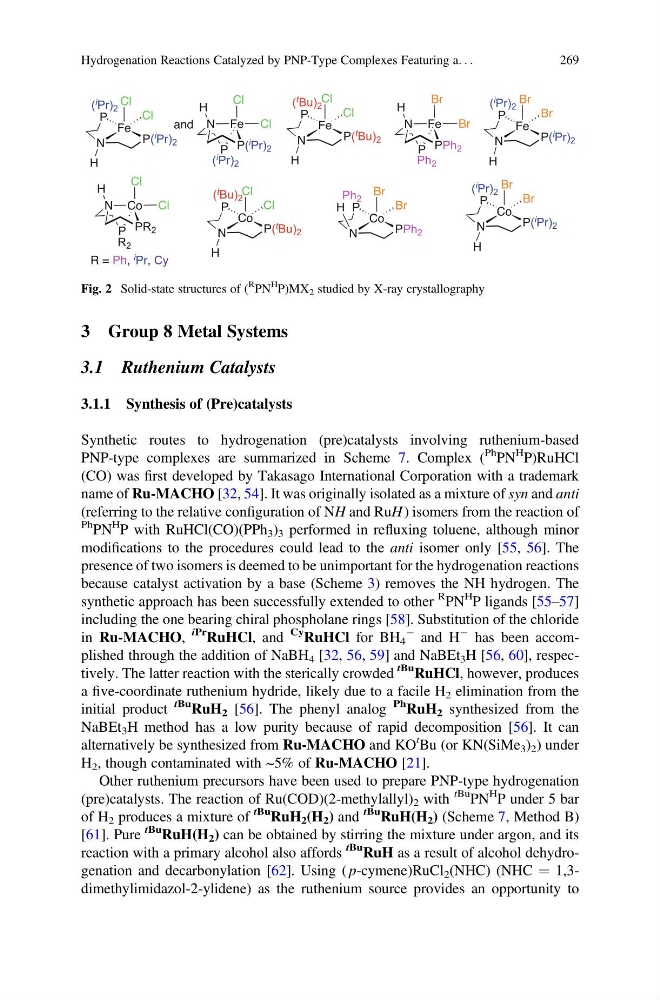
Fig. 2 Solid-state structures of (
R PN
H
P)MX 2 studied by X-ray crystallography
Hydrogenation Reactions Catalyzed by PNP-Type Complexes Featuring a. . .
269
3.1 Ruthenium Catalysts
3.1.1 Synthesis of (Pre)catalysts
Synthetic routes to hydrogenation (pre)catalysts involving ruthenium-based
PNP-type complexes are summarized in Scheme 7. Complex (
Ph PN
H P)RuHCl
(CO) was first developed by Takasago International Corporation with a trademark
name of Ru-MACHO [32, 54]. It was originally isolated as a mixture of syn and anti
(referring to the relative configuration of NH and RuH ) isomers from the reaction of
Ph PN
H
P with RuHCl(CO)(PPh 3 ) 3 performed in refluxing toluene, although minor
modifications to the procedures could lead to the anti isomer only [55, 56]. The
presence of two isomers is deemed to be unimportant for the hydrogenation reactions
because catalyst activation by a base (Scheme 3) removes the NH hydrogen. The
synthetic approach has been successfully extended to other
R PN
H
P ligands [55–57]
including the one bearing chiral phospholane rings [58]. Substitution of the chloride
in Ru-MACHO,
iPr
RuHCl, and
Cy
RuHCl for BH 4
À and H
À has been accomplished through the addition of NaBH 4 [32, 56, 59] and NaBEt 3 H [56, 60], respectively. The latter reaction with the sterically crowded
tBu RuHCl, however, produces
a five-coordinate ruthenium hydride, likely due to a facile H 2 elimination from the
initial product
tBu RuH 2 [56]. The phenyl analog
Ph RuH 2 synthesized from the
NaBEt 3 H method has a low purity because of rapid decomposition [56]. It can
alternatively be synthesized from Ru-MACHO and KO
t Bu (or KN(SiMe 3 ) 2 ) under
H 2 , though contaminated with ~5% of Ru-MACHO [21].
Other ruthenium precursors have been used to prepare PNP-type hydrogenation
(pre)catalysts. The reaction of Ru(COD)(2-methylallyl) 2 with
tBu PN
H P under 5 bar
of H 2 produces a mixture of
tBu RuH 2 (H 2 ) and
tBu RuH(H 2 ) (Scheme 7, Method B)
[61]. Pure
tBu
RuH(H 2 ) can be obtained by stirring the mixture under argon, and its
reaction with a primary alcohol also affords
tBu RuH as a result of alcohol dehydrogenation and decarbonylation [62]. Using ( p-cymene)RuCl 2 (NHC) (NHC ¼ 1,3dimethylimidazol-2-ylidene) as the ruthenium source provides an opportunity to
Fig. 2 Solid-state structures of (
R PN
H
P)MX 2 studied by X-ray crystallography
Hydrogenation Reactions Catalyzed by PNP-Type Complexes Featuring a. . .
269