

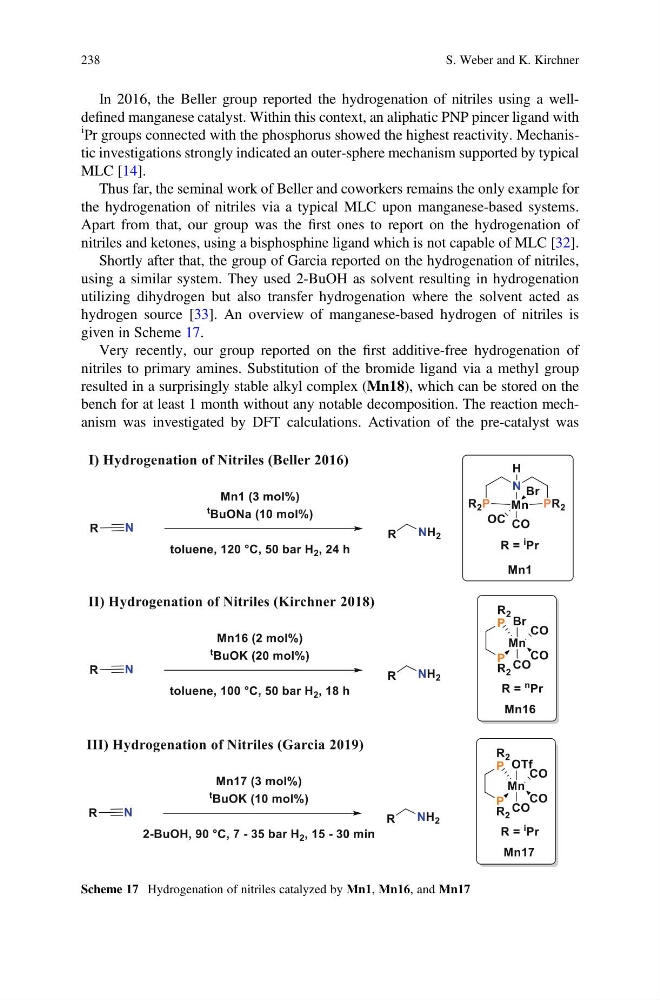
In 2016, the Beller group reported the hydrogenation of nitriles using a welldefined manganese catalyst. Within this context, an aliphatic PNP pincer ligand with
i Pr groups connected with the phosphorus showed the highest reactivity. Mechanistic investigations strongly indicated an outer-sphere mechanism supported by typical
MLC [14].
Thus far, the seminal work of Beller and coworkers remains the only example for
the hydrogenation of nitriles via a typical MLC upon manganese-based systems.
Apart from that, our group was the first ones to report on the hydrogenation of
nitriles and ketones, using a bisphosphine ligand which is not capable of MLC [32].
Shortly after that, the group of Garcia reported on the hydrogenation of nitriles,
using a similar system. They used 2-BuOH as solvent resulting in hydrogenation
utilizing dihydrogen but also transfer hydrogenation where the solvent acted as
hydrogen source [33]. An overview of manganese-based hydrogen of nitriles is
given in Scheme 17.
Very recently, our group reported on the first additive-free hydrogenation of
nitriles to primary amines. Substitution of the bromide ligand via a methyl group
resulted in a surprisingly stable alkyl complex (Mn18), which can be stored on the
bench for at least 1 month without any notable decomposition. The reaction mechanism was investigated by DFT calculations. Activation of the pre-catalyst was
Scheme 17 Hydrogenation of nitriles catalyzed by Mn1, Mn16, and Mn17
238
S. Weber and K. Kirchner
i Pr groups connected with the phosphorus showed the highest reactivity. Mechanistic investigations strongly indicated an outer-sphere mechanism supported by typical
MLC [14].
Thus far, the seminal work of Beller and coworkers remains the only example for
the hydrogenation of nitriles via a typical MLC upon manganese-based systems.
Apart from that, our group was the first ones to report on the hydrogenation of
nitriles and ketones, using a bisphosphine ligand which is not capable of MLC [32].
Shortly after that, the group of Garcia reported on the hydrogenation of nitriles,
using a similar system. They used 2-BuOH as solvent resulting in hydrogenation
utilizing dihydrogen but also transfer hydrogenation where the solvent acted as
hydrogen source [33]. An overview of manganese-based hydrogen of nitriles is
given in Scheme 17.
Very recently, our group reported on the first additive-free hydrogenation of
nitriles to primary amines. Substitution of the bromide ligand via a methyl group
resulted in a surprisingly stable alkyl complex (Mn18), which can be stored on the
bench for at least 1 month without any notable decomposition. The reaction mechanism was investigated by DFT calculations. Activation of the pre-catalyst was
Scheme 17 Hydrogenation of nitriles catalyzed by Mn1, Mn16, and Mn17
238
S. Weber and K. Kirchner