

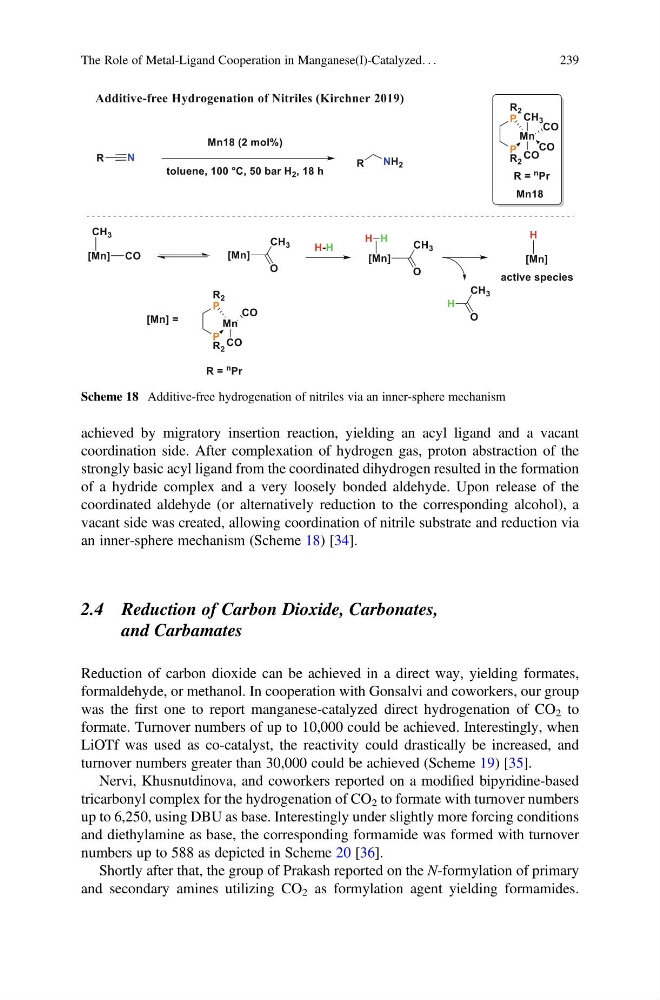
achieved by migratory insertion reaction, yielding an acyl ligand and a vacant
coordination side. After complexation of hydrogen gas, proton abstraction of the
strongly basic acyl ligand from the coordinated dihydrogen resulted in the formation
of a hydride complex and a very loosely bonded aldehyde. Upon release of the
coordinated aldehyde (or alternatively reduction to the corresponding alcohol), a
vacant side was created, allowing coordination of nitrile substrate and reduction via
an inner-sphere mechanism (Scheme 18) [34].
2.4 Reduction of Carbon Dioxide, Carbonates,
and Carbamates
Reduction of carbon dioxide can be achieved in a direct way, yielding formates,
formaldehyde, or methanol. In cooperation with Gonsalvi and coworkers, our group
was the first one to report manganese-catalyzed direct hydrogenation of CO 2 to
formate. Turnover numbers of up to 10,000 could be achieved. Interestingly, when
LiOTf was used as co-catalyst, the reactivity could drastically be increased, and
turnover numbers greater than 30,000 could be achieved (Scheme 19) [35].
Nervi, Khusnutdinova, and coworkers reported on a modified bipyridine-based
tricarbonyl complex for the hydrogenation of CO 2 to formate with turnover numbers
up to 6,250, using DBU as base. Interestingly under slightly more forcing conditions
and diethylamine as base, the corresponding formamide was formed with turnover
numbers up to 588 as depicted in Scheme 20 [36].
Shortly after that, the group of Prakash reported on the N-formylation of primary
and secondary amines utilizing CO 2 as formylation agent yielding formamides.
Scheme 18 Additive-free hydrogenation of nitriles via an inner-sphere mechanism
The Role of Metal-Ligand Cooperation in Manganese(I)-Catalyzed. . .
239
coordination side. After complexation of hydrogen gas, proton abstraction of the
strongly basic acyl ligand from the coordinated dihydrogen resulted in the formation
of a hydride complex and a very loosely bonded aldehyde. Upon release of the
coordinated aldehyde (or alternatively reduction to the corresponding alcohol), a
vacant side was created, allowing coordination of nitrile substrate and reduction via
an inner-sphere mechanism (Scheme 18) [34].
2.4 Reduction of Carbon Dioxide, Carbonates,
and Carbamates
Reduction of carbon dioxide can be achieved in a direct way, yielding formates,
formaldehyde, or methanol. In cooperation with Gonsalvi and coworkers, our group
was the first one to report manganese-catalyzed direct hydrogenation of CO 2 to
formate. Turnover numbers of up to 10,000 could be achieved. Interestingly, when
LiOTf was used as co-catalyst, the reactivity could drastically be increased, and
turnover numbers greater than 30,000 could be achieved (Scheme 19) [35].
Nervi, Khusnutdinova, and coworkers reported on a modified bipyridine-based
tricarbonyl complex for the hydrogenation of CO 2 to formate with turnover numbers
up to 6,250, using DBU as base. Interestingly under slightly more forcing conditions
and diethylamine as base, the corresponding formamide was formed with turnover
numbers up to 588 as depicted in Scheme 20 [36].
Shortly after that, the group of Prakash reported on the N-formylation of primary
and secondary amines utilizing CO 2 as formylation agent yielding formamides.
Scheme 18 Additive-free hydrogenation of nitriles via an inner-sphere mechanism
The Role of Metal-Ligand Cooperation in Manganese(I)-Catalyzed. . .
239