

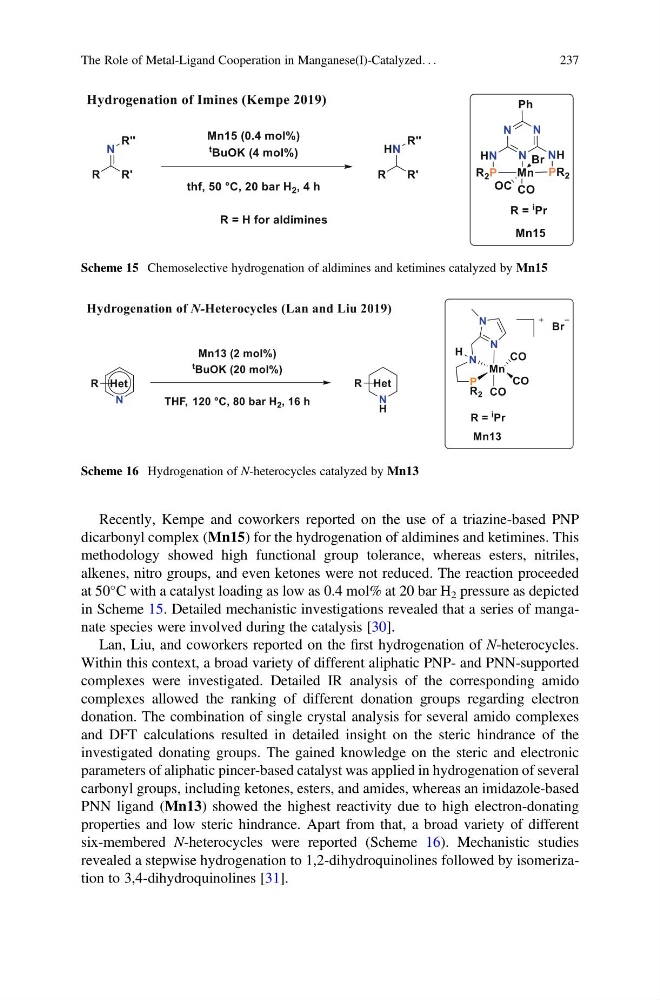
Recently, Kempe and coworkers reported on the use of a triazine-based PNP
dicarbonyl complex (Mn15) for the hydrogenation of aldimines and ketimines. This
methodology showed high functional group tolerance, whereas esters, nitriles,
alkenes, nitro groups, and even ketones were not reduced. The reaction proceeded
at 50
C with a catalyst loading as low as 0.4 mol% at 20 bar H 2 pressure as depicted
in Scheme 15. Detailed mechanistic investigations revealed that a series of manganate species were involved during the catalysis [30].
Lan, Liu, and coworkers reported on the first hydrogenation of N-heterocycles.
Within this context, a broad variety of different aliphatic PNP- and PNN-supported
complexes were investigated. Detailed IR analysis of the corresponding amido
complexes allowed the ranking of different donation groups regarding electron
donation. The combination of single crystal analysis for several amido complexes
and DFT calculations resulted in detailed insight on the steric hindrance of the
investigated donating groups. The gained knowledge on the steric and electronic
parameters of aliphatic pincer-based catalyst was applied in hydrogenation of several
carbonyl groups, including ketones, esters, and amides, whereas an imidazole-based
PNN ligand (Mn13) showed the highest reactivity due to high electron-donating
properties and low steric hindrance. Apart from that, a broad variety of different
six-membered N-heterocycles were reported (Scheme 16). Mechanistic studies
revealed a stepwise hydrogenation to 1,2-dihydroquinolines followed by isomerization to 3,4-dihydroquinolines [31].
Scheme 15 Chemoselective hydrogenation of aldimines and ketimines catalyzed by Mn15
Scheme 16 Hydrogenation of N-heterocycles catalyzed by Mn13
The Role of Metal-Ligand Cooperation in Manganese(I)-Catalyzed. . .
237
dicarbonyl complex (Mn15) for the hydrogenation of aldimines and ketimines. This
methodology showed high functional group tolerance, whereas esters, nitriles,
alkenes, nitro groups, and even ketones were not reduced. The reaction proceeded
at 50
C with a catalyst loading as low as 0.4 mol% at 20 bar H 2 pressure as depicted
in Scheme 15. Detailed mechanistic investigations revealed that a series of manganate species were involved during the catalysis [30].
Lan, Liu, and coworkers reported on the first hydrogenation of N-heterocycles.
Within this context, a broad variety of different aliphatic PNP- and PNN-supported
complexes were investigated. Detailed IR analysis of the corresponding amido
complexes allowed the ranking of different donation groups regarding electron
donation. The combination of single crystal analysis for several amido complexes
and DFT calculations resulted in detailed insight on the steric hindrance of the
investigated donating groups. The gained knowledge on the steric and electronic
parameters of aliphatic pincer-based catalyst was applied in hydrogenation of several
carbonyl groups, including ketones, esters, and amides, whereas an imidazole-based
PNN ligand (Mn13) showed the highest reactivity due to high electron-donating
properties and low steric hindrance. Apart from that, a broad variety of different
six-membered N-heterocycles were reported (Scheme 16). Mechanistic studies
revealed a stepwise hydrogenation to 1,2-dihydroquinolines followed by isomerization to 3,4-dihydroquinolines [31].
Scheme 15 Chemoselective hydrogenation of aldimines and ketimines catalyzed by Mn15
Scheme 16 Hydrogenation of N-heterocycles catalyzed by Mn13
The Role of Metal-Ligand Cooperation in Manganese(I)-Catalyzed. . .
237