

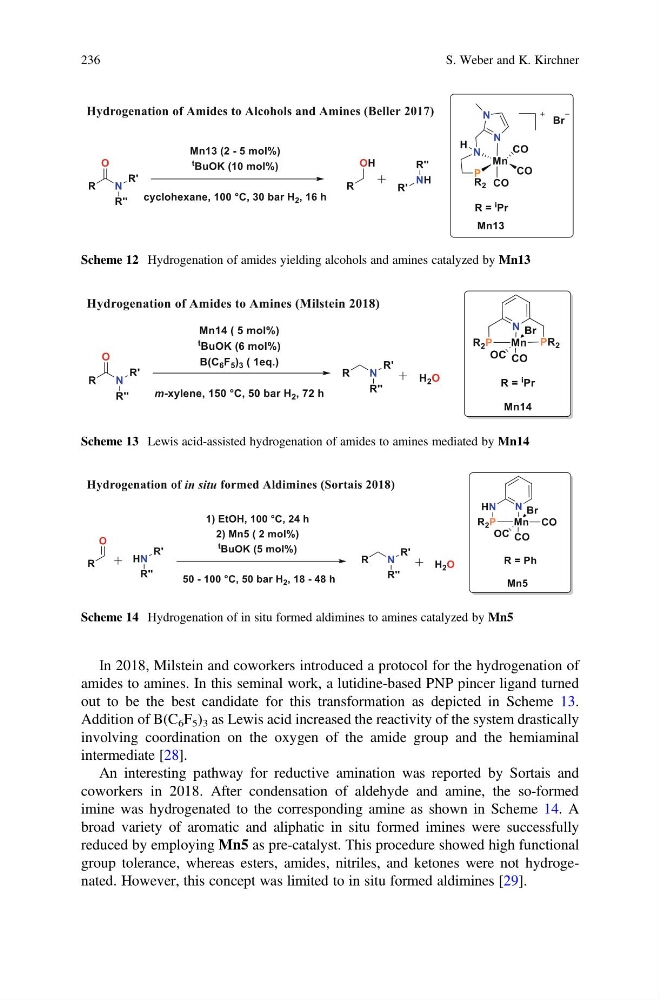
In 2018, Milstein and coworkers introduced a protocol for the hydrogenation of
amides to amines. In this seminal work, a lutidine-based PNP pincer ligand turned
out to be the best candidate for this transformation as depicted in Scheme 13.
Addition of B(C 6 F 5 ) 3 as Lewis acid increased the reactivity of the system drastically
involving coordination on the oxygen of the amide group and the hemiaminal
intermediate [28].
An interesting pathway for reductive amination was reported by Sortais and
coworkers in 2018. After condensation of aldehyde and amine, the so-formed
imine was hydrogenated to the corresponding amine as shown in Scheme 14. A
broad variety of aromatic and aliphatic in situ formed imines were successfully
reduced by employing Mn5 as pre-catalyst. This procedure showed high functional
group tolerance, whereas esters, amides, nitriles, and ketones were not hydrogenated. However, this concept was limited to in situ formed aldimines [29].
Scheme 12 Hydrogenation of amides yielding alcohols and amines catalyzed by Mn13
Scheme 13 Lewis acid-assisted hydrogenation of amides to amines mediated by Mn14
Scheme 14 Hydrogenation of in situ formed aldimines to amines catalyzed by Mn5
236
S. Weber and K. Kirchner
amides to amines. In this seminal work, a lutidine-based PNP pincer ligand turned
out to be the best candidate for this transformation as depicted in Scheme 13.
Addition of B(C 6 F 5 ) 3 as Lewis acid increased the reactivity of the system drastically
involving coordination on the oxygen of the amide group and the hemiaminal
intermediate [28].
An interesting pathway for reductive amination was reported by Sortais and
coworkers in 2018. After condensation of aldehyde and amine, the so-formed
imine was hydrogenated to the corresponding amine as shown in Scheme 14. A
broad variety of aromatic and aliphatic in situ formed imines were successfully
reduced by employing Mn5 as pre-catalyst. This procedure showed high functional
group tolerance, whereas esters, amides, nitriles, and ketones were not hydrogenated. However, this concept was limited to in situ formed aldimines [29].
Scheme 12 Hydrogenation of amides yielding alcohols and amines catalyzed by Mn13
Scheme 13 Lewis acid-assisted hydrogenation of amides to amines mediated by Mn14
Scheme 14 Hydrogenation of in situ formed aldimines to amines catalyzed by Mn5
236
S. Weber and K. Kirchner