

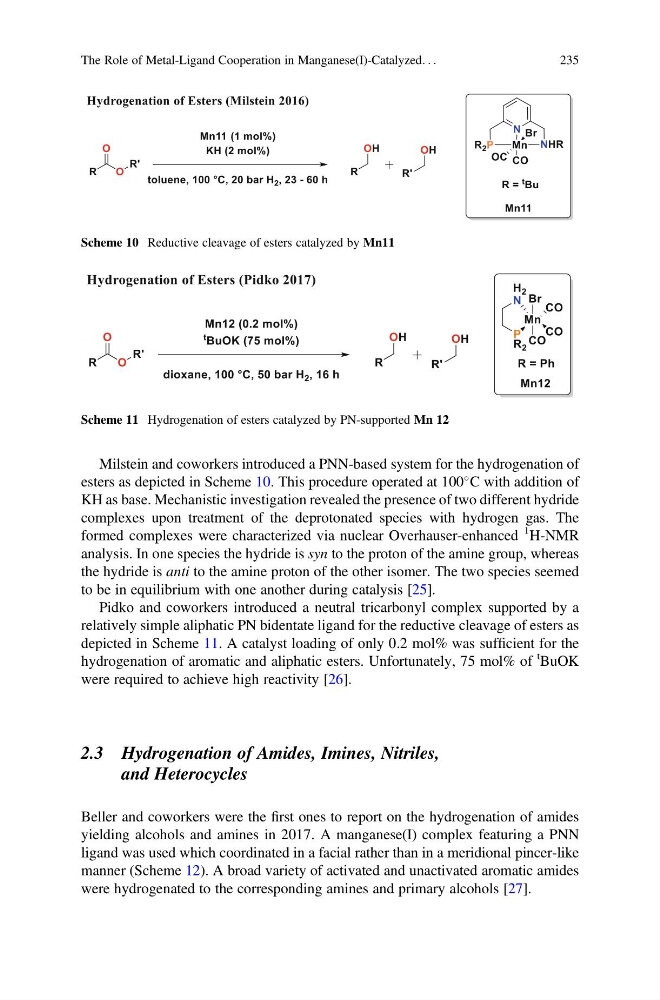
Milstein and coworkers introduced a PNN-based system for the hydrogenation of
esters as depicted in Scheme 10. This procedure operated at 100
C with addition of
KH as base. Mechanistic investigation revealed the presence of two different hydride
complexes upon treatment of the deprotonated species with hydrogen gas. The
formed complexes were characterized via nuclear Overhauser-enhanced
1 H-NMR
analysis. In one species the hydride is syn to the proton of the amine group, whereas
the hydride is anti to the amine proton of the other isomer. The two species seemed
to be in equilibrium with one another during catalysis [25].
Pidko and coworkers introduced a neutral tricarbonyl complex supported by a
relatively simple aliphatic PN bidentate ligand for the reductive cleavage of esters as
depicted in Scheme 11. A catalyst loading of only 0.2 mol% was sufficient for the
hydrogenation of aromatic and aliphatic esters. Unfortunately, 75 mol% of
t
BuOK
were required to achieve high reactivity [26].
2.3 Hydrogenation of Amides, Imines, Nitriles,
and Heterocycles
Beller and coworkers were the first ones to report on the hydrogenation of amides
yielding alcohols and amines in 2017. A manganese(I) complex featuring a PNN
ligand was used which coordinated in a facial rather than in a meridional pincer-like
manner (Scheme 12). A broad variety of activated and unactivated aromatic amides
were hydrogenated to the corresponding amines and primary alcohols [27].
Scheme 10 Reductive cleavage of esters catalyzed by Mn11
Scheme 11 Hydrogenation of esters catalyzed by PN-supported Mn 12
The Role of Metal-Ligand Cooperation in Manganese(I)-Catalyzed. . .
235
esters as depicted in Scheme 10. This procedure operated at 100
C with addition of
KH as base. Mechanistic investigation revealed the presence of two different hydride
complexes upon treatment of the deprotonated species with hydrogen gas. The
formed complexes were characterized via nuclear Overhauser-enhanced
1 H-NMR
analysis. In one species the hydride is syn to the proton of the amine group, whereas
the hydride is anti to the amine proton of the other isomer. The two species seemed
to be in equilibrium with one another during catalysis [25].
Pidko and coworkers introduced a neutral tricarbonyl complex supported by a
relatively simple aliphatic PN bidentate ligand for the reductive cleavage of esters as
depicted in Scheme 11. A catalyst loading of only 0.2 mol% was sufficient for the
hydrogenation of aromatic and aliphatic esters. Unfortunately, 75 mol% of
t
BuOK
were required to achieve high reactivity [26].
2.3 Hydrogenation of Amides, Imines, Nitriles,
and Heterocycles
Beller and coworkers were the first ones to report on the hydrogenation of amides
yielding alcohols and amines in 2017. A manganese(I) complex featuring a PNN
ligand was used which coordinated in a facial rather than in a meridional pincer-like
manner (Scheme 12). A broad variety of activated and unactivated aromatic amides
were hydrogenated to the corresponding amines and primary alcohols [27].
Scheme 10 Reductive cleavage of esters catalyzed by Mn11
Scheme 11 Hydrogenation of esters catalyzed by PN-supported Mn 12
The Role of Metal-Ligand Cooperation in Manganese(I)-Catalyzed. . .
235