

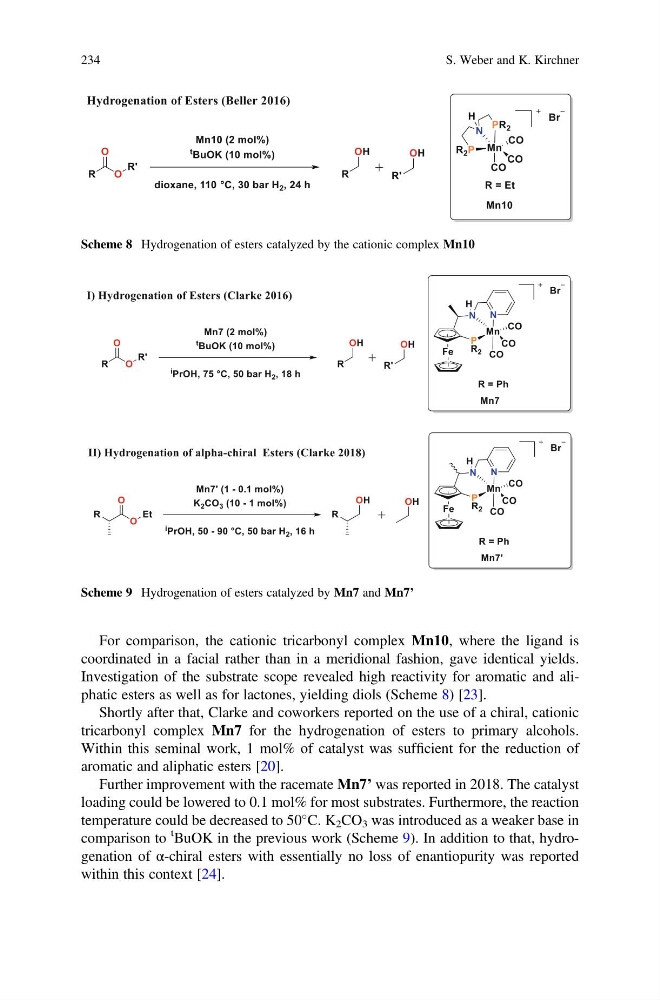
For comparison, the cationic tricarbonyl complex Mn10, where the ligand is
coordinated in a facial rather than in a meridional fashion, gave identical yields.
Investigation of the substrate scope revealed high reactivity for aromatic and aliphatic esters as well as for lactones, yielding diols (Scheme 8) [23].
Shortly after that, Clarke and coworkers reported on the use of a chiral, cationic
tricarbonyl complex Mn7 for the hydrogenation of esters to primary alcohols.
Within this seminal work, 1 mol% of catalyst was sufficient for the reduction of
aromatic and aliphatic esters [20].
Further improvement with the racemate Mn7’ was reported in 2018. The catalyst
loading could be lowered to 0.1 mol% for most substrates. Furthermore, the reaction
temperature could be decreased to 50
C. K 2 CO 3 was introduced as a weaker base in
comparison to
t BuOK in the previous work (Scheme 9). In addition to that, hydrogenation of α-chiral esters with essentially no loss of enantiopurity was reported
within this context [24].
Scheme 8 Hydrogenation of esters catalyzed by the cationic complex Mn10
Scheme 9 Hydrogenation of esters catalyzed by Mn7 and Mn7’
234
S. Weber and K. Kirchner
coordinated in a facial rather than in a meridional fashion, gave identical yields.
Investigation of the substrate scope revealed high reactivity for aromatic and aliphatic esters as well as for lactones, yielding diols (Scheme 8) [23].
Shortly after that, Clarke and coworkers reported on the use of a chiral, cationic
tricarbonyl complex Mn7 for the hydrogenation of esters to primary alcohols.
Within this seminal work, 1 mol% of catalyst was sufficient for the reduction of
aromatic and aliphatic esters [20].
Further improvement with the racemate Mn7’ was reported in 2018. The catalyst
loading could be lowered to 0.1 mol% for most substrates. Furthermore, the reaction
temperature could be decreased to 50
C. K 2 CO 3 was introduced as a weaker base in
comparison to
t BuOK in the previous work (Scheme 9). In addition to that, hydrogenation of α-chiral esters with essentially no loss of enantiopurity was reported
within this context [24].
Scheme 8 Hydrogenation of esters catalyzed by the cationic complex Mn10
Scheme 9 Hydrogenation of esters catalyzed by Mn7 and Mn7’
234
S. Weber and K. Kirchner