

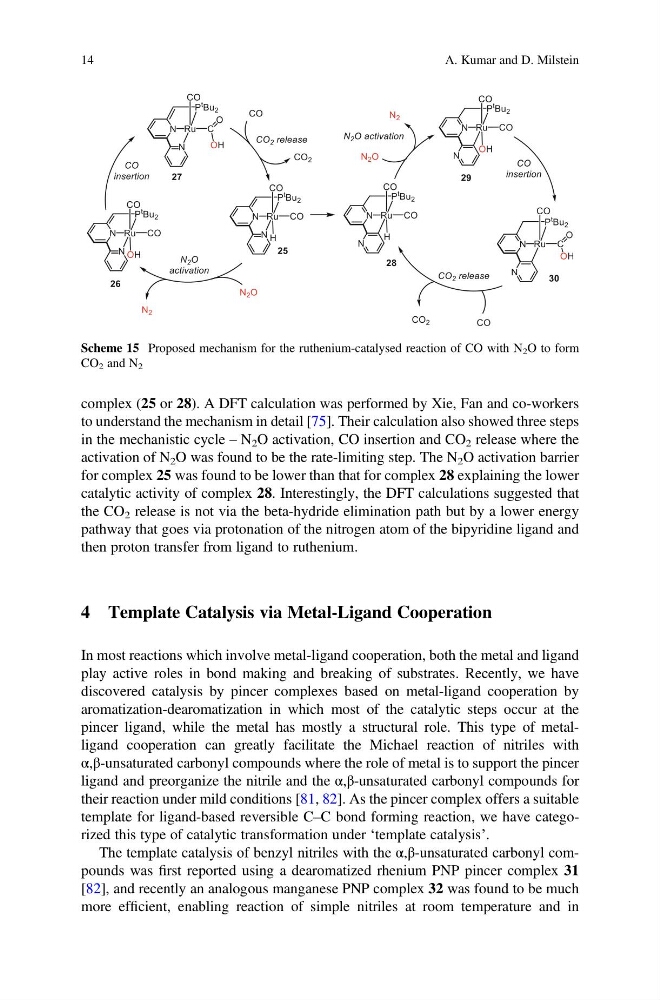
complex (25 or 28). A DFT calculation was performed by Xie, Fan and co-workers
to understand the mechanism in detail [75]. Their calculation also showed three steps
in the mechanistic cycle – N 2 O activation, CO insertion and CO 2 release where the
activation of N 2 O was found to be the rate-limiting step. The N 2 O activation barrier
for complex 25 was found to be lower than that for complex 28 explaining the lower
catalytic activity of complex 28. Interestingly, the DFT calculations suggested that
the CO 2 release is not via the beta-hydride elimination path but by a lower energy
pathway that goes via protonation of the nitrogen atom of the bipyridine ligand and
then proton transfer from ligand to ruthenium.
4 Template Catalysis via Metal-Ligand Cooperation
In most reactions which involve metal-ligand cooperation, both the metal and ligand
play active roles in bond making and breaking of substrates. Recently, we have
discovered catalysis by pincer complexes based on metal-ligand cooperation by
aromatization-dearomatization in which most of the catalytic steps occur at the
pincer ligand, while the metal has mostly a structural role. This type of metalligand cooperation can greatly facilitate the Michael reaction of nitriles with
α,β-unsaturated carbonyl compounds where the role of metal is to support the pincer
ligand and preorganize the nitrile and the α,β-unsaturated carbonyl compounds for
their reaction under mild conditions [81, 82]. As the pincer complex offers a suitable
template for ligand-based reversible C–C bond forming reaction, we have categorized this type of catalytic transformation under ‘template catalysis’.
The template catalysis of benzyl nitriles with the α,β-unsaturated carbonyl compounds was first reported using a dearomatized rhenium PNP pincer complex 31
[82], and recently an analogous manganese PNP complex 32 was found to be much
more efficient, enabling reaction of simple nitriles at room temperature and in
Scheme 15 Proposed mechanism for the ruthenium-catalysed reaction of CO with N 2 O to form
CO 2 and N 2
14
A. Kumar and D. Milstein
to understand the mechanism in detail [75]. Their calculation also showed three steps
in the mechanistic cycle – N 2 O activation, CO insertion and CO 2 release where the
activation of N 2 O was found to be the rate-limiting step. The N 2 O activation barrier
for complex 25 was found to be lower than that for complex 28 explaining the lower
catalytic activity of complex 28. Interestingly, the DFT calculations suggested that
the CO 2 release is not via the beta-hydride elimination path but by a lower energy
pathway that goes via protonation of the nitrogen atom of the bipyridine ligand and
then proton transfer from ligand to ruthenium.
4 Template Catalysis via Metal-Ligand Cooperation
In most reactions which involve metal-ligand cooperation, both the metal and ligand
play active roles in bond making and breaking of substrates. Recently, we have
discovered catalysis by pincer complexes based on metal-ligand cooperation by
aromatization-dearomatization in which most of the catalytic steps occur at the
pincer ligand, while the metal has mostly a structural role. This type of metalligand cooperation can greatly facilitate the Michael reaction of nitriles with
α,β-unsaturated carbonyl compounds where the role of metal is to support the pincer
ligand and preorganize the nitrile and the α,β-unsaturated carbonyl compounds for
their reaction under mild conditions [81, 82]. As the pincer complex offers a suitable
template for ligand-based reversible C–C bond forming reaction, we have categorized this type of catalytic transformation under ‘template catalysis’.
The template catalysis of benzyl nitriles with the α,β-unsaturated carbonyl compounds was first reported using a dearomatized rhenium PNP pincer complex 31
[82], and recently an analogous manganese PNP complex 32 was found to be much
more efficient, enabling reaction of simple nitriles at room temperature and in
Scheme 15 Proposed mechanism for the ruthenium-catalysed reaction of CO with N 2 O to form
CO 2 and N 2
14
A. Kumar and D. Milstein