

absence of base with low catalytic loading, and has wide substrate scope [81]. Using
0.5 mol% of the dearomatized manganese PNP complex 32, at ambient temperature
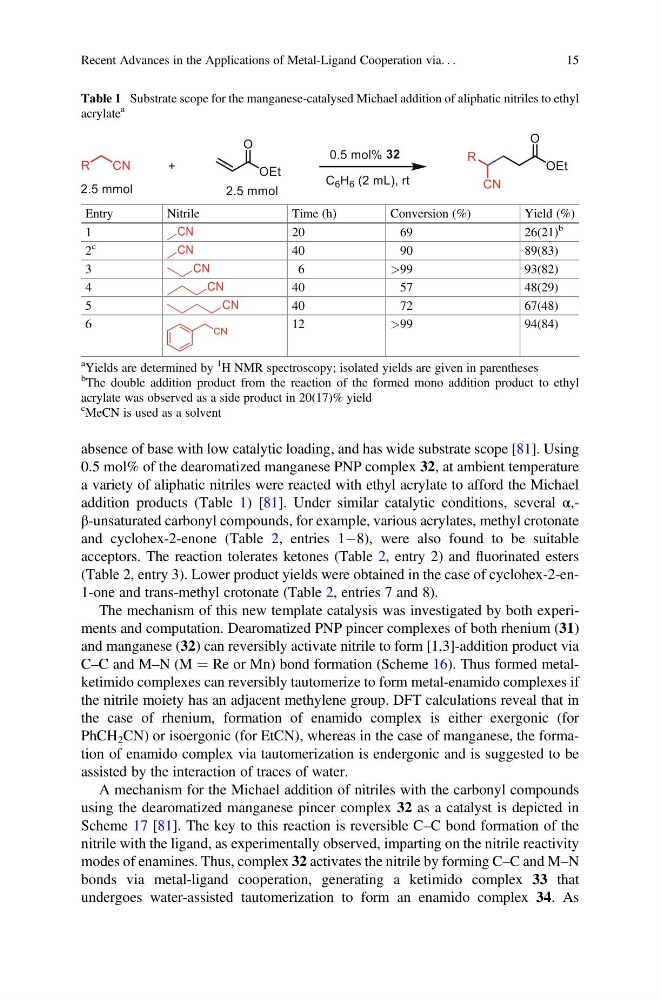
a variety of aliphatic nitriles were reacted with ethyl acrylate to afford the Michael
addition products (Table 1) [81]. Under similar catalytic conditions, several α,β-unsaturated carbonyl compounds, for example, various acrylates, methyl crotonate
and cyclohex-2-enone (Table 2, entries 1À8), were also found to be suitable
acceptors. The reaction tolerates ketones (Table 2, entry 2) and fluorinated esters
(Table 2, entry 3). Lower product yields were obtained in the case of cyclohex-2-en1-one and trans-methyl crotonate (Table 2, entries 7 and 8).
The mechanism of this new template catalysis was investigated by both experiments and computation. Dearomatized PNP pincer complexes of both rhenium (31)
and manganese (32) can reversibly activate nitrile to form [1,3]-addition product via
C–C and M–N (M ¼ Re or Mn) bond formation (Scheme 16). Thus formed metalketimido complexes can reversibly tautomerize to form metal-enamido complexes if
the nitrile moiety has an adjacent methylene group. DFT calculations reveal that in
the case of rhenium, formation of enamido complex is either exergonic (for
PhCH 2 CN) or isoergonic (for EtCN), whereas in the case of manganese, the formation of enamido complex via tautomerization is endergonic and is suggested to be
assisted by the interaction of traces of water.
A mechanism for the Michael addition of nitriles with the carbonyl compounds
using the dearomatized manganese pincer complex 32 as a catalyst is depicted in
Scheme 17 [81]. The key to this reaction is reversible C–C bond formation of the
nitrile with the ligand, as experimentally observed, imparting on the nitrile reactivity
modes of enamines. Thus, complex 32 activates the nitrile by forming C–C and M–N
bonds via metal-ligand cooperation, generating a ketimido complex 33 that
undergoes water-assisted tautomerization to form an enamido complex 34. As
Table 1 Substrate scope for the manganese-catalysed Michael addition of aliphatic nitriles to ethyl
acrylate
a
Entry
Nitrile
Time (h)
Conversion (%)
Yield (%)
1
20
69
26(21)
b
2
c
40
90
89(83)
3
6
>99
93(82)
4
40
57
48(29)
5
40
72
67(48)
6
12
>99
94(84)
a Yields are determined by
1
H NMR spectroscopy; isolated yields are given in parentheses
b
The double addition product from the reaction of the formed mono addition product to ethyl
acrylate was observed as a side product in 20(17)% yield
c MeCN is used as a solvent
Recent Advances in the Applications of Metal-Ligand Cooperation via. . .
15
0.5 mol% of the dearomatized manganese PNP complex 32, at ambient temperature
a variety of aliphatic nitriles were reacted with ethyl acrylate to afford the Michael
addition products (Table 1) [81]. Under similar catalytic conditions, several α,β-unsaturated carbonyl compounds, for example, various acrylates, methyl crotonate
and cyclohex-2-enone (Table 2, entries 1À8), were also found to be suitable
acceptors. The reaction tolerates ketones (Table 2, entry 2) and fluorinated esters
(Table 2, entry 3). Lower product yields were obtained in the case of cyclohex-2-en1-one and trans-methyl crotonate (Table 2, entries 7 and 8).
The mechanism of this new template catalysis was investigated by both experiments and computation. Dearomatized PNP pincer complexes of both rhenium (31)
and manganese (32) can reversibly activate nitrile to form [1,3]-addition product via
C–C and M–N (M ¼ Re or Mn) bond formation (Scheme 16). Thus formed metalketimido complexes can reversibly tautomerize to form metal-enamido complexes if
the nitrile moiety has an adjacent methylene group. DFT calculations reveal that in
the case of rhenium, formation of enamido complex is either exergonic (for
PhCH 2 CN) or isoergonic (for EtCN), whereas in the case of manganese, the formation of enamido complex via tautomerization is endergonic and is suggested to be
assisted by the interaction of traces of water.
A mechanism for the Michael addition of nitriles with the carbonyl compounds
using the dearomatized manganese pincer complex 32 as a catalyst is depicted in
Scheme 17 [81]. The key to this reaction is reversible C–C bond formation of the
nitrile with the ligand, as experimentally observed, imparting on the nitrile reactivity
modes of enamines. Thus, complex 32 activates the nitrile by forming C–C and M–N
bonds via metal-ligand cooperation, generating a ketimido complex 33 that
undergoes water-assisted tautomerization to form an enamido complex 34. As
Table 1 Substrate scope for the manganese-catalysed Michael addition of aliphatic nitriles to ethyl
acrylate
a
Entry
Nitrile
Time (h)
Conversion (%)
Yield (%)
1
20
69
26(21)
b
2
c
40
90
89(83)
3
6
>99
93(82)
4
40
57
48(29)
5
40
72
67(48)
6
12
>99
94(84)
a Yields are determined by
1
H NMR spectroscopy; isolated yields are given in parentheses
b
The double addition product from the reaction of the formed mono addition product to ethyl
acrylate was observed as a side product in 20(17)% yield
c MeCN is used as a solvent
Recent Advances in the Applications of Metal-Ligand Cooperation via. . .
15