

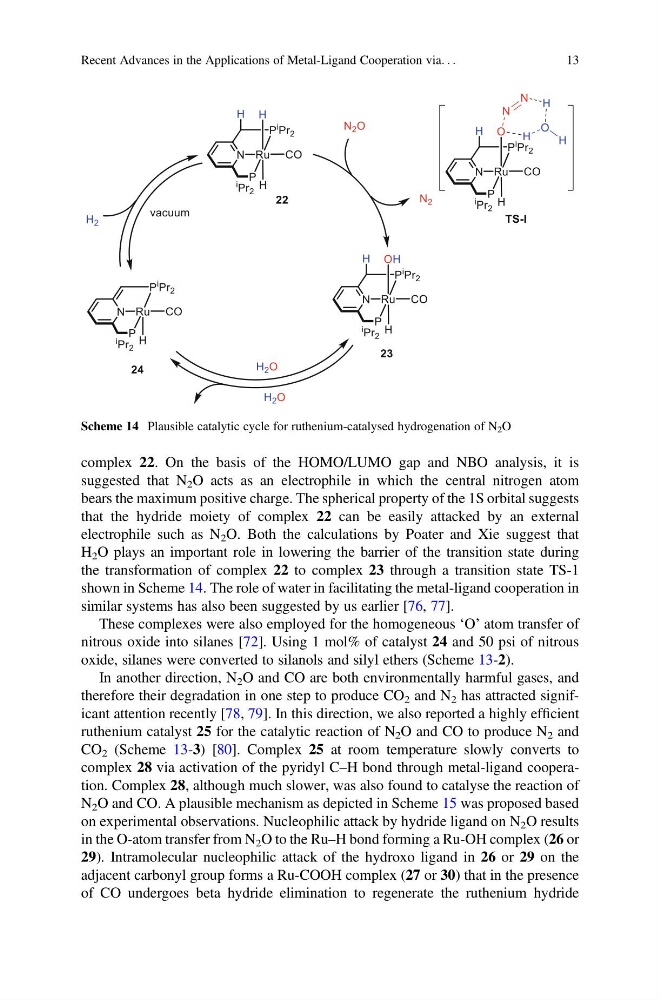
complex 22. On the basis of the HOMO/LUMO gap and NBO analysis, it is
suggested that N 2 O acts as an electrophile in which the central nitrogen atom
bears the maximum positive charge. The spherical property of the 1S orbital suggests
that the hydride moiety of complex 22 can be easily attacked by an external
electrophile such as N 2 O. Both the calculations by Poater and Xie suggest that
H 2 O plays an important role in lowering the barrier of the transition state during
the transformation of complex 22 to complex 23 through a transition state TS-1
shown in Scheme 14. The role of water in facilitating the metal-ligand cooperation in
similar systems has also been suggested by us earlier [76, 77].
These complexes were also employed for the homogeneous ‘O’ atom transfer of
nitrous oxide into silanes [72]. Using 1 mol% of catalyst 24 and 50 psi of nitrous
oxide, silanes were converted to silanols and silyl ethers (Scheme 13-2).
In another direction, N 2 O and CO are both environmentally harmful gases, and
therefore their degradation in one step to produce CO 2 and N 2 has attracted significant attention recently [78, 79]. In this direction, we also reported a highly efficient
ruthenium catalyst 25 for the catalytic reaction of N 2 O and CO to produce N 2 and
CO 2 (Scheme 13-3) [80]. Complex 25 at room temperature slowly converts to
complex 28 via activation of the pyridyl C–H bond through metal-ligand cooperation. Complex 28, although much slower, was also found to catalyse the reaction of
N 2 O and CO. A plausible mechanism as depicted in Scheme 15 was proposed based
on experimental observations. Nucleophilic attack by hydride ligand on N 2 O results
in the O-atom transfer from N 2 O to the Ru–H bond forming a Ru-OH complex (26 or
29). Intramolecular nucleophilic attack of the hydroxo ligand in 26 or 29 on the
adjacent carbonyl group forms a Ru-COOH complex (27 or 30) that in the presence
of CO undergoes beta hydride elimination to regenerate the ruthenium hydride
Scheme 14 Plausible catalytic cycle for ruthenium-catalysed hydrogenation of N 2 O
Recent Advances in the Applications of Metal-Ligand Cooperation via. . .
13
suggested that N 2 O acts as an electrophile in which the central nitrogen atom
bears the maximum positive charge. The spherical property of the 1S orbital suggests
that the hydride moiety of complex 22 can be easily attacked by an external
electrophile such as N 2 O. Both the calculations by Poater and Xie suggest that
H 2 O plays an important role in lowering the barrier of the transition state during
the transformation of complex 22 to complex 23 through a transition state TS-1
shown in Scheme 14. The role of water in facilitating the metal-ligand cooperation in
similar systems has also been suggested by us earlier [76, 77].
These complexes were also employed for the homogeneous ‘O’ atom transfer of
nitrous oxide into silanes [72]. Using 1 mol% of catalyst 24 and 50 psi of nitrous
oxide, silanes were converted to silanols and silyl ethers (Scheme 13-2).
In another direction, N 2 O and CO are both environmentally harmful gases, and
therefore their degradation in one step to produce CO 2 and N 2 has attracted significant attention recently [78, 79]. In this direction, we also reported a highly efficient
ruthenium catalyst 25 for the catalytic reaction of N 2 O and CO to produce N 2 and
CO 2 (Scheme 13-3) [80]. Complex 25 at room temperature slowly converts to
complex 28 via activation of the pyridyl C–H bond through metal-ligand cooperation. Complex 28, although much slower, was also found to catalyse the reaction of
N 2 O and CO. A plausible mechanism as depicted in Scheme 15 was proposed based
on experimental observations. Nucleophilic attack by hydride ligand on N 2 O results
in the O-atom transfer from N 2 O to the Ru–H bond forming a Ru-OH complex (26 or
29). Intramolecular nucleophilic attack of the hydroxo ligand in 26 or 29 on the
adjacent carbonyl group forms a Ru-COOH complex (27 or 30) that in the presence
of CO undergoes beta hydride elimination to regenerate the ruthenium hydride
Scheme 14 Plausible catalytic cycle for ruthenium-catalysed hydrogenation of N 2 O
Recent Advances in the Applications of Metal-Ligand Cooperation via. . .
13