

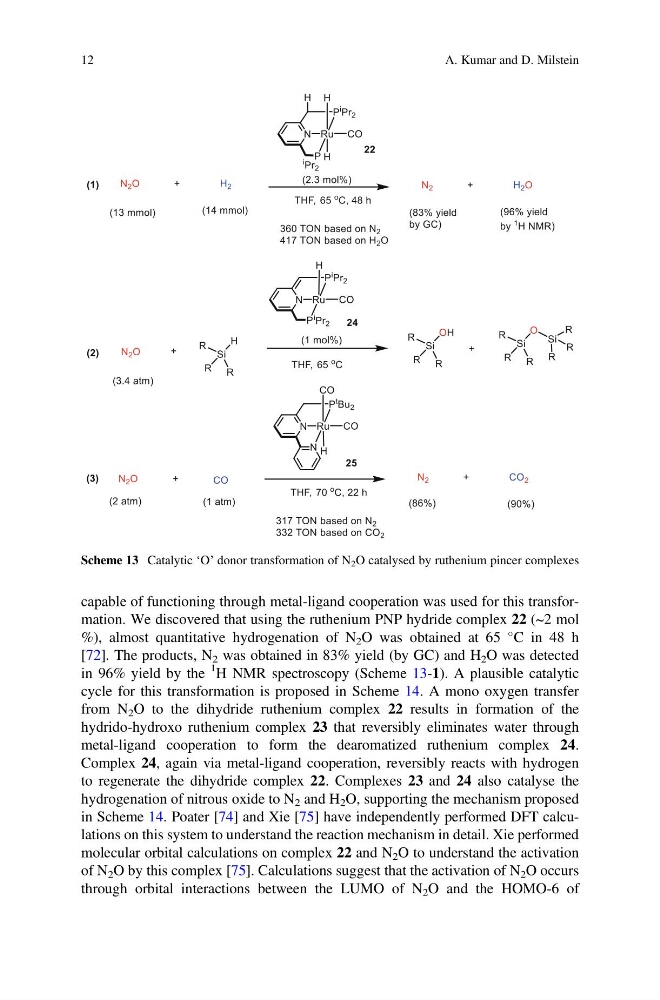
capable of functioning through metal-ligand cooperation was used for this transformation. We discovered that using the ruthenium PNP hydride complex 22 (~2 mol
%), almost quantitative hydrogenation of N 2 O was obtained at 65
C in 48 h
[72]. The products, N 2 was obtained in 83% yield (by GC) and H 2 O was detected
in 96% yield by the
1 H NMR spectroscopy (Scheme 13-1). A plausible catalytic
cycle for this transformation is proposed in Scheme 14. A mono oxygen transfer
from N 2 O to the dihydride ruthenium complex 22 results in formation of the
hydrido-hydroxo ruthenium complex 23 that reversibly eliminates water through
metal-ligand cooperation to form the dearomatized ruthenium complex 24.
Complex 24, again via metal-ligand cooperation, reversibly reacts with hydrogen
to regenerate the dihydride complex 22. Complexes 23 and 24 also catalyse the
hydrogenation of nitrous oxide to N 2 and H 2 O, supporting the mechanism proposed
in Scheme 14. Poater [74] and Xie [75] have independently performed DFT calculations on this system to understand the reaction mechanism in detail. Xie performed
molecular orbital calculations on complex 22 and N 2 O to understand the activation
of N 2 O by this complex [75]. Calculations suggest that the activation of N 2 O occurs
through orbital interactions between the LUMO of N 2 O and the HOMO-6 of
Scheme 13 Catalytic ‘O’ donor transformation of N 2 O catalysed by ruthenium pincer complexes
12
A. Kumar and D. Milstein
%), almost quantitative hydrogenation of N 2 O was obtained at 65
C in 48 h
[72]. The products, N 2 was obtained in 83% yield (by GC) and H 2 O was detected
in 96% yield by the
1 H NMR spectroscopy (Scheme 13-1). A plausible catalytic
cycle for this transformation is proposed in Scheme 14. A mono oxygen transfer
from N 2 O to the dihydride ruthenium complex 22 results in formation of the
hydrido-hydroxo ruthenium complex 23 that reversibly eliminates water through
metal-ligand cooperation to form the dearomatized ruthenium complex 24.
Complex 24, again via metal-ligand cooperation, reversibly reacts with hydrogen
to regenerate the dihydride complex 22. Complexes 23 and 24 also catalyse the
hydrogenation of nitrous oxide to N 2 and H 2 O, supporting the mechanism proposed
in Scheme 14. Poater [74] and Xie [75] have independently performed DFT calculations on this system to understand the reaction mechanism in detail. Xie performed
molecular orbital calculations on complex 22 and N 2 O to understand the activation
of N 2 O by this complex [75]. Calculations suggest that the activation of N 2 O occurs
through orbital interactions between the LUMO of N 2 O and the HOMO-6 of
Scheme 13 Catalytic ‘O’ donor transformation of N 2 O catalysed by ruthenium pincer complexes
12
A. Kumar and D. Milstein