

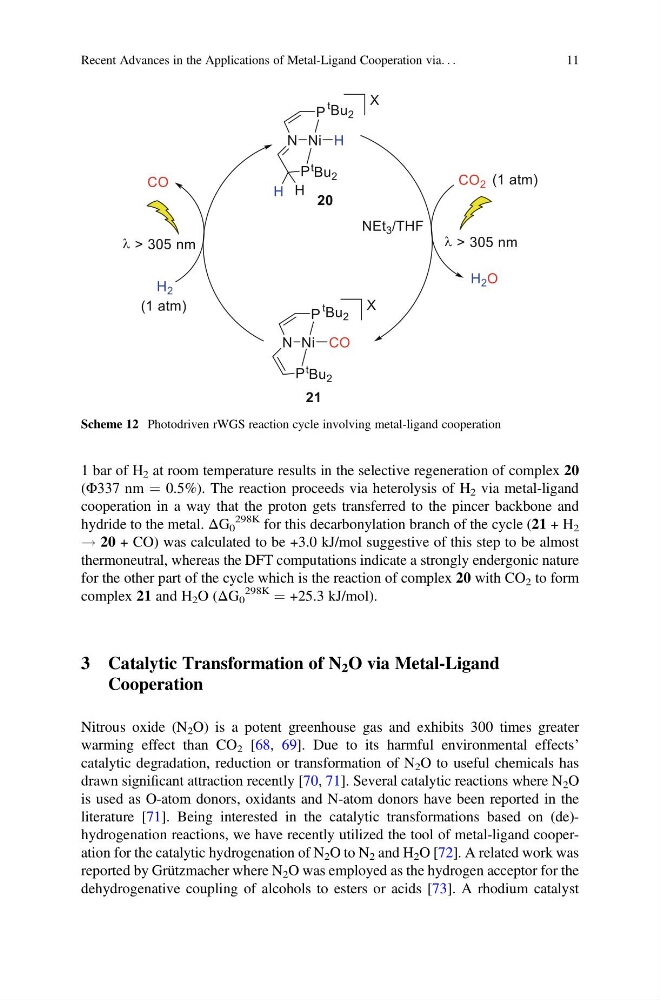
1 bar of H 2 at room temperature results in the selective regeneration of complex 20
(Φ337 nm ¼ 0.5%). The reaction proceeds via heterolysis of H 2 via metal-ligand
cooperation in a way that the proton gets transferred to the pincer backbone and
hydride to the metal. ΔG 0
298K for this decarbonylation branch of the cycle (21 + H 2
! 20 + CO) was calculated to be +3.0 kJ/mol suggestive of this step to be almost
thermoneutral, whereas the DFT computations indicate a strongly endergonic nature
for the other part of the cycle which is the reaction of complex 20 with CO 2 to form
complex 21 and H 2 O (ΔG 0
298K
¼ +25.3 kJ/mol).
3 Catalytic Transformation of N 2 O via Metal-Ligand
Cooperation
Nitrous oxide (N 2 O) is a potent greenhouse gas and exhibits 300 times greater
warming effect than CO 2 [68, 69]. Due to its harmful environmental effects’
catalytic degradation, reduction or transformation of N 2 O to useful chemicals has
drawn significant attraction recently [70, 71]. Several catalytic reactions where N 2 O
is used as O-atom donors, oxidants and N-atom donors have been reported in the
literature [71]. Being interested in the catalytic transformations based on (de)hydrogenation reactions, we have recently utilized the tool of metal-ligand cooperation for the catalytic hydrogenation of N 2 O to N 2 and H 2 O [72]. A related work was
reported by Grützmacher where N 2 O was employed as the hydrogen acceptor for the
dehydrogenative coupling of alcohols to esters or acids [73]. A rhodium catalyst
Scheme 12 Photodriven rWGS reaction cycle involving metal-ligand cooperation
Recent Advances in the Applications of Metal-Ligand Cooperation via. . .
11
(Φ337 nm ¼ 0.5%). The reaction proceeds via heterolysis of H 2 via metal-ligand
cooperation in a way that the proton gets transferred to the pincer backbone and
hydride to the metal. ΔG 0
298K for this decarbonylation branch of the cycle (21 + H 2
! 20 + CO) was calculated to be +3.0 kJ/mol suggestive of this step to be almost
thermoneutral, whereas the DFT computations indicate a strongly endergonic nature
for the other part of the cycle which is the reaction of complex 20 with CO 2 to form
complex 21 and H 2 O (ΔG 0
298K
¼ +25.3 kJ/mol).
3 Catalytic Transformation of N 2 O via Metal-Ligand
Cooperation
Nitrous oxide (N 2 O) is a potent greenhouse gas and exhibits 300 times greater
warming effect than CO 2 [68, 69]. Due to its harmful environmental effects’
catalytic degradation, reduction or transformation of N 2 O to useful chemicals has
drawn significant attraction recently [70, 71]. Several catalytic reactions where N 2 O
is used as O-atom donors, oxidants and N-atom donors have been reported in the
literature [71]. Being interested in the catalytic transformations based on (de)hydrogenation reactions, we have recently utilized the tool of metal-ligand cooperation for the catalytic hydrogenation of N 2 O to N 2 and H 2 O [72]. A related work was
reported by Grützmacher where N 2 O was employed as the hydrogen acceptor for the
dehydrogenative coupling of alcohols to esters or acids [73]. A rhodium catalyst
Scheme 12 Photodriven rWGS reaction cycle involving metal-ligand cooperation
Recent Advances in the Applications of Metal-Ligand Cooperation via. . .
11