

cooperation. Unexpectedly, heating complex 17b at 80
C under 5 bar of CO 2
resulted in the formation of a mixture of complexes 18 and 19. The overall process
involves two molecules of CO 2 – the first molecule of CO 2 facilitates the C–P
cleavage and formation of a new C–C bond that results in the formation of a
carboxylate ligand. The second molecule of CO 2 apparently gets reductively split
to CO and O where the oxygen atom is being trapped by the phosphine ligand
to form
i Pr 2 P¼O ligand resulting in the formation of complex 18 and CO gets
trapped by another nickel fragment of the starting complex to form complex 19.
Similar reactivity of CO 2 has been reported recently by Langer and Pápai for the Ir
(I) complex [Ir(depe)(dbuP)] (depe: 1,2-bis(diethylphosphino)ethane; dbuP –
1,8-diazabicyclo[5.4.0]undec-7-ene) [64] as well as by Müller and Wolf for a
phosphine Iron(0) complex [65].
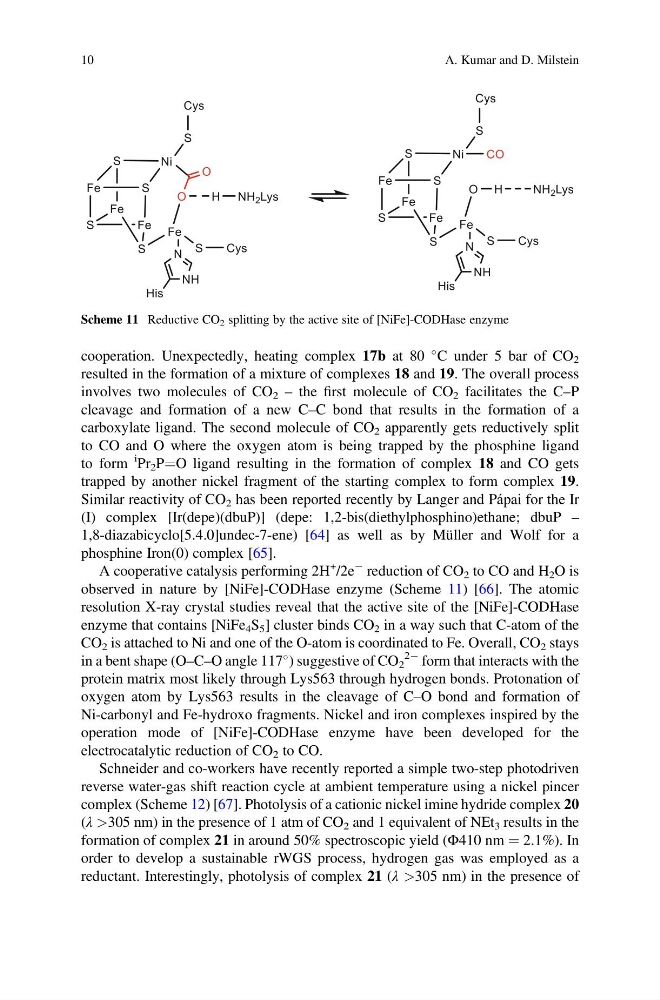
A cooperative catalysis performing 2H
+
/2e
À reduction of CO 2 to CO and H 2 O is
observed in nature by [NiFe]-CODHase enzyme (Scheme 11) [66]. The atomic
resolution X-ray crystal studies reveal that the active site of the [NiFe]-CODHase
enzyme that contains [NiFe 4 S 5 ] cluster binds CO 2 in a way such that C-atom of the
CO 2 is attached to Ni and one of the O-atom is coordinated to Fe. Overall, CO 2 stays
in a bent shape (O–C–O angle 117
) suggestive of CO 2
2À form that interacts with the
protein matrix most likely through Lys563 through hydrogen bonds. Protonation of
oxygen atom by Lys563 results in the cleavage of C–O bond and formation of
Ni-carbonyl and Fe-hydroxo fragments. Nickel and iron complexes inspired by the
operation mode of [NiFe]-CODHase enzyme have been developed for the
electrocatalytic reduction of CO 2 to CO.
Schneider and co-workers have recently reported a simple two-step photodriven
reverse water-gas shift reaction cycle at ambient temperature using a nickel pincer
complex (Scheme 12) [67]. Photolysis of a cationic nickel imine hydride complex 20
(λ >305 nm) in the presence of 1 atm of CO 2 and 1 equivalent of NEt 3 results in the
formation of complex 21 in around 50% spectroscopic yield (Φ410 nm ¼ 2.1%). In
order to develop a sustainable rWGS process, hydrogen gas was employed as a
reductant. Interestingly, photolysis of complex 21 (λ >305 nm) in the presence of
Scheme 11 Reductive CO 2 splitting by the active site of [NiFe]-CODHase enzyme
10
A. Kumar and D. Milstein
C under 5 bar of CO 2
resulted in the formation of a mixture of complexes 18 and 19. The overall process
involves two molecules of CO 2 – the first molecule of CO 2 facilitates the C–P
cleavage and formation of a new C–C bond that results in the formation of a
carboxylate ligand. The second molecule of CO 2 apparently gets reductively split
to CO and O where the oxygen atom is being trapped by the phosphine ligand
to form
i Pr 2 P¼O ligand resulting in the formation of complex 18 and CO gets
trapped by another nickel fragment of the starting complex to form complex 19.
Similar reactivity of CO 2 has been reported recently by Langer and Pápai for the Ir
(I) complex [Ir(depe)(dbuP)] (depe: 1,2-bis(diethylphosphino)ethane; dbuP –
1,8-diazabicyclo[5.4.0]undec-7-ene) [64] as well as by Müller and Wolf for a
phosphine Iron(0) complex [65].
A cooperative catalysis performing 2H
+
/2e
À reduction of CO 2 to CO and H 2 O is
observed in nature by [NiFe]-CODHase enzyme (Scheme 11) [66]. The atomic
resolution X-ray crystal studies reveal that the active site of the [NiFe]-CODHase
enzyme that contains [NiFe 4 S 5 ] cluster binds CO 2 in a way such that C-atom of the
CO 2 is attached to Ni and one of the O-atom is coordinated to Fe. Overall, CO 2 stays
in a bent shape (O–C–O angle 117
) suggestive of CO 2
2À form that interacts with the
protein matrix most likely through Lys563 through hydrogen bonds. Protonation of
oxygen atom by Lys563 results in the cleavage of C–O bond and formation of
Ni-carbonyl and Fe-hydroxo fragments. Nickel and iron complexes inspired by the
operation mode of [NiFe]-CODHase enzyme have been developed for the
electrocatalytic reduction of CO 2 to CO.
Schneider and co-workers have recently reported a simple two-step photodriven
reverse water-gas shift reaction cycle at ambient temperature using a nickel pincer
complex (Scheme 12) [67]. Photolysis of a cationic nickel imine hydride complex 20
(λ >305 nm) in the presence of 1 atm of CO 2 and 1 equivalent of NEt 3 results in the
formation of complex 21 in around 50% spectroscopic yield (Φ410 nm ¼ 2.1%). In
order to develop a sustainable rWGS process, hydrogen gas was employed as a
reductant. Interestingly, photolysis of complex 21 (λ >305 nm) in the presence of
Scheme 11 Reductive CO 2 splitting by the active site of [NiFe]-CODHase enzyme
10
A. Kumar and D. Milstein