

aldehydes were reduced under comparatively mild conditions and short reaction
times with a catalyst loading of merely 0.1 mol% Mn2 for most substrates [15].
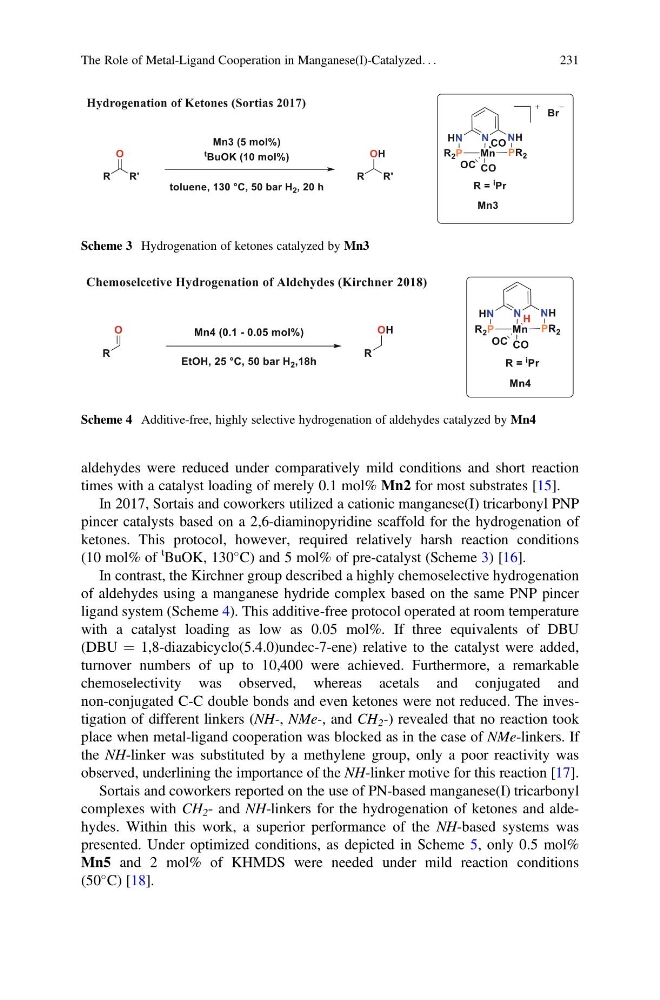
In 2017, Sortais and coworkers utilized a cationic manganese(I) tricarbonyl PNP
pincer catalysts based on a 2,6-diaminopyridine scaffold for the hydrogenation of
ketones. This protocol, however, required relatively harsh reaction conditions
(10 mol% of
t
BuOK, 130
C) and 5 mol% of pre-catalyst (Scheme 3) [16].
In contrast, the Kirchner group described a highly chemoselective hydrogenation
of aldehydes using a manganese hydride complex based on the same PNP pincer
ligand system (Scheme 4). This additive-free protocol operated at room temperature
with a catalyst loading as low as 0.05 mol%. If three equivalents of DBU
(DBU ¼ 1,8-diazabicyclo(5.4.0)undec-7-ene) relative to the catalyst were added,
turnover numbers of up to 10,400 were achieved. Furthermore, a remarkable
chemoselectivity was observed, whereas acetals and conjugated and
non-conjugated C-C double bonds and even ketones were not reduced. The investigation of different linkers (NH-, NMe-, and CH 2 -) revealed that no reaction took
place when metal-ligand cooperation was blocked as in the case of NMe-linkers. If
the NH-linker was substituted by a methylene group, only a poor reactivity was
observed, underlining the importance of the NH-linker motive for this reaction [17].
Sortais and coworkers reported on the use of PN-based manganese(I) tricarbonyl
complexes with CH 2 - and NH-linkers for the hydrogenation of ketones and aldehydes. Within this work, a superior performance of the NH-based systems was
presented. Under optimized conditions, as depicted in Scheme 5, only 0.5 mol%
Mn5 and 2 mol% of KHMDS were needed under mild reaction conditions
(50
C) [18].
Scheme 3 Hydrogenation of ketones catalyzed by Mn3
Scheme 4 Additive-free, highly selective hydrogenation of aldehydes catalyzed by Mn4
The Role of Metal-Ligand Cooperation in Manganese(I)-Catalyzed. . .
231
times with a catalyst loading of merely 0.1 mol% Mn2 for most substrates [15].
In 2017, Sortais and coworkers utilized a cationic manganese(I) tricarbonyl PNP
pincer catalysts based on a 2,6-diaminopyridine scaffold for the hydrogenation of
ketones. This protocol, however, required relatively harsh reaction conditions
(10 mol% of
t
BuOK, 130
C) and 5 mol% of pre-catalyst (Scheme 3) [16].
In contrast, the Kirchner group described a highly chemoselective hydrogenation
of aldehydes using a manganese hydride complex based on the same PNP pincer
ligand system (Scheme 4). This additive-free protocol operated at room temperature
with a catalyst loading as low as 0.05 mol%. If three equivalents of DBU
(DBU ¼ 1,8-diazabicyclo(5.4.0)undec-7-ene) relative to the catalyst were added,
turnover numbers of up to 10,400 were achieved. Furthermore, a remarkable
chemoselectivity was observed, whereas acetals and conjugated and
non-conjugated C-C double bonds and even ketones were not reduced. The investigation of different linkers (NH-, NMe-, and CH 2 -) revealed that no reaction took
place when metal-ligand cooperation was blocked as in the case of NMe-linkers. If
the NH-linker was substituted by a methylene group, only a poor reactivity was
observed, underlining the importance of the NH-linker motive for this reaction [17].
Sortais and coworkers reported on the use of PN-based manganese(I) tricarbonyl
complexes with CH 2 - and NH-linkers for the hydrogenation of ketones and aldehydes. Within this work, a superior performance of the NH-based systems was
presented. Under optimized conditions, as depicted in Scheme 5, only 0.5 mol%
Mn5 and 2 mol% of KHMDS were needed under mild reaction conditions
(50
C) [18].
Scheme 3 Hydrogenation of ketones catalyzed by Mn3
Scheme 4 Additive-free, highly selective hydrogenation of aldehydes catalyzed by Mn4
The Role of Metal-Ligand Cooperation in Manganese(I)-Catalyzed. . .
231