

2.1 Hydrogenation of Aldehydes and Ketones
Beller and coworkers were the first ones to report the hydrogenation of ketones and
aldehyde using a well-defined manganese(I) catalyst in 2016. Within this context, a
series of manganese(I) dicarbonyl as well as manganese(II) complexes, containing
aliphatic PNP pincer ligands, were synthesized and characterized.
Notably, only manganese(I) complexes were active for the hydrogenation of
carbonyl compounds, whereas the related manganese(II) complex did not show
any reactivity for this transformation. Upon addition of
t
BuONa as base, a broad
variety of aldehydes and ketones could be reduced to the corresponding alcohols
employing catalyst Mn1. This procedure displayed high chemoselectivity, whereas
esters, amides, and non-conjugated and conjugated C-C double and triple bonds
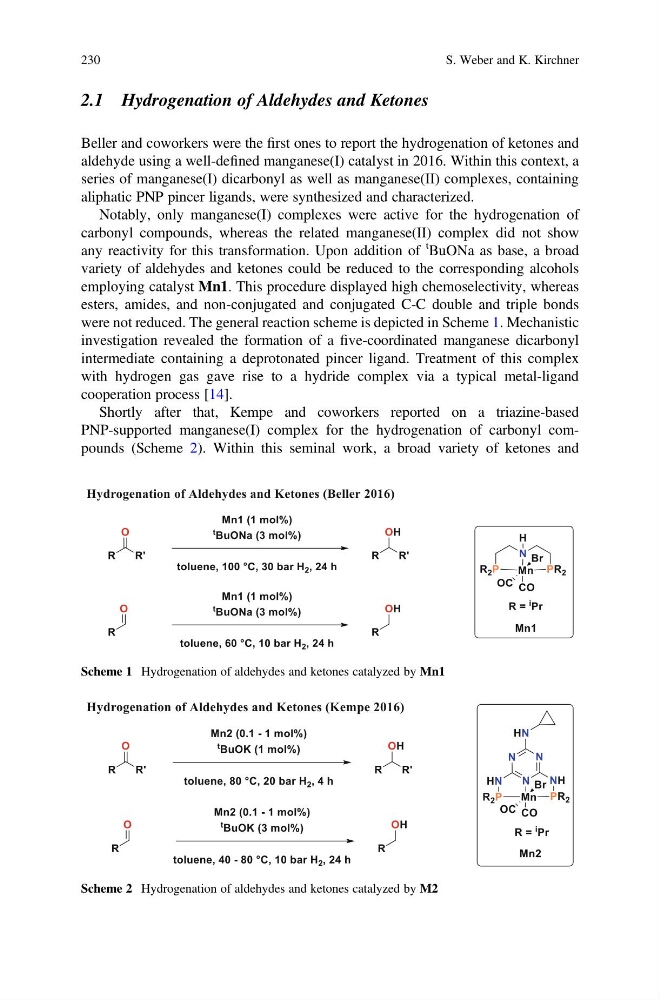
were not reduced. The general reaction scheme is depicted in Scheme 1. Mechanistic
investigation revealed the formation of a five-coordinated manganese dicarbonyl
intermediate containing a deprotonated pincer ligand. Treatment of this complex
with hydrogen gas gave rise to a hydride complex via a typical metal-ligand
cooperation process [14].
Shortly after that, Kempe and coworkers reported on a triazine-based
PNP-supported manganese(I) complex for the hydrogenation of carbonyl compounds (Scheme 2). Within this seminal work, a broad variety of ketones and
Scheme 1 Hydrogenation of aldehydes and ketones catalyzed by Mn1
Scheme 2 Hydrogenation of aldehydes and ketones catalyzed by M2
230
S. Weber and K. Kirchner
Beller and coworkers were the first ones to report the hydrogenation of ketones and
aldehyde using a well-defined manganese(I) catalyst in 2016. Within this context, a
series of manganese(I) dicarbonyl as well as manganese(II) complexes, containing
aliphatic PNP pincer ligands, were synthesized and characterized.
Notably, only manganese(I) complexes were active for the hydrogenation of
carbonyl compounds, whereas the related manganese(II) complex did not show
any reactivity for this transformation. Upon addition of
t
BuONa as base, a broad
variety of aldehydes and ketones could be reduced to the corresponding alcohols
employing catalyst Mn1. This procedure displayed high chemoselectivity, whereas
esters, amides, and non-conjugated and conjugated C-C double and triple bonds
were not reduced. The general reaction scheme is depicted in Scheme 1. Mechanistic
investigation revealed the formation of a five-coordinated manganese dicarbonyl
intermediate containing a deprotonated pincer ligand. Treatment of this complex
with hydrogen gas gave rise to a hydride complex via a typical metal-ligand
cooperation process [14].
Shortly after that, Kempe and coworkers reported on a triazine-based
PNP-supported manganese(I) complex for the hydrogenation of carbonyl compounds (Scheme 2). Within this seminal work, a broad variety of ketones and
Scheme 1 Hydrogenation of aldehydes and ketones catalyzed by Mn1
Scheme 2 Hydrogenation of aldehydes and ketones catalyzed by M2
230
S. Weber and K. Kirchner