

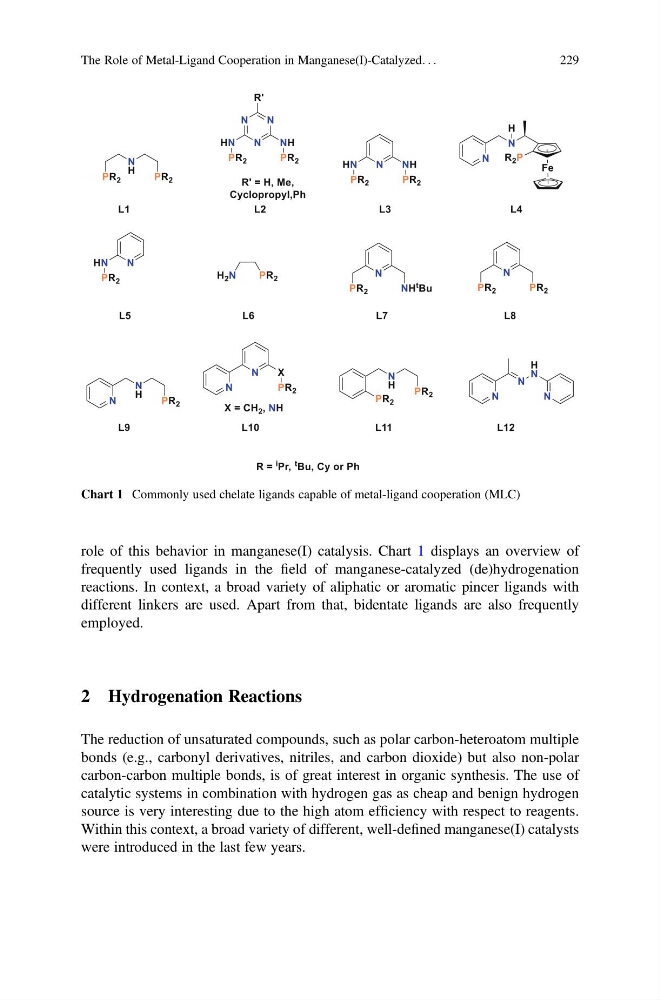
role of this behavior in manganese(I) catalysis. Chart 1 displays an overview of
frequently used ligands in the field of manganese-catalyzed (de)hydrogenation
reactions. In context, a broad variety of aliphatic or aromatic pincer ligands with
different linkers are used. Apart from that, bidentate ligands are also frequently
employed.
2 Hydrogenation Reactions
The reduction of unsaturated compounds, such as polar carbon-heteroatom multiple
bonds (e.g., carbonyl derivatives, nitriles, and carbon dioxide) but also non-polar
carbon-carbon multiple bonds, is of great interest in organic synthesis. The use of
catalytic systems in combination with hydrogen gas as cheap and benign hydrogen
source is very interesting due to the high atom efficiency with respect to reagents.
Within this context, a broad variety of different, well-defined manganese(I) catalysts
were introduced in the last few years.
Chart 1 Commonly used chelate ligands capable of metal-ligand cooperation (MLC)
The Role of Metal-Ligand Cooperation in Manganese(I)-Catalyzed. . .
229
frequently used ligands in the field of manganese-catalyzed (de)hydrogenation
reactions. In context, a broad variety of aliphatic or aromatic pincer ligands with
different linkers are used. Apart from that, bidentate ligands are also frequently
employed.
2 Hydrogenation Reactions
The reduction of unsaturated compounds, such as polar carbon-heteroatom multiple
bonds (e.g., carbonyl derivatives, nitriles, and carbon dioxide) but also non-polar
carbon-carbon multiple bonds, is of great interest in organic synthesis. The use of
catalytic systems in combination with hydrogen gas as cheap and benign hydrogen
source is very interesting due to the high atom efficiency with respect to reagents.
Within this context, a broad variety of different, well-defined manganese(I) catalysts
were introduced in the last few years.
Chart 1 Commonly used chelate ligands capable of metal-ligand cooperation (MLC)
The Role of Metal-Ligand Cooperation in Manganese(I)-Catalyzed. . .
229