

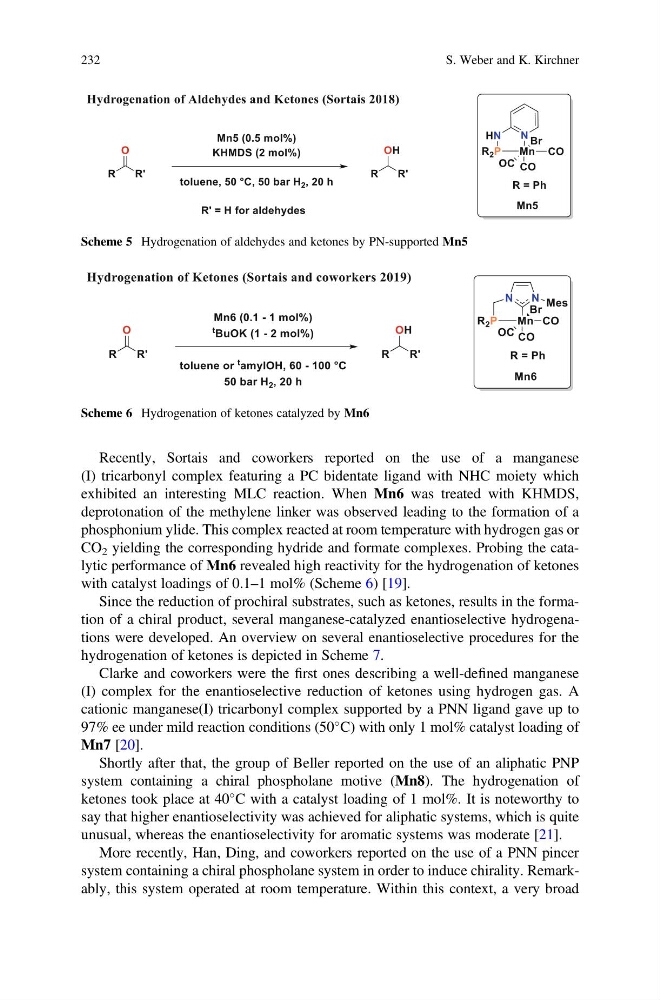
Recently, Sortais and coworkers reported on the use of a manganese
(I) tricarbonyl complex featuring a PC bidentate ligand with NHC moiety which
exhibited an interesting MLC reaction. When Mn6 was treated with KHMDS,
deprotonation of the methylene linker was observed leading to the formation of a
phosphonium ylide. This complex reacted at room temperature with hydrogen gas or
CO 2 yielding the corresponding hydride and formate complexes. Probing the catalytic performance of Mn6 revealed high reactivity for the hydrogenation of ketones
with catalyst loadings of 0.1–1 mol% (Scheme 6) [19].
Since the reduction of prochiral substrates, such as ketones, results in the formation of a chiral product, several manganese-catalyzed enantioselective hydrogenations were developed. An overview on several enantioselective procedures for the
hydrogenation of ketones is depicted in Scheme 7.
Clarke and coworkers were the first ones describing a well-defined manganese
(I) complex for the enantioselective reduction of ketones using hydrogen gas. A
cationic manganese(I) tricarbonyl complex supported by a PNN ligand gave up to
97% ee under mild reaction conditions (50
C) with only 1 mol% catalyst loading of
Mn7 [20].
Shortly after that, the group of Beller reported on the use of an aliphatic PNP
system containing a chiral phospholane motive (Mn8). The hydrogenation of
ketones took place at 40
C with a catalyst loading of 1 mol%. It is noteworthy to
say that higher enantioselectivity was achieved for aliphatic systems, which is quite
unusual, whereas the enantioselectivity for aromatic systems was moderate [21].
More recently, Han, Ding, and coworkers reported on the use of a PNN pincer
system containing a chiral phospholane system in order to induce chirality. Remarkably, this system operated at room temperature. Within this context, a very broad
Scheme 5 Hydrogenation of aldehydes and ketones by PN-supported Mn5
Scheme 6 Hydrogenation of ketones catalyzed by Mn6
232
S. Weber and K. Kirchner
(I) tricarbonyl complex featuring a PC bidentate ligand with NHC moiety which
exhibited an interesting MLC reaction. When Mn6 was treated with KHMDS,
deprotonation of the methylene linker was observed leading to the formation of a
phosphonium ylide. This complex reacted at room temperature with hydrogen gas or
CO 2 yielding the corresponding hydride and formate complexes. Probing the catalytic performance of Mn6 revealed high reactivity for the hydrogenation of ketones
with catalyst loadings of 0.1–1 mol% (Scheme 6) [19].
Since the reduction of prochiral substrates, such as ketones, results in the formation of a chiral product, several manganese-catalyzed enantioselective hydrogenations were developed. An overview on several enantioselective procedures for the
hydrogenation of ketones is depicted in Scheme 7.
Clarke and coworkers were the first ones describing a well-defined manganese
(I) complex for the enantioselective reduction of ketones using hydrogen gas. A
cationic manganese(I) tricarbonyl complex supported by a PNN ligand gave up to
97% ee under mild reaction conditions (50
C) with only 1 mol% catalyst loading of
Mn7 [20].
Shortly after that, the group of Beller reported on the use of an aliphatic PNP
system containing a chiral phospholane motive (Mn8). The hydrogenation of
ketones took place at 40
C with a catalyst loading of 1 mol%. It is noteworthy to
say that higher enantioselectivity was achieved for aliphatic systems, which is quite
unusual, whereas the enantioselectivity for aromatic systems was moderate [21].
More recently, Han, Ding, and coworkers reported on the use of a PNN pincer
system containing a chiral phospholane system in order to induce chirality. Remarkably, this system operated at room temperature. Within this context, a very broad
Scheme 5 Hydrogenation of aldehydes and ketones by PN-supported Mn5
Scheme 6 Hydrogenation of ketones catalyzed by Mn6
232
S. Weber and K. Kirchner