

Various Substitutions: Alkylation
Oxygenation
4.3 C–H Bond Activation
The formation of a μ-acetaldehyde bridge in the rhodium(III) m-benziporphyrin can
be considered an enlightening example of C–H bond activation in a
carbaporphyrinoid surrounding (Scheme 41) [23].
The nature of this transformation and, above all, the source of the
μ-acetaldehyde bridge in 75-Rh remained quite a puzzle for the chemistry confined
m-benziporphyrin cavity [23]. In fact, such a transformation did not have any
precedent in the chemistry of metallocarbaporphyrinoids [72]. Two hypotheses
were initially outlined involving (a) a carbonyl ligand and/or (b) solvent participations. The first one examined a feasible transformation of the axial carbonyl
ligand. In particular, the reductive coupling of two 5-Rh(CO) molecules was
considered. The process could resemble the one-electron activation of CO by a
N
N
N
Pd
O
R
61-Pd
(61-R)-Pd
N
N
N
Pd
O
RI
61-Pd
(61-R)-Pd
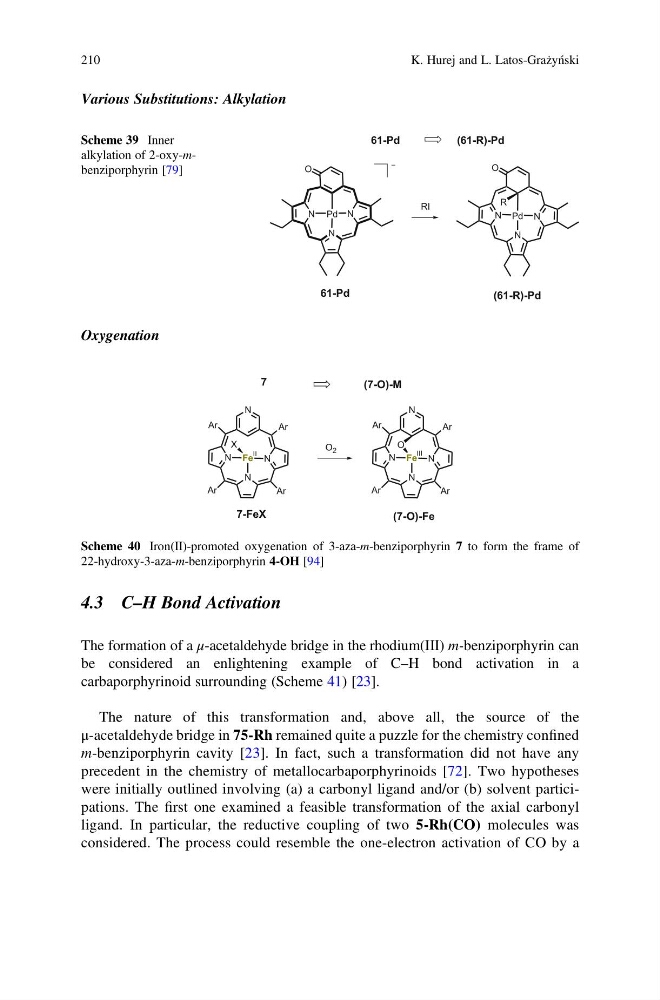
Scheme 39 Inner
alkylation of 2-oxy-mbenziporphyrin [79]
N
N
N
N
Ar
Ar
Ar
Ar
Fe
O
N
N
N
N
Ar
Ar
Ar
Ar
Fe
X
II
III
7-FeX
(7-O)-Fe
O 2
7
(7-O)-M
Scheme 40 Iron(II)-promoted oxygenation of 3-aza-m-benziporphyrin 7 to form the frame of
22-hydroxy-3-aza-m-benziporphyrin 4-OH [94]
210
K. Hurej and L. Latos-Grażyński
Oxygenation
4.3 C–H Bond Activation
The formation of a μ-acetaldehyde bridge in the rhodium(III) m-benziporphyrin can
be considered an enlightening example of C–H bond activation in a
carbaporphyrinoid surrounding (Scheme 41) [23].
The nature of this transformation and, above all, the source of the
μ-acetaldehyde bridge in 75-Rh remained quite a puzzle for the chemistry confined
m-benziporphyrin cavity [23]. In fact, such a transformation did not have any
precedent in the chemistry of metallocarbaporphyrinoids [72]. Two hypotheses
were initially outlined involving (a) a carbonyl ligand and/or (b) solvent participations. The first one examined a feasible transformation of the axial carbonyl
ligand. In particular, the reductive coupling of two 5-Rh(CO) molecules was
considered. The process could resemble the one-electron activation of CO by a
N
N
N
Pd
O
R
61-Pd
(61-R)-Pd
N
N
N
Pd
O
RI
61-Pd
(61-R)-Pd
Scheme 39 Inner
alkylation of 2-oxy-mbenziporphyrin [79]
N
N
N
N
Ar
Ar
Ar
Ar
Fe
O
N
N
N
N
Ar
Ar
Ar
Ar
Fe
X
II
III
7-FeX
(7-O)-Fe
O 2
7
(7-O)-M
Scheme 40 Iron(II)-promoted oxygenation of 3-aza-m-benziporphyrin 7 to form the frame of
22-hydroxy-3-aza-m-benziporphyrin 4-OH [94]
210
K. Hurej and L. Latos-Grażyński