

molecular structures, metallocarbaporphyrinoids provide the appropriate environment for intensive spectroscopic, synthetic, and structural exploration targeting
organometallic reactivity [9, 72]. In a more specified approach, m-benziporphyrins
and aza-m-benziporphyrins enable exploring some intriguing aspects of organometallic chemistry which engage the m-phenylene or aza-m-phenylene units. Accordingly, one can investigate C–H bond activation or C–M reactivity, identify novel
structural motifs, and – most importantly – gain some insight into rare examples of
benzene cleavage and contraction [95–103].
4.2.1 Overview
In the following section, the core reactivity of m-benziporphyrins and aza-mbenziporphyrins has been subjectively and arbitrarily divided into eight types distinguished by the principal type of transformation. Nonetheless, in several instances
the process reflects a complexity of two or more inseparable steps – then the
dominant one was applied as the criterion:
• Oxidative nucleophilic processes (Scheme 22) [2, 73]
• Macrocyclic fusion (Scheme 24) [73]
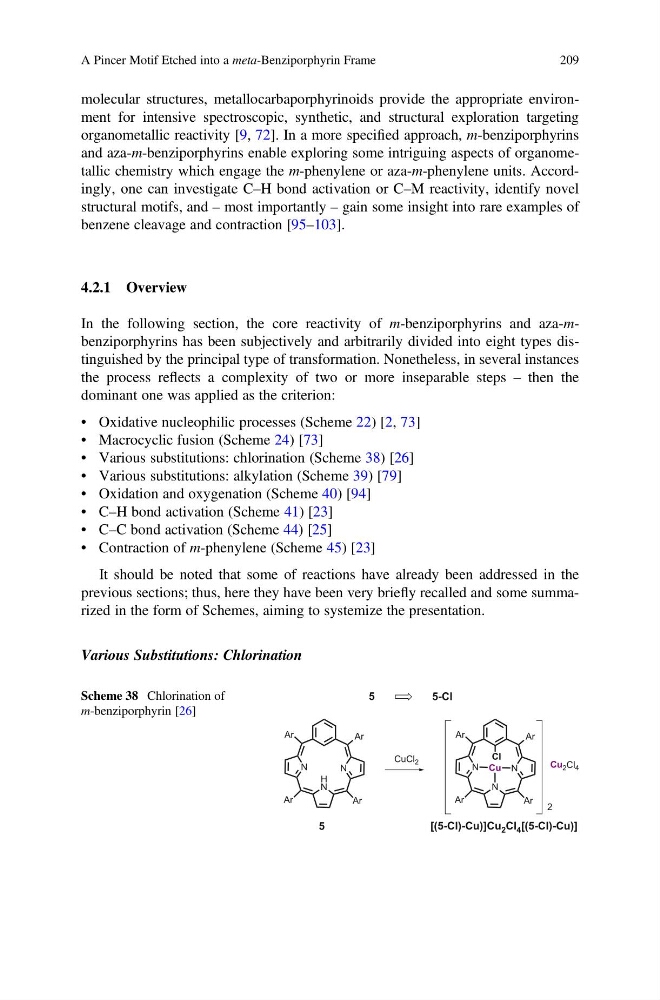
• Various substitutions: chlorination (Scheme 38) [26]
• Various substitutions: alkylation (Scheme 39) [79]
• Oxidation and oxygenation (Scheme 40) [94]
• C–H bond activation (Scheme 41) [23]
• C–C bond activation (Scheme 44) [25]
• Contraction of m-phenylene (Scheme 45) [23]
It should be noted that some of reactions have already been addressed in the
previous sections; thus, here they have been very briefly recalled and some summarized in the form of Schemes, aiming to systemize the presentation.
Various Substitutions: Chlorination
5
[(5-Cl)-Cu)]Cu 2 Cl 4 [(5-Cl)-Cu)]
H
N
N
N
Ar
Ar
Ar
Ar
N
N
N
Ar
Ar
Ar
Ar
Cu
Cl
2
Cu 2 Cl 4
CuCl 2
5
5-Cl
Scheme 38 Chlorination of
m-benziporphyrin [26]
A Pincer Motif Etched into a meta-Benziporphyrin Frame
209
organometallic reactivity [9, 72]. In a more specified approach, m-benziporphyrins
and aza-m-benziporphyrins enable exploring some intriguing aspects of organometallic chemistry which engage the m-phenylene or aza-m-phenylene units. Accordingly, one can investigate C–H bond activation or C–M reactivity, identify novel
structural motifs, and – most importantly – gain some insight into rare examples of
benzene cleavage and contraction [95–103].
4.2.1 Overview
In the following section, the core reactivity of m-benziporphyrins and aza-mbenziporphyrins has been subjectively and arbitrarily divided into eight types distinguished by the principal type of transformation. Nonetheless, in several instances
the process reflects a complexity of two or more inseparable steps – then the
dominant one was applied as the criterion:
• Oxidative nucleophilic processes (Scheme 22) [2, 73]
• Macrocyclic fusion (Scheme 24) [73]
• Various substitutions: chlorination (Scheme 38) [26]
• Various substitutions: alkylation (Scheme 39) [79]
• Oxidation and oxygenation (Scheme 40) [94]
• C–H bond activation (Scheme 41) [23]
• C–C bond activation (Scheme 44) [25]
• Contraction of m-phenylene (Scheme 45) [23]
It should be noted that some of reactions have already been addressed in the
previous sections; thus, here they have been very briefly recalled and some summarized in the form of Schemes, aiming to systemize the presentation.
Various Substitutions: Chlorination
5
[(5-Cl)-Cu)]Cu 2 Cl 4 [(5-Cl)-Cu)]
H
N
N
N
Ar
Ar
Ar
Ar
N
N
N
Ar
Ar
Ar
Ar
Cu
Cl
2
Cu 2 Cl 4
CuCl 2
5
5-Cl
Scheme 38 Chlorination of
m-benziporphyrin [26]
A Pincer Motif Etched into a meta-Benziporphyrin Frame
209