

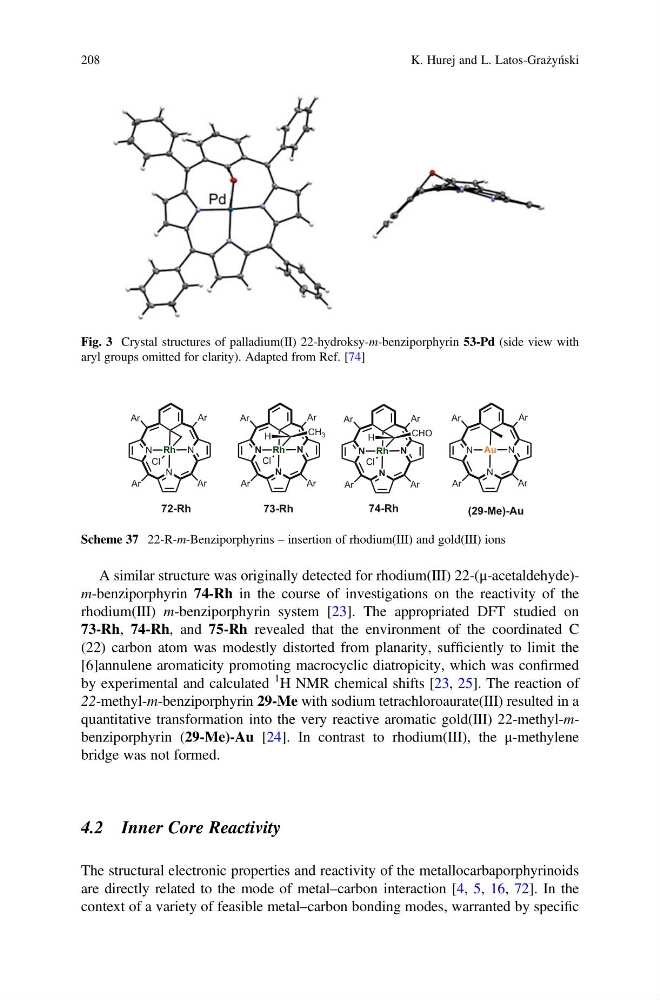
A similar structure was originally detected for rhodium(III) 22-(μ-acetaldehyde)m-benziporphyrin 74-Rh in the course of investigations on the reactivity of the
rhodium(III) m-benziporphyrin system [23]. The appropriated DFT studied on
73-Rh, 74-Rh, and 75-Rh revealed that the environment of the coordinated C
(22) carbon atom was modestly distorted from planarity, sufficiently to limit the
[6]annulene aromaticity promoting macrocyclic diatropicity, which was confirmed
by experimental and calculated
1 H NMR chemical shifts [23, 25]. The reaction of
22-methyl-m-benziporphyrin 29-Me with sodium tetrachloroaurate(III) resulted in a
quantitative transformation into the very reactive aromatic gold(III) 22-methyl-mbenziporphyrin (29-Me)-Au [24]. In contrast to rhodium(III), the μ-methylene
bridge was not formed.
4.2 Inner Core Reactivity
The structural electronic properties and reactivity of the metallocarbaporphyrinoids
are directly related to the mode of metal–carbon interaction [4, 5, 16, 72]. In the
context of a variety of feasible metal–carbon bonding modes, warranted by specific
N
N
N
Ar
Ar
Ar
Ar
Rh
Cl
N
N
N
Ar
Ar
Ar
Ar
Rh
CH 3
Cl
H
N
N
N
Ar
Ar
Ar
Ar
Au
72-Rh
73-Rh
74-Rh
(29-Me)-Au
N
N
N
Ar
Ar
Ar
Ar
Rh
CHO
Cl
H
Scheme 37 22-R-m-Benziporphyrins – insertion of rhodium(III) and gold(III) ions
Fig. 3 Crystal structures of palladium(II) 22-hydroksy-m-benziporphyrin 53-Pd (side view with
aryl groups omitted for clarity). Adapted from Ref. [74]
208
K. Hurej and L. Latos-Grażyński
rhodium(III) m-benziporphyrin system [23]. The appropriated DFT studied on
73-Rh, 74-Rh, and 75-Rh revealed that the environment of the coordinated C
(22) carbon atom was modestly distorted from planarity, sufficiently to limit the
[6]annulene aromaticity promoting macrocyclic diatropicity, which was confirmed
by experimental and calculated
1 H NMR chemical shifts [23, 25]. The reaction of
22-methyl-m-benziporphyrin 29-Me with sodium tetrachloroaurate(III) resulted in a
quantitative transformation into the very reactive aromatic gold(III) 22-methyl-mbenziporphyrin (29-Me)-Au [24]. In contrast to rhodium(III), the μ-methylene
bridge was not formed.
4.2 Inner Core Reactivity
The structural electronic properties and reactivity of the metallocarbaporphyrinoids
are directly related to the mode of metal–carbon interaction [4, 5, 16, 72]. In the
context of a variety of feasible metal–carbon bonding modes, warranted by specific
N
N
N
Ar
Ar
Ar
Ar
Rh
Cl
N
N
N
Ar
Ar
Ar
Ar
Rh
CH 3
Cl
H
N
N
N
Ar
Ar
Ar
Ar
Au
72-Rh
73-Rh
74-Rh
(29-Me)-Au
N
N
N
Ar
Ar
Ar
Ar
Rh
CHO
Cl
H
Scheme 37 22-R-m-Benziporphyrins – insertion of rhodium(III) and gold(III) ions
Fig. 3 Crystal structures of palladium(II) 22-hydroksy-m-benziporphyrin 53-Pd (side view with
aryl groups omitted for clarity). Adapted from Ref. [74]
208
K. Hurej and L. Latos-Grażyński