

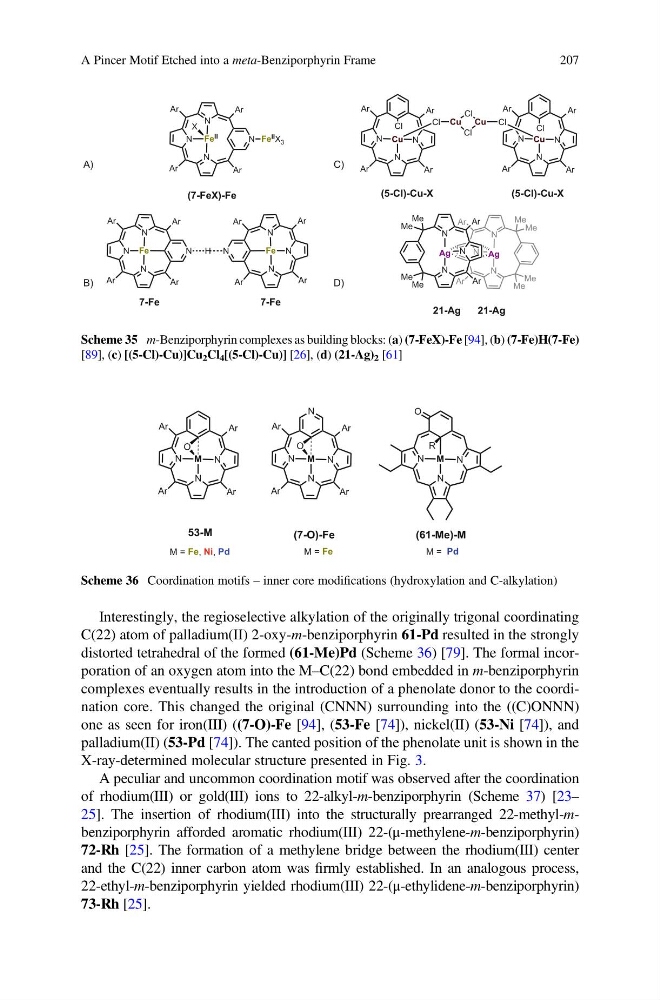
Interestingly, the regioselective alkylation of the originally trigonal coordinating
C(22) atom of palladium(II) 2-oxy-m-benziporphyrin 61-Pd resulted in the strongly
distorted tetrahedral of the formed (61-Me)Pd (Scheme 36) [79]. The formal incorporation of an oxygen atom into the M–C(22) bond embedded in m-benziporphyrin
complexes eventually results in the introduction of a phenolate donor to the coordination core. This changed the original (CNNN) surrounding into the ((C)ONNN)
one as seen for iron(III) ((7-O)-Fe [94], (53-Fe [74]), nickel(II) (53-Ni [74]), and
palladium(II) (53-Pd [74]). The canted position of the phenolate unit is shown in the
X-ray-determined molecular structure presented in Fig. 3.
A peculiar and uncommon coordination motif was observed after the coordination
of rhodium(III) or gold(III) ions to 22-alkyl-m-benziporphyrin (Scheme 37) [23–
25]. The insertion of rhodium(III) into the structurally prearranged 22-methyl-mbenziporphyrin afforded aromatic rhodium(III) 22-(μ-methylene-m-benziporphyrin)
72-Rh [25]. The formation of a methylene bridge between the rhodium(III) center
and the C(22) inner carbon atom was firmly established. In an analogous process,
22-ethyl-m-benziporphyrin yielded rhodium(III) 22-(μ-ethylidene-m-benziporphyrin)
73-Rh [25].
N
N
N
N
Ar
Ar
Ar
Ar
M
O
N
N
N
Ar
Ar
Ar
Ar
M
M = Fe, Ni, Pd
M = Fe
O
N
N
N
M
O
R
53-M
(7-O)-Fe
M = Pd
(61-Me)-M
Scheme 36 Coordination motifs – inner core modifications (hydroxylation and C-alkylation)
N
N
N
Ar
Ar
Ag
Me
Me
Me
Me
N
N
N
N
Ar
Ar
Ar
Ar
Fe II
X
Fe II X 3
(7-FeX)-Fe
N
N
N
N
Ar
Ar
Ar
Ar
Fe
H
N
N
N
N
Ar
Ar
Ar
Ar
Fe
7-Fe
7-Fe
N
N
N
Ar
Ar
Ar
Ar
Cu
N
N
N
Ar
Ar
Ar
Ar
Cu
Cl
Cl
Cl
Cl
Cu
Cu
Cl
Cl
(5-Cl)-Cu-X
(5-Cl)-Cu-X
N
N
N
Ar
Ar
Ag
Me
Me
Me
Me
21-Ag
21-Ag
A)
B)
C)
D)
Scheme 35 m-Benziporphyrin complexes as building blocks: (a) (7-FeX)-Fe [94], (b) (7-Fe)H(7-Fe)
[89], (c) [(5-Cl)-Cu)]Cu 2 Cl 4 [(5-Cl)-Cu)] [26], (d) (21-Ag) 2 [61]
A Pincer Motif Etched into a meta-Benziporphyrin Frame
207
C(22) atom of palladium(II) 2-oxy-m-benziporphyrin 61-Pd resulted in the strongly
distorted tetrahedral of the formed (61-Me)Pd (Scheme 36) [79]. The formal incorporation of an oxygen atom into the M–C(22) bond embedded in m-benziporphyrin
complexes eventually results in the introduction of a phenolate donor to the coordination core. This changed the original (CNNN) surrounding into the ((C)ONNN)
one as seen for iron(III) ((7-O)-Fe [94], (53-Fe [74]), nickel(II) (53-Ni [74]), and
palladium(II) (53-Pd [74]). The canted position of the phenolate unit is shown in the
X-ray-determined molecular structure presented in Fig. 3.
A peculiar and uncommon coordination motif was observed after the coordination
of rhodium(III) or gold(III) ions to 22-alkyl-m-benziporphyrin (Scheme 37) [23–
25]. The insertion of rhodium(III) into the structurally prearranged 22-methyl-mbenziporphyrin afforded aromatic rhodium(III) 22-(μ-methylene-m-benziporphyrin)
72-Rh [25]. The formation of a methylene bridge between the rhodium(III) center
and the C(22) inner carbon atom was firmly established. In an analogous process,
22-ethyl-m-benziporphyrin yielded rhodium(III) 22-(μ-ethylidene-m-benziporphyrin)
73-Rh [25].
N
N
N
N
Ar
Ar
Ar
Ar
M
O
N
N
N
Ar
Ar
Ar
Ar
M
M = Fe, Ni, Pd
M = Fe
O
N
N
N
M
O
R
53-M
(7-O)-Fe
M = Pd
(61-Me)-M
Scheme 36 Coordination motifs – inner core modifications (hydroxylation and C-alkylation)
N
N
N
Ar
Ar
Ag
Me
Me
Me
Me
N
N
N
N
Ar
Ar
Ar
Ar
Fe II
X
Fe II X 3
(7-FeX)-Fe
N
N
N
N
Ar
Ar
Ar
Ar
Fe
H
N
N
N
N
Ar
Ar
Ar
Ar
Fe
7-Fe
7-Fe
N
N
N
Ar
Ar
Ar
Ar
Cu
N
N
N
Ar
Ar
Ar
Ar
Cu
Cl
Cl
Cl
Cl
Cu
Cu
Cl
Cl
(5-Cl)-Cu-X
(5-Cl)-Cu-X
N
N
N
Ar
Ar
Ag
Me
Me
Me
Me
21-Ag
21-Ag
A)
B)
C)
D)
Scheme 35 m-Benziporphyrin complexes as building blocks: (a) (7-FeX)-Fe [94], (b) (7-Fe)H(7-Fe)
[89], (c) [(5-Cl)-Cu)]Cu 2 Cl 4 [(5-Cl)-Cu)] [26], (d) (21-Ag) 2 [61]
A Pincer Motif Etched into a meta-Benziporphyrin Frame
207