

constraints introducing agostic interactions [16, 26]. The appropriate shifts are
380 ppm and 450 ppm (293 K) for 5-NiCl and 5-FeCl, respectively.
The equatorial [CNNN] coordination mode seems to be a common denominator,
generally accepted for m-benziporphyrins and aza-m-benziporphyrins encountered
for the attempted coordination of gold(III) (5-Au [24]), iron(III) (7-Fe [89]), nickel
(II) (5-Ni [16], 14-Ni [90], 71-Ni [78]), palladium(II) (5-Pd [2], 14-Pd [90], 23-Pd
[66], 61-Pd [79], 60-Pd [79], 70-Pd [57]), platinum (II) (5-Pt [2]), rhodium(III)
(5-Rh [23]), and silver(III) (61-Ag [91]), gathered in Scheme 33. Furthermore,
22-aza-benziporphyrins acquire a planar macrocyclic arrangement imposed by the
coordination of four nitrogen equatorial donors, i.e., iron(III) (6-Fe [22]), copper
(64-Cu(II) [53]), nickel(II) (64-Ni [53], 52-Ni [92, 93]), and zinc(II) (6-Zn [22],
64-Zn [53]).
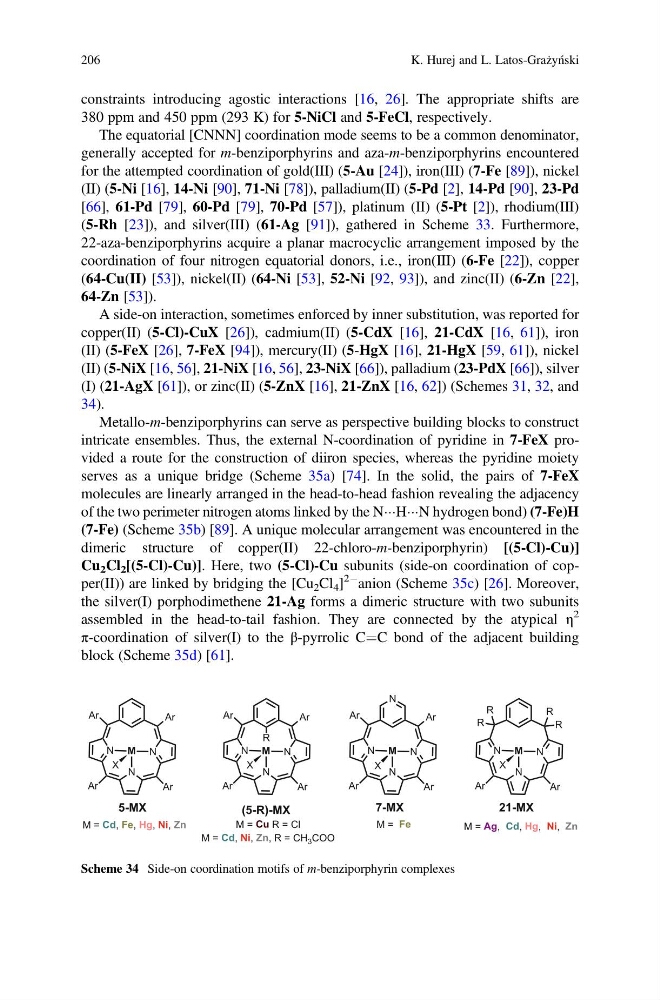
A side-on interaction, sometimes enforced by inner substitution, was reported for
copper(II) (5-Cl)-CuX [26]), cadmium(II) (5-CdX [16], 21-CdX [16, 61]), iron
(II) (5-FeX [26], 7-FeX [94]), mercury(II) (5-HgX [16], 21-HgX [59, 61]), nickel
(II) (5-NiX [16, 56], 21-NiX [16, 56], 23-NiX [66]), palladium (23-PdX [66]), silver
(I) (21-AgX [61]), or zinc(II) (5-ZnX [16], 21-ZnX [16, 62]) (Schemes 31, 32, and
34).
Metallo-m-benziporphyrins can serve as perspective building blocks to construct
intricate ensembles. Thus, the external N-coordination of pyridine in 7-FeX provided a route for the construction of diiron species, whereas the pyridine moiety
serves as a unique bridge (Scheme 35a) [74]. In the solid, the pairs of 7-FeX
molecules are linearly arranged in the head-to-head fashion revealing the adjacency
of the two perimeter nitrogen atoms linked by the NÁÁÁHÁÁÁN hydrogen bond) (7-Fe)H
(7-Fe) (Scheme 35b) [89]. A unique molecular arrangement was encountered in the
dimeric structure of copper(II) 22-chloro-m-benziporphyrin) [(5-Cl)-Cu)]
Cu 2 Cl 2 [(5-Cl)-Cu)]. Here, two (5-Cl)-Cu subunits (side-on coordination of copper(II)) are linked by bridging the [Cu 2 Cl 4 ]
2À
anion (Scheme 35c) [26]. Moreover,
the silver(I) porphodimethene 21-Ag forms a dimeric structure with two subunits
assembled in the head-to-tail fashion. They are connected by the atypical η
2
π-coordination of silver(I) to the β-pyrrolic C¼C bond of the adjacent building
block (Scheme 35d) [61].
N
N
N
Ar
Ar
Ar
Ar
M
M = Cd, Fe, Hg, Ni, Zn
N
N
N
N
Ar
Ar
Ar
Ar
M
M = Fe
X
N
N
N
Ar
Ar
Ar
Ar
M
M = Cu R = Cl
M = Cd, Ni, Zn, R = CH 3 COO
R
X
X
N
N
N
Ar
Ar
M
M = Ag, Cd, Hg, Ni, Zn
X
R
R
R
R
5-MX
(5-R)-MX
7-MX
21-MX
Scheme 34 Side-on coordination motifs of m-benziporphyrin complexes
206
K. Hurej and L. Latos-Grażyński
380 ppm and 450 ppm (293 K) for 5-NiCl and 5-FeCl, respectively.
The equatorial [CNNN] coordination mode seems to be a common denominator,
generally accepted for m-benziporphyrins and aza-m-benziporphyrins encountered
for the attempted coordination of gold(III) (5-Au [24]), iron(III) (7-Fe [89]), nickel
(II) (5-Ni [16], 14-Ni [90], 71-Ni [78]), palladium(II) (5-Pd [2], 14-Pd [90], 23-Pd
[66], 61-Pd [79], 60-Pd [79], 70-Pd [57]), platinum (II) (5-Pt [2]), rhodium(III)
(5-Rh [23]), and silver(III) (61-Ag [91]), gathered in Scheme 33. Furthermore,
22-aza-benziporphyrins acquire a planar macrocyclic arrangement imposed by the
coordination of four nitrogen equatorial donors, i.e., iron(III) (6-Fe [22]), copper
(64-Cu(II) [53]), nickel(II) (64-Ni [53], 52-Ni [92, 93]), and zinc(II) (6-Zn [22],
64-Zn [53]).
A side-on interaction, sometimes enforced by inner substitution, was reported for
copper(II) (5-Cl)-CuX [26]), cadmium(II) (5-CdX [16], 21-CdX [16, 61]), iron
(II) (5-FeX [26], 7-FeX [94]), mercury(II) (5-HgX [16], 21-HgX [59, 61]), nickel
(II) (5-NiX [16, 56], 21-NiX [16, 56], 23-NiX [66]), palladium (23-PdX [66]), silver
(I) (21-AgX [61]), or zinc(II) (5-ZnX [16], 21-ZnX [16, 62]) (Schemes 31, 32, and
34).
Metallo-m-benziporphyrins can serve as perspective building blocks to construct
intricate ensembles. Thus, the external N-coordination of pyridine in 7-FeX provided a route for the construction of diiron species, whereas the pyridine moiety
serves as a unique bridge (Scheme 35a) [74]. In the solid, the pairs of 7-FeX
molecules are linearly arranged in the head-to-head fashion revealing the adjacency
of the two perimeter nitrogen atoms linked by the NÁÁÁHÁÁÁN hydrogen bond) (7-Fe)H
(7-Fe) (Scheme 35b) [89]. A unique molecular arrangement was encountered in the
dimeric structure of copper(II) 22-chloro-m-benziporphyrin) [(5-Cl)-Cu)]
Cu 2 Cl 2 [(5-Cl)-Cu)]. Here, two (5-Cl)-Cu subunits (side-on coordination of copper(II)) are linked by bridging the [Cu 2 Cl 4 ]
2À
anion (Scheme 35c) [26]. Moreover,
the silver(I) porphodimethene 21-Ag forms a dimeric structure with two subunits
assembled in the head-to-tail fashion. They are connected by the atypical η
2
π-coordination of silver(I) to the β-pyrrolic C¼C bond of the adjacent building
block (Scheme 35d) [61].
N
N
N
Ar
Ar
Ar
Ar
M
M = Cd, Fe, Hg, Ni, Zn
N
N
N
N
Ar
Ar
Ar
Ar
M
M = Fe
X
N
N
N
Ar
Ar
Ar
Ar
M
M = Cu R = Cl
M = Cd, Ni, Zn, R = CH 3 COO
R
X
X
N
N
N
Ar
Ar
M
M = Ag, Cd, Hg, Ni, Zn
X
R
R
R
R
5-MX
(5-R)-MX
7-MX
21-MX
Scheme 34 Side-on coordination motifs of m-benziporphyrin complexes
206
K. Hurej and L. Latos-Grażyński