

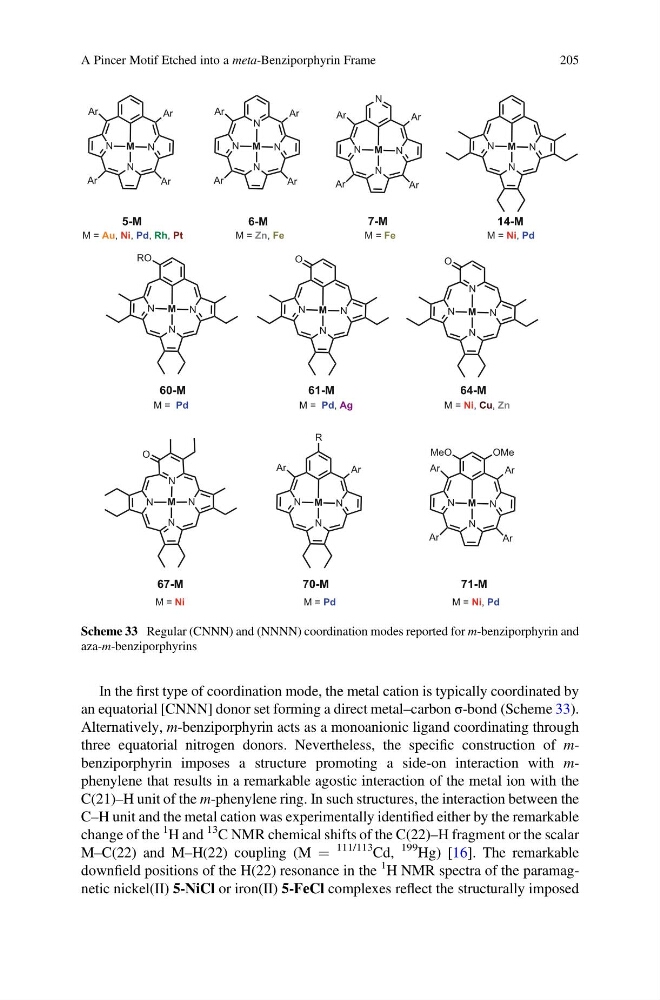
In the first type of coordination mode, the metal cation is typically coordinated by
an equatorial [CNNN] donor set forming a direct metal–carbon σ-bond (Scheme 33).
Alternatively, m-benziporphyrin acts as a monoanionic ligand coordinating through
three equatorial nitrogen donors. Nevertheless, the specific construction of mbenziporphyrin imposes a structure promoting a side-on interaction with mphenylene that results in a remarkable agostic interaction of the metal ion with the
C(21)–H unit of the m-phenylene ring. In such structures, the interaction between the
C–H unit and the metal cation was experimentally identified either by the remarkable
change of the
1 H and
13 C NMR chemical shifts of the C(22)–H fragment or the scalar
M–C(22) and M–H(22) coupling (M ¼
111/113 Cd,
199 Hg) [16]. The remarkable
downfield positions of the H(22) resonance in the
1 H NMR spectra of the paramagnetic nickel(II) 5-NiCl or iron(II) 5-FeCl complexes reflect the structurally imposed
N
N
N
Ar
Ar
Ar
Ar
M
M = Au, Ni, Pd, Rh, Pt
M = Zn, Fe
M = Fe
M = Ni, Pd
5-M
6-M
7-M
14-M
N
N
N
M
N
N
N
N
Ar
Ar
Ar
Ar
M
N
N
N
M
O
N
N
N
N
Ar
Ar
Ar
Ar
M
60-M
61-M
64-M
N
N
N
Ar
Ar
Ar
Ar
M
MeO
OMe
N
N
N
M
RO
N
N
N
Ar
Ar
M
R
M = Pd
M = Pd, Ag
M = Ni, Cu, Zn
N
N
N
N
M
O
67-M
70-M
71-M
M = Ni
M = Pd
M = Ni, Pd
N
N
N
N
O
M
Scheme 33 Regular (CNNN) and (NNNN) coordination modes reported for m-benziporphyrin and
aza-m-benziporphyrins
A Pincer Motif Etched into a meta-Benziporphyrin Frame
205
an equatorial [CNNN] donor set forming a direct metal–carbon σ-bond (Scheme 33).
Alternatively, m-benziporphyrin acts as a monoanionic ligand coordinating through
three equatorial nitrogen donors. Nevertheless, the specific construction of mbenziporphyrin imposes a structure promoting a side-on interaction with mphenylene that results in a remarkable agostic interaction of the metal ion with the
C(21)–H unit of the m-phenylene ring. In such structures, the interaction between the
C–H unit and the metal cation was experimentally identified either by the remarkable
change of the
1 H and
13 C NMR chemical shifts of the C(22)–H fragment or the scalar
M–C(22) and M–H(22) coupling (M ¼
111/113 Cd,
199 Hg) [16]. The remarkable
downfield positions of the H(22) resonance in the
1 H NMR spectra of the paramagnetic nickel(II) 5-NiCl or iron(II) 5-FeCl complexes reflect the structurally imposed
N
N
N
Ar
Ar
Ar
Ar
M
M = Au, Ni, Pd, Rh, Pt
M = Zn, Fe
M = Fe
M = Ni, Pd
5-M
6-M
7-M
14-M
N
N
N
M
N
N
N
N
Ar
Ar
Ar
Ar
M
N
N
N
M
O
N
N
N
N
Ar
Ar
Ar
Ar
M
60-M
61-M
64-M
N
N
N
Ar
Ar
Ar
Ar
M
MeO
OMe
N
N
N
M
RO
N
N
N
Ar
Ar
M
R
M = Pd
M = Pd, Ag
M = Ni, Cu, Zn
N
N
N
N
M
O
67-M
70-M
71-M
M = Ni
M = Pd
M = Ni, Pd
N
N
N
N
O
M
Scheme 33 Regular (CNNN) and (NNNN) coordination modes reported for m-benziporphyrin and
aza-m-benziporphyrins
A Pincer Motif Etched into a meta-Benziporphyrin Frame
205