

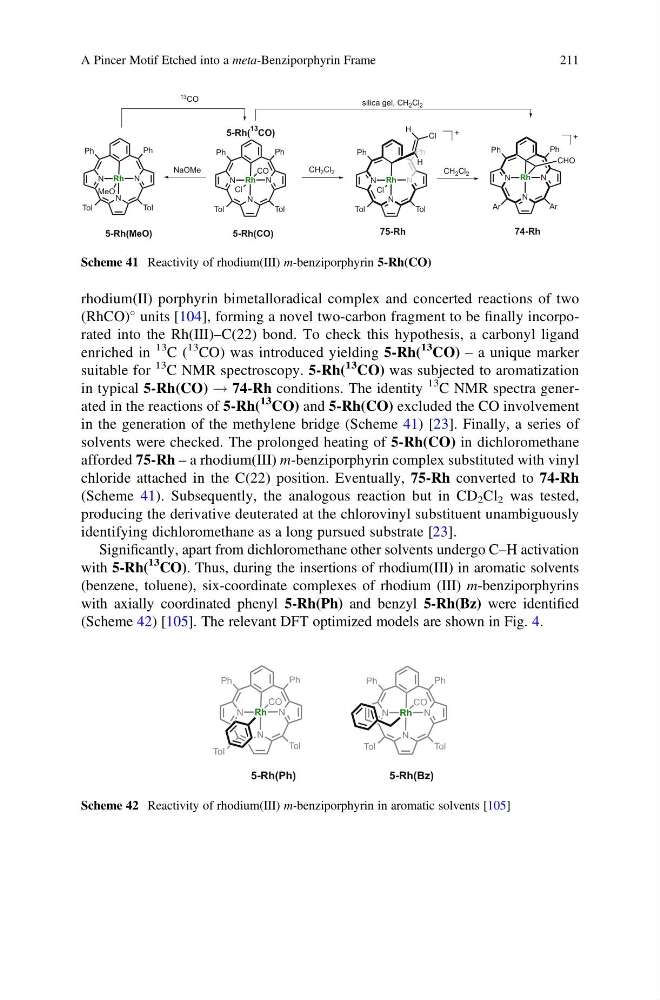
rhodium(II) porphyrin bimetalloradical complex and concerted reactions of two
(RhCO)
units [104], forming a novel two-carbon fragment to be finally incorporated into the Rh(III)–C(22) bond. To check this hypothesis, a carbonyl ligand
enriched in
13 C (
13 CO) was introduced yielding 5-Rh(
13 CO) – a unique marker
suitable for
13 C NMR spectroscopy. 5-Rh(
13 CO) was subjected to aromatization
in typical 5-Rh(CO) ! 74-Rh conditions. The identity
13 C NMR spectra generated in the reactions of 5-Rh(
13 CO) and 5-Rh(CO) excluded the CO involvement
in the generation of the methylene bridge (Scheme 41) [23]. Finally, a series of
solvents were checked. The prolonged heating of 5-Rh(CO) in dichloromethane
afforded 75-Rh – a rhodium(III) m-benziporphyrin complex substituted with vinyl
chloride attached in the C(22) position. Eventually, 75-Rh converted to 74-Rh
(Scheme 41). Subsequently, the analogous reaction but in CD 2 Cl 2 was tested,
producing the derivative deuterated at the chlorovinyl substituent unambiguously
identifying dichloromethane as a long pursued substrate [23].
Significantly, apart from dichloromethane other solvents undergo C–H activation
with 5-Rh(
13 CO). Thus, during the insertions of rhodium(III) in aromatic solvents
(benzene, toluene), six-coordinate complexes of rhodium (III) m-benziporphyrins
with axially coordinated phenyl 5-Rh(Ph) and benzyl 5-Rh(Bz) were identified
(Scheme 42) [105]. The relevant DFT optimized models are shown in Fig. 4.
N
N
N
Ph
Ph
Tol
Tol
Rh
CO
Cl
N
N
N
Ph
Ph
Tol
Tol
Rh
N
N
N
Ph
Ph
Ar
Ar
Rh
CHO
H
+
+
H
Cl
Cl
CH 2 Cl 2
CH 2 Cl 2
silica gel, CH 2 Cl 2
NaOMe
N
N
N
Ph
Ph
Tol
Tol
Rh
MeO
5-Rh(MeO)
5-Rh(CO)
75-Rh
74-Rh
13 CO
5-Rh(
13 CO)
Scheme 41 Reactivity of rhodium(III) m-benziporphyrin 5-Rh(CO)
N
N
N
Ph
Ph
Tol
Tol
Rh
CO
N
N
N
Ph
Ph
Tol
Tol
Rh
CO
5-Rh(Ph)
5-Rh(Bz)
Scheme 42 Reactivity of rhodium(III) m-benziporphyrin in aromatic solvents [105]
A Pincer Motif Etched into a meta-Benziporphyrin Frame
211
(RhCO)
units [104], forming a novel two-carbon fragment to be finally incorporated into the Rh(III)–C(22) bond. To check this hypothesis, a carbonyl ligand
enriched in
13 C (
13 CO) was introduced yielding 5-Rh(
13 CO) – a unique marker
suitable for
13 C NMR spectroscopy. 5-Rh(
13 CO) was subjected to aromatization
in typical 5-Rh(CO) ! 74-Rh conditions. The identity
13 C NMR spectra generated in the reactions of 5-Rh(
13 CO) and 5-Rh(CO) excluded the CO involvement
in the generation of the methylene bridge (Scheme 41) [23]. Finally, a series of
solvents were checked. The prolonged heating of 5-Rh(CO) in dichloromethane
afforded 75-Rh – a rhodium(III) m-benziporphyrin complex substituted with vinyl
chloride attached in the C(22) position. Eventually, 75-Rh converted to 74-Rh
(Scheme 41). Subsequently, the analogous reaction but in CD 2 Cl 2 was tested,
producing the derivative deuterated at the chlorovinyl substituent unambiguously
identifying dichloromethane as a long pursued substrate [23].
Significantly, apart from dichloromethane other solvents undergo C–H activation
with 5-Rh(
13 CO). Thus, during the insertions of rhodium(III) in aromatic solvents
(benzene, toluene), six-coordinate complexes of rhodium (III) m-benziporphyrins
with axially coordinated phenyl 5-Rh(Ph) and benzyl 5-Rh(Bz) were identified
(Scheme 42) [105]. The relevant DFT optimized models are shown in Fig. 4.
N
N
N
Ph
Ph
Tol
Tol
Rh
CO
Cl
N
N
N
Ph
Ph
Tol
Tol
Rh
N
N
N
Ph
Ph
Ar
Ar
Rh
CHO
H
+
+
H
Cl
Cl
CH 2 Cl 2
CH 2 Cl 2
silica gel, CH 2 Cl 2
NaOMe
N
N
N
Ph
Ph
Tol
Tol
Rh
MeO
5-Rh(MeO)
5-Rh(CO)
75-Rh
74-Rh
13 CO
5-Rh(
13 CO)
Scheme 41 Reactivity of rhodium(III) m-benziporphyrin 5-Rh(CO)
N
N
N
Ph
Ph
Tol
Tol
Rh
CO
N
N
N
Ph
Ph
Tol
Tol
Rh
CO
5-Rh(Ph)
5-Rh(Bz)
Scheme 42 Reactivity of rhodium(III) m-benziporphyrin in aromatic solvents [105]
A Pincer Motif Etched into a meta-Benziporphyrin Frame
211