

13-Cu(II) (classified also as copper macrocyclic pincer complexes or macrocyclic
arene complexes) [27, 50], which exemplify some aspects of organometallic chemistry in the macrocyclic environment as well as reveal the potential enclosed in this
area. For instance, aryl-copper(III)-halide complexes 13-Cu(III) closely resemble
elusive intermediates invoked in catalytic reactions, such as Ullmann cross-coupling
[51]. A detailed study covered the key mechanistic aspects of a mild C–H activation
process conducted by triazamacrocyclic copper(II) complexes revealing the intermediate locating an aromatic C–H bond in close proximity to metal center 13-Cu(II).
The copper-catalyzed aerobic oxidative functionalization of an arene C–H bond has
been detected as well [52]. Thus, the fusion of macrocyclic motifs with the NCN or
NNN functionality (Schemes 2 and 3) offers a promising platform for studying the
activation of C–H and C–C bonds. Eventually, the requested properties were tuned
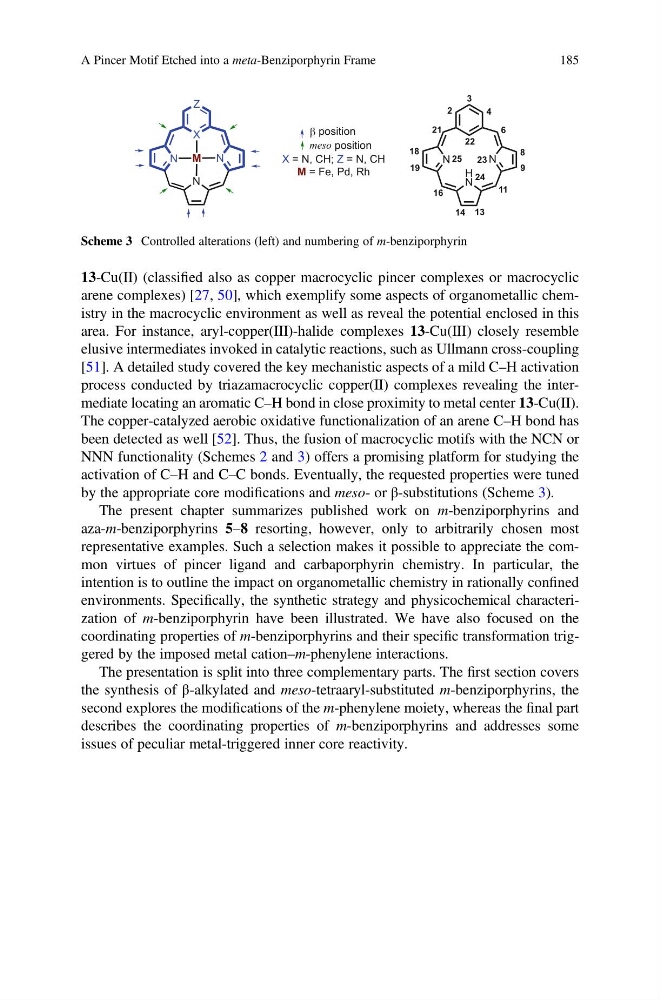
by the appropriate core modifications and meso- or β-substitutions (Scheme 3).
The present chapter summarizes published work on m-benziporphyrins and
aza-m-benziporphyrins 5–8 resorting, however, only to arbitrarily chosen most
representative examples. Such a selection makes it possible to appreciate the common virtues of pincer ligand and carbaporphyrin chemistry. In particular, the
intention is to outline the impact on organometallic chemistry in rationally confined
environments. Specifically, the synthetic strategy and physicochemical characterization of m-benziporphyrin have been illustrated. We have also focused on the
coordinating properties of m-benziporphyrins and their specific transformation triggered by the imposed metal cation–m-phenylene interactions.
The presentation is split into three complementary parts. The first section covers
the synthesis of β-alkylated and meso-tetraaryl-substituted m-benziporphyrins, the
second explores the modifications of the m-phenylene moiety, whereas the final part
describes the coordinating properties of m-benziporphyrins and addresses some
issues of peculiar metal-triggered inner core reactivity.
N
N
N
X
Z
M
X = N, CH; Z = N, CH
M = Fe, Pd, Rh
β position
meso position
H
N
N
N
2
3
4
6
8
9
11
13
14
16
18
19
21
22
23
24
25
Scheme 3 Controlled alterations (left) and numbering of m-benziporphyrin
A Pincer Motif Etched into a meta-Benziporphyrin Frame
185
arene complexes) [27, 50], which exemplify some aspects of organometallic chemistry in the macrocyclic environment as well as reveal the potential enclosed in this
area. For instance, aryl-copper(III)-halide complexes 13-Cu(III) closely resemble
elusive intermediates invoked in catalytic reactions, such as Ullmann cross-coupling
[51]. A detailed study covered the key mechanistic aspects of a mild C–H activation
process conducted by triazamacrocyclic copper(II) complexes revealing the intermediate locating an aromatic C–H bond in close proximity to metal center 13-Cu(II).
The copper-catalyzed aerobic oxidative functionalization of an arene C–H bond has
been detected as well [52]. Thus, the fusion of macrocyclic motifs with the NCN or
NNN functionality (Schemes 2 and 3) offers a promising platform for studying the
activation of C–H and C–C bonds. Eventually, the requested properties were tuned
by the appropriate core modifications and meso- or β-substitutions (Scheme 3).
The present chapter summarizes published work on m-benziporphyrins and
aza-m-benziporphyrins 5–8 resorting, however, only to arbitrarily chosen most
representative examples. Such a selection makes it possible to appreciate the common virtues of pincer ligand and carbaporphyrin chemistry. In particular, the
intention is to outline the impact on organometallic chemistry in rationally confined
environments. Specifically, the synthetic strategy and physicochemical characterization of m-benziporphyrin have been illustrated. We have also focused on the
coordinating properties of m-benziporphyrins and their specific transformation triggered by the imposed metal cation–m-phenylene interactions.
The presentation is split into three complementary parts. The first section covers
the synthesis of β-alkylated and meso-tetraaryl-substituted m-benziporphyrins, the
second explores the modifications of the m-phenylene moiety, whereas the final part
describes the coordinating properties of m-benziporphyrins and addresses some
issues of peculiar metal-triggered inner core reactivity.
N
N
N
X
Z
M
X = N, CH; Z = N, CH
M = Fe, Pd, Rh
β position
meso position
H
N
N
N
2
3
4
6
8
9
11
13
14
16
18
19
21
22
23
24
25
Scheme 3 Controlled alterations (left) and numbering of m-benziporphyrin
A Pincer Motif Etched into a meta-Benziporphyrin Frame
185