

2 The Synthesis of m-Benziporphyrin
and Aza-m-Benziporphyrins: Toward a Pincer-Like
Macrocyclic Ligand Library
2.1 m-Benziporphyrins
2.1.1 β-Substituted m-Benziporphyrin
R
R
R
R
R
R
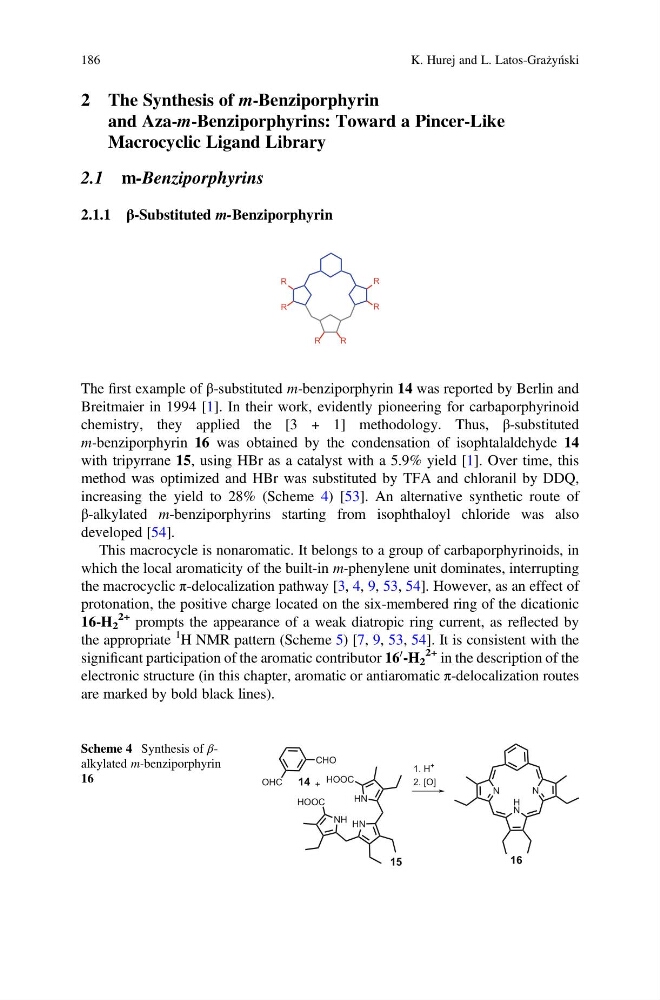
The first example of β-substituted m-benziporphyrin 14 was reported by Berlin and
Breitmaier in 1994 [1]. In their work, evidently pioneering for carbaporphyrinoid
chemistry, they applied the [3 + 1] methodology. Thus, β-substituted
m-benziporphyrin 16 was obtained by the condensation of isophtalaldehyde 14
with tripyrrane 15, using HBr as a catalyst with a 5.9% yield [1]. Over time, this
method was optimized and HBr was substituted by TFA and chloranil by DDQ,
increasing the yield to 28% (Scheme 4) [53]. An alternative synthetic route of
β-alkylated m-benziporphyrins starting from isophthaloyl chloride was also
developed [54].
This macrocycle is nonaromatic. It belongs to a group of carbaporphyrinoids, in
which the local aromaticity of the built-in m-phenylene unit dominates, interrupting
the macrocyclic π-delocalization pathway [3, 4, 9, 53, 54]. However, as an effect of
protonation, the positive charge located on the six-membered ring of the dicationic
16-H 2
2+ prompts the appearance of a weak diatropic ring current, as reflected by
the appropriate
1 H NMR pattern (Scheme 5) [7, 9, 53, 54]. It is consistent with the
significant participation of the aromatic contributor 16
0 -H 2
2+ in the description of the
electronic structure (in this chapter, aromatic or antiaromatic π-delocalization routes
are marked by bold black lines).
OHC
CHO
NH HN
HN
HOOC
HOOC
16
1. H
+
2. [O]
H
N
N
N
+
14
15
Scheme 4 Synthesis of βalkylated m-benziporphyrin
16
186
K. Hurej and L. Latos-Grażyński
and Aza-m-Benziporphyrins: Toward a Pincer-Like
Macrocyclic Ligand Library
2.1 m-Benziporphyrins
2.1.1 β-Substituted m-Benziporphyrin
R
R
R
R
R
R
The first example of β-substituted m-benziporphyrin 14 was reported by Berlin and
Breitmaier in 1994 [1]. In their work, evidently pioneering for carbaporphyrinoid
chemistry, they applied the [3 + 1] methodology. Thus, β-substituted
m-benziporphyrin 16 was obtained by the condensation of isophtalaldehyde 14
with tripyrrane 15, using HBr as a catalyst with a 5.9% yield [1]. Over time, this
method was optimized and HBr was substituted by TFA and chloranil by DDQ,
increasing the yield to 28% (Scheme 4) [53]. An alternative synthetic route of
β-alkylated m-benziporphyrins starting from isophthaloyl chloride was also
developed [54].
This macrocycle is nonaromatic. It belongs to a group of carbaporphyrinoids, in
which the local aromaticity of the built-in m-phenylene unit dominates, interrupting
the macrocyclic π-delocalization pathway [3, 4, 9, 53, 54]. However, as an effect of
protonation, the positive charge located on the six-membered ring of the dicationic
16-H 2
2+ prompts the appearance of a weak diatropic ring current, as reflected by
the appropriate
1 H NMR pattern (Scheme 5) [7, 9, 53, 54]. It is consistent with the
significant participation of the aromatic contributor 16
0 -H 2
2+ in the description of the
electronic structure (in this chapter, aromatic or antiaromatic π-delocalization routes
are marked by bold black lines).
OHC
CHO
NH HN
HN
HOOC
HOOC
16
1. H
+
2. [O]
H
N
N
N
+
14
15
Scheme 4 Synthesis of βalkylated m-benziporphyrin
16
186
K. Hurej and L. Latos-Grażyński