

effective stabilization of the M–C bond. Modifications of various ligand parameters
resulted in the fine-tuning of the steric and the electronic properties of the metal
center preserving the essential coordination frame. Extensive exploration has provided direct access to fundamental comprehension of a variety of reactions in
organometallic chemistry.
A range of applications (e.g., alkane dehydrogenation catalysts, the mechanistic
elucidation of fundamental transformations C–C bond activation, the construction of
the first metallodendrimers for sustainable homogeneous catalysis, sensors) have
also been developed [45–47]. Essential concepts – nicely explored for pyridine- or
acridine-based ruthenium, platinum, or iridium pincer complexes – have emerged.
Milstein and coworkers consider this “a new paradigm in bond activation and
‘green’ catalysis” [35, 36]. In these catalytic systems, pincer ligands cooperate by
means of the aromatization–dearomatization of the built-in heteroaromatic moiety.
Significantly, bond activation takes place with no formal change in the metal
oxidation state affording the activation of select single bonds (H–H, C–H, O–H,
and N–H). For instance, a unique water splitting process was catalyzed by a
pyridine-based pincer ruthenium complex [48].
To put this review into proper perspective, one has to note that organometallic
chemistry in a macrocyclic environment is still evidently limited to
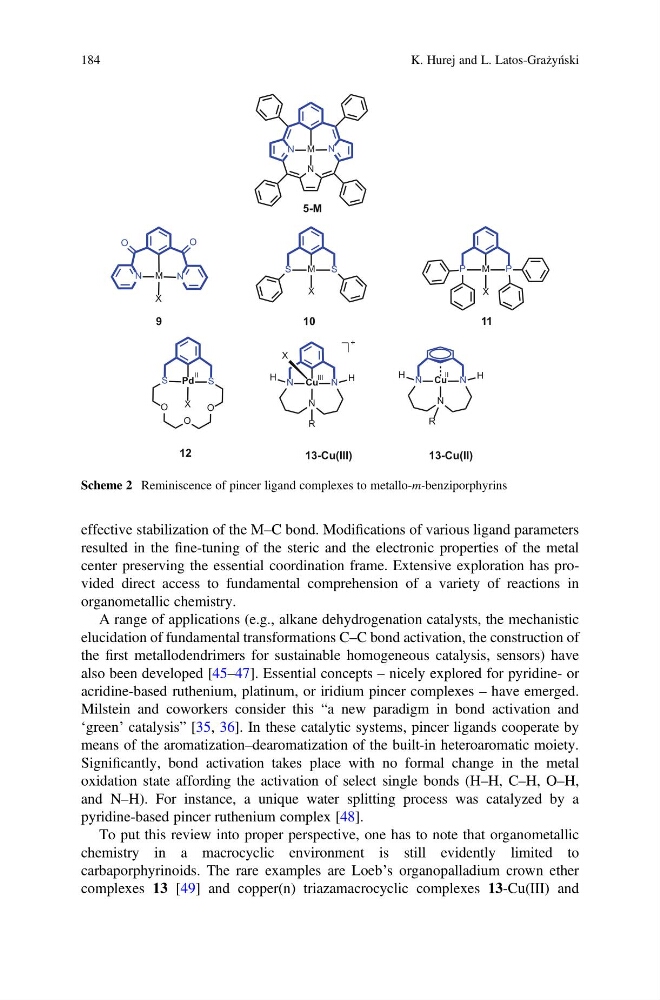
carbaporphyrinoids. The rare examples are Loeb’s organopalladium crown ether
complexes 13 [49] and copper(n) triazamacrocyclic complexes 13-Cu(III) and
N
N
N
N
N
O
O
M
P
P
M
X
X
M
M
S
S
X
N
N
N
Cu
R
H
H
S
S
O
O
O
Pd
X
X
III
+
N
N
N
Cu
R
H
H
II
II
5-M
9
10
11
12
13-Cu(III)
13-Cu(II)
Scheme 2 Reminiscence of pincer ligand complexes to metallo-m-benziporphyrins
184
K. Hurej and L. Latos-Grażyński
resulted in the fine-tuning of the steric and the electronic properties of the metal
center preserving the essential coordination frame. Extensive exploration has provided direct access to fundamental comprehension of a variety of reactions in
organometallic chemistry.
A range of applications (e.g., alkane dehydrogenation catalysts, the mechanistic
elucidation of fundamental transformations C–C bond activation, the construction of
the first metallodendrimers for sustainable homogeneous catalysis, sensors) have
also been developed [45–47]. Essential concepts – nicely explored for pyridine- or
acridine-based ruthenium, platinum, or iridium pincer complexes – have emerged.
Milstein and coworkers consider this “a new paradigm in bond activation and
‘green’ catalysis” [35, 36]. In these catalytic systems, pincer ligands cooperate by
means of the aromatization–dearomatization of the built-in heteroaromatic moiety.
Significantly, bond activation takes place with no formal change in the metal
oxidation state affording the activation of select single bonds (H–H, C–H, O–H,
and N–H). For instance, a unique water splitting process was catalyzed by a
pyridine-based pincer ruthenium complex [48].
To put this review into proper perspective, one has to note that organometallic
chemistry in a macrocyclic environment is still evidently limited to
carbaporphyrinoids. The rare examples are Loeb’s organopalladium crown ether
complexes 13 [49] and copper(n) triazamacrocyclic complexes 13-Cu(III) and
N
N
N
N
N
O
O
M
P
P
M
X
X
M
M
S
S
X
N
N
N
Cu
R
H
H
S
S
O
O
O
Pd
X
X
III
+
N
N
N
Cu
R
H
H
II
II
5-M
9
10
11
12
13-Cu(III)
13-Cu(II)
Scheme 2 Reminiscence of pincer ligand complexes to metallo-m-benziporphyrins
184
K. Hurej and L. Latos-Grażyński