

complexes) with bulky peripheral phosphine fragments and the relative rigidity of
the diarylamino skeleton. However, given their diarylamino-based skeleton, which
itself is known to undergo oxidation, these PNP ligands may also engage in
reversible one-electron oxidation processes at nitrogen upon deprotonation and
coordination of the central amido functionality to a (transition) metal. The first
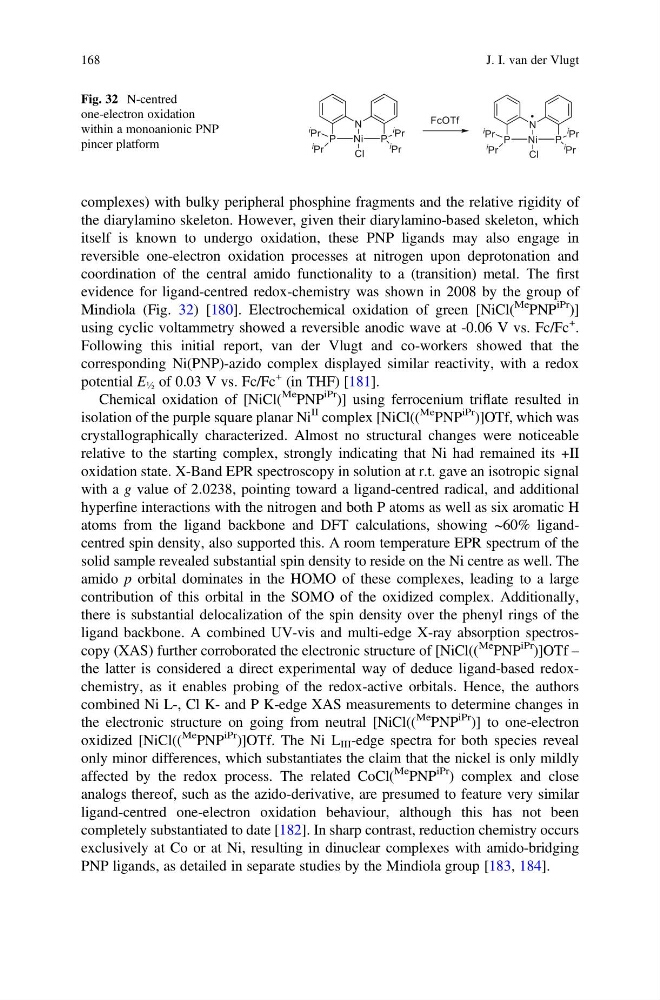
evidence for ligand-centred redox-chemistry was shown in 2008 by the group of
Mindiola (Fig. 32) [180]. Electrochemical oxidation of green [NiCl(
Me PNP
iPr )]
using cyclic voltammetry showed a reversible anodic wave at -0.06 V vs. Fc/Fc
+
.
Following this initial report, van der Vlugt and co-workers showed that the
corresponding Ni(PNP)-azido complex displayed similar reactivity, with a redox
potential E ½ of 0.03 V vs. Fc/Fc
+ (in THF) [181].
Chemical oxidation of [NiCl(
Me
PNP
iPr )] using ferrocenium triflate resulted in
isolation of the purple square planar Ni
II complex [NiCl((
Me PNP
iPr )]OTf, which was
crystallographically characterized. Almost no structural changes were noticeable
relative to the starting complex, strongly indicating that Ni had remained its +II
oxidation state. X-Band EPR spectroscopy in solution at r.t. gave an isotropic signal
with a g value of 2.0238, pointing toward a ligand-centred radical, and additional
hyperfine interactions with the nitrogen and both P atoms as well as six aromatic H
atoms from the ligand backbone and DFT calculations, showing ~60% ligandcentred spin density, also supported this. A room temperature EPR spectrum of the
solid sample revealed substantial spin density to reside on the Ni centre as well. The
amido p orbital dominates in the HOMO of these complexes, leading to a large
contribution of this orbital in the SOMO of the oxidized complex. Additionally,
there is substantial delocalization of the spin density over the phenyl rings of the
ligand backbone. A combined UV-vis and multi-edge X-ray absorption spectroscopy (XAS) further corroborated the electronic structure of [NiCl((
Me
PNP
iPr )]OTf –
the latter is considered a direct experimental way of deduce ligand-based redoxchemistry, as it enables probing of the redox-active orbitals. Hence, the authors
combined Ni L-, Cl K- and P K-edge XAS measurements to determine changes in
the electronic structure on going from neutral [NiCl((
Me
PNP
iPr )] to one-electron
oxidized [NiCl((
Me PNP
iPr )]OTf. The Ni L III -edge spectra for both species reveal
only minor differences, which substantiates the claim that the nickel is only mildly
affected by the redox process. The related CoCl(
Me PNP
iPr ) complex and close
analogs thereof, such as the azido-derivative, are presumed to feature very similar
ligand-centred one-electron oxidation behaviour, although this has not been
completely substantiated to date [182]. In sharp contrast, reduction chemistry occurs
exclusively at Co or at Ni, resulting in dinuclear complexes with amido-bridging
PNP ligands, as detailed in separate studies by the Mindiola group [183, 184].
Fig. 32 N-centred
one-electron oxidation
within a monoanionic PNP
pincer platform
168
J. I. van der Vlugt
the diarylamino skeleton. However, given their diarylamino-based skeleton, which
itself is known to undergo oxidation, these PNP ligands may also engage in
reversible one-electron oxidation processes at nitrogen upon deprotonation and
coordination of the central amido functionality to a (transition) metal. The first
evidence for ligand-centred redox-chemistry was shown in 2008 by the group of
Mindiola (Fig. 32) [180]. Electrochemical oxidation of green [NiCl(
Me PNP
iPr )]
using cyclic voltammetry showed a reversible anodic wave at -0.06 V vs. Fc/Fc
+
.
Following this initial report, van der Vlugt and co-workers showed that the
corresponding Ni(PNP)-azido complex displayed similar reactivity, with a redox
potential E ½ of 0.03 V vs. Fc/Fc
+ (in THF) [181].
Chemical oxidation of [NiCl(
Me
PNP
iPr )] using ferrocenium triflate resulted in
isolation of the purple square planar Ni
II complex [NiCl((
Me PNP
iPr )]OTf, which was
crystallographically characterized. Almost no structural changes were noticeable
relative to the starting complex, strongly indicating that Ni had remained its +II
oxidation state. X-Band EPR spectroscopy in solution at r.t. gave an isotropic signal
with a g value of 2.0238, pointing toward a ligand-centred radical, and additional
hyperfine interactions with the nitrogen and both P atoms as well as six aromatic H
atoms from the ligand backbone and DFT calculations, showing ~60% ligandcentred spin density, also supported this. A room temperature EPR spectrum of the
solid sample revealed substantial spin density to reside on the Ni centre as well. The
amido p orbital dominates in the HOMO of these complexes, leading to a large
contribution of this orbital in the SOMO of the oxidized complex. Additionally,
there is substantial delocalization of the spin density over the phenyl rings of the
ligand backbone. A combined UV-vis and multi-edge X-ray absorption spectroscopy (XAS) further corroborated the electronic structure of [NiCl((
Me
PNP
iPr )]OTf –
the latter is considered a direct experimental way of deduce ligand-based redoxchemistry, as it enables probing of the redox-active orbitals. Hence, the authors
combined Ni L-, Cl K- and P K-edge XAS measurements to determine changes in
the electronic structure on going from neutral [NiCl((
Me
PNP
iPr )] to one-electron
oxidized [NiCl((
Me PNP
iPr )]OTf. The Ni L III -edge spectra for both species reveal
only minor differences, which substantiates the claim that the nickel is only mildly
affected by the redox process. The related CoCl(
Me PNP
iPr ) complex and close
analogs thereof, such as the azido-derivative, are presumed to feature very similar
ligand-centred one-electron oxidation behaviour, although this has not been
completely substantiated to date [182]. In sharp contrast, reduction chemistry occurs
exclusively at Co or at Ni, resulting in dinuclear complexes with amido-bridging
PNP ligands, as detailed in separate studies by the Mindiola group [183, 184].
Fig. 32 N-centred
one-electron oxidation
within a monoanionic PNP
pincer platform
168
J. I. van der Vlugt