

examples of palladium radical carbene complexes, with g values close to 2 for all
halide complexes. The DFT-calculated spin density plot showed ~65% radical
character at the central carbon atom of the PCP scaffold. This system displays
stoichiometric H atom transfer reactivity with a variety of donors bearing weak C–
H bonds. More recently, the same group also reported the Pt
II congener of this
carbene radical ligand [175]. This species showed an effective magnetic moment μ eff
of 1.27 μΒ in solution (Evans’ method) as well as an EPR signal in line with a ligandcentred radical, with a g value of 2.0105 and hyperfine coupling with
195 Pt nucleus
of 92 G, ruling out a platinum centred radical. Unlike what was found with Pd,
dimerization for the iodido-containing variant was not observed with Pt. Although in
CV only quasi-reversible one-electron events were observed with the Pd-complex,
chemical oxidation successfully led to isolation of the cationic carbene complex (Pd
(PCP)I]BAr
F
4 , which was also crystallographically characterized. The C in this
complex was shown to have electrophilic character, and thus a formal Umpolung
has taken place at this pivotal donor [176]. The carbene radical was also shown to be
able to cleave S–S bonds in a homolytic fashion.
Oxidation of the nucleophilic neutral carbene complex [Pd(PCP)(PMe 3 )] bearing
a PCP variant containing tert-butyl groups on both phenyl rings that are para to the
carbene carbon provided the cation ligand radical-containing analogous Pd
II species
a EPR doublet at g ¼ 2.020, from coupling with the
31 P nucleus of trans-bound
PMe 3 and hyperfine coupling to all six aromatic hydrogens of the PCP backbone
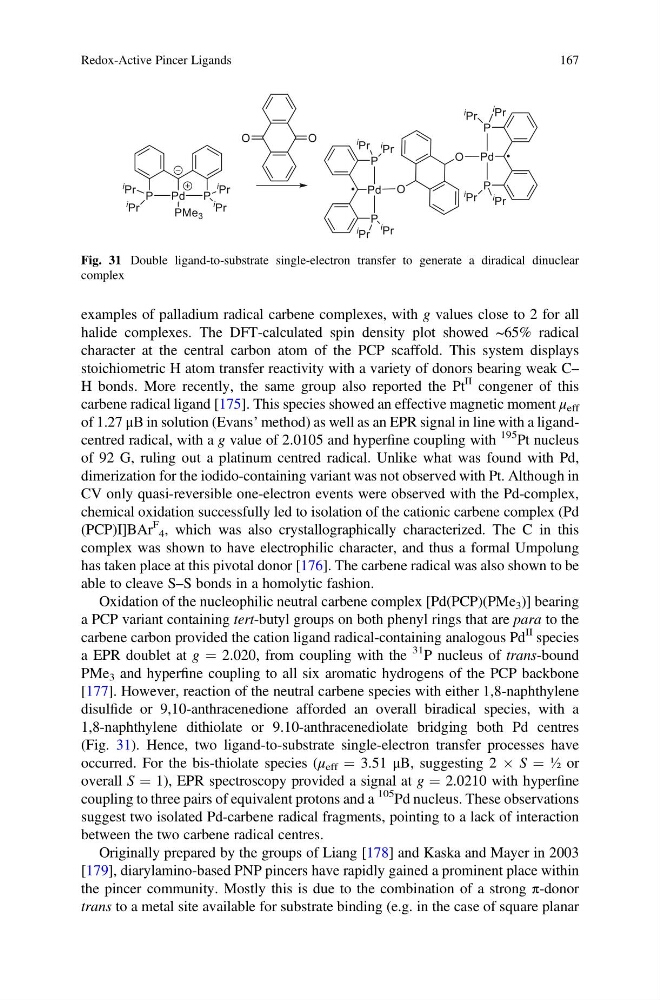
[177]. However, reaction of the neutral carbene species with either 1,8-naphthylene
disulfide or 9,10-anthracenedione afforded an overall biradical species, with a
1,8-naphthylene dithiolate or 9.10-anthracenediolate bridging both Pd centres
(Fig. 31). Hence, two ligand-to-substrate single-electron transfer processes have
occurred. For the bis-thiolate species (μ eff ¼ 3.51 μB, suggesting 2 Â S ¼ ½ or
overall S ¼ 1), EPR spectroscopy provided a signal at g ¼ 2.0210 with hyperfine
coupling to three pairs of equivalent protons and a
105
Pd nucleus. These observations
suggest two isolated Pd-carbene radical fragments, pointing to a lack of interaction
between the two carbene radical centres.
Originally prepared by the groups of Liang [178] and Kaska and Mayer in 2003
[179], diarylamino-based PNP pincers have rapidly gained a prominent place within
the pincer community. Mostly this is due to the combination of a strong π-donor
trans to a metal site available for substrate binding (e.g. in the case of square planar
Fig. 31 Double ligand-to-substrate single-electron transfer to generate a diradical dinuclear
complex
Redox-Active Pincer Ligands
167
halide complexes. The DFT-calculated spin density plot showed ~65% radical
character at the central carbon atom of the PCP scaffold. This system displays
stoichiometric H atom transfer reactivity with a variety of donors bearing weak C–
H bonds. More recently, the same group also reported the Pt
II congener of this
carbene radical ligand [175]. This species showed an effective magnetic moment μ eff
of 1.27 μΒ in solution (Evans’ method) as well as an EPR signal in line with a ligandcentred radical, with a g value of 2.0105 and hyperfine coupling with
195 Pt nucleus
of 92 G, ruling out a platinum centred radical. Unlike what was found with Pd,
dimerization for the iodido-containing variant was not observed with Pt. Although in
CV only quasi-reversible one-electron events were observed with the Pd-complex,
chemical oxidation successfully led to isolation of the cationic carbene complex (Pd
(PCP)I]BAr
F
4 , which was also crystallographically characterized. The C in this
complex was shown to have electrophilic character, and thus a formal Umpolung
has taken place at this pivotal donor [176]. The carbene radical was also shown to be
able to cleave S–S bonds in a homolytic fashion.
Oxidation of the nucleophilic neutral carbene complex [Pd(PCP)(PMe 3 )] bearing
a PCP variant containing tert-butyl groups on both phenyl rings that are para to the
carbene carbon provided the cation ligand radical-containing analogous Pd
II species
a EPR doublet at g ¼ 2.020, from coupling with the
31 P nucleus of trans-bound
PMe 3 and hyperfine coupling to all six aromatic hydrogens of the PCP backbone
[177]. However, reaction of the neutral carbene species with either 1,8-naphthylene
disulfide or 9,10-anthracenedione afforded an overall biradical species, with a
1,8-naphthylene dithiolate or 9.10-anthracenediolate bridging both Pd centres
(Fig. 31). Hence, two ligand-to-substrate single-electron transfer processes have
occurred. For the bis-thiolate species (μ eff ¼ 3.51 μB, suggesting 2 Â S ¼ ½ or
overall S ¼ 1), EPR spectroscopy provided a signal at g ¼ 2.0210 with hyperfine
coupling to three pairs of equivalent protons and a
105
Pd nucleus. These observations
suggest two isolated Pd-carbene radical fragments, pointing to a lack of interaction
between the two carbene radical centres.
Originally prepared by the groups of Liang [178] and Kaska and Mayer in 2003
[179], diarylamino-based PNP pincers have rapidly gained a prominent place within
the pincer community. Mostly this is due to the combination of a strong π-donor
trans to a metal site available for substrate binding (e.g. in the case of square planar
Fig. 31 Double ligand-to-substrate single-electron transfer to generate a diradical dinuclear
complex
Redox-Active Pincer Ligands
167