

reversible oxidation processes at +0.46 V and +0.93 V vs. Fc/Fc
+ by CV, which were
both assigned to occur at the ligand, based on similarity with the NHC-based OCO
system.
Although originally starting from a bis(arylazo)pyrrolide scaffold, which was
expected to exhibit only ligand-centred reduction chemistry, Pramanik and coworkers established that coordination to Rh
III
Cl 3 led to oxygenation of one of the
side arm aryl groups, converting the NNN pincer into a preferential dianionic NNO
pincer, wherein the phenolate fragment displayed ligand-centred oxidation
chemistry [169].
3.3 Monoanionic Pincer Ligands
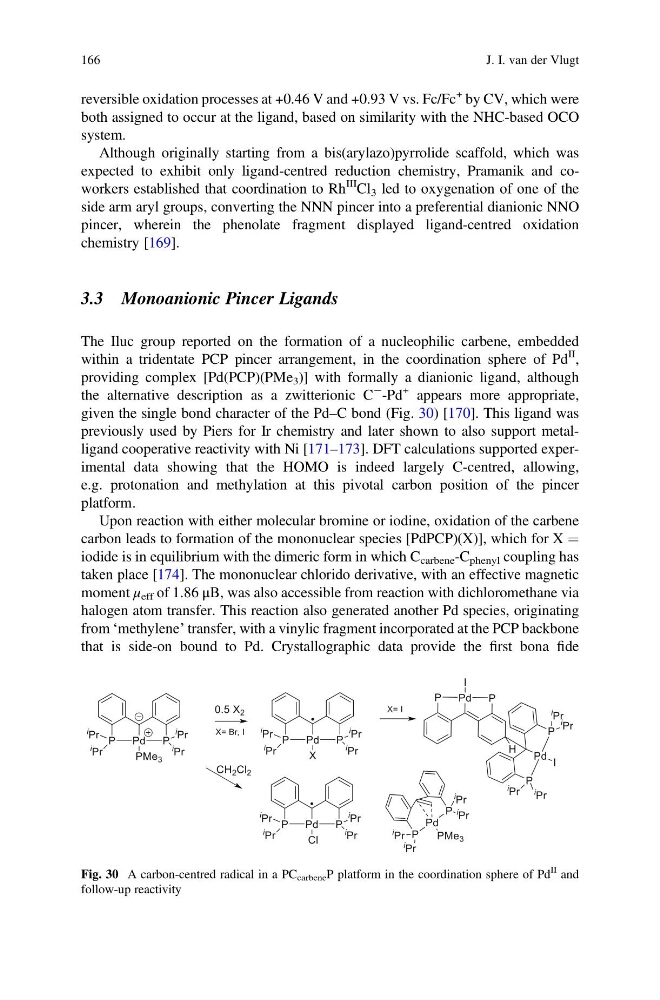
The Iluc group reported on the formation of a nucleophilic carbene, embedded
within a tridentate PCP pincer arrangement, in the coordination sphere of Pd
II ,
providing complex [Pd(PCP)(PMe 3 )] with formally a dianionic ligand, although
the alternative description as a zwitterionic C
À -Pd
+ appears more appropriate,
given the single bond character of the Pd–C bond (Fig. 30) [170]. This ligand was
previously used by Piers for Ir chemistry and later shown to also support metalligand cooperative reactivity with Ni [171–173]. DFT calculations supported experimental data showing that the HOMO is indeed largely C-centred, allowing,
e.g. protonation and methylation at this pivotal carbon position of the pincer
platform.
Upon reaction with either molecular bromine or iodine, oxidation of the carbene
carbon leads to formation of the mononuclear species [PdPCP)(X)], which for X ¼
iodide is in equilibrium with the dimeric form in which C carbene -C phenyl coupling has
taken place [174]. The mononuclear chlorido derivative, with an effective magnetic
moment μ eff of 1.86 μB, was also accessible from reaction with dichloromethane via
halogen atom transfer. This reaction also generated another Pd species, originating
from ‘methylene’ transfer, with a vinylic fragment incorporated at the PCP backbone
that is side-on bound to Pd. Crystallographic data provide the first bona fide
Fig. 30 A carbon-centred radical in a PC carbene P platform in the coordination sphere of Pd
II and
follow-up reactivity
166
J. I. van der Vlugt
+ by CV, which were
both assigned to occur at the ligand, based on similarity with the NHC-based OCO
system.
Although originally starting from a bis(arylazo)pyrrolide scaffold, which was
expected to exhibit only ligand-centred reduction chemistry, Pramanik and coworkers established that coordination to Rh
III
Cl 3 led to oxygenation of one of the
side arm aryl groups, converting the NNN pincer into a preferential dianionic NNO
pincer, wherein the phenolate fragment displayed ligand-centred oxidation
chemistry [169].
3.3 Monoanionic Pincer Ligands
The Iluc group reported on the formation of a nucleophilic carbene, embedded
within a tridentate PCP pincer arrangement, in the coordination sphere of Pd
II ,
providing complex [Pd(PCP)(PMe 3 )] with formally a dianionic ligand, although
the alternative description as a zwitterionic C
À -Pd
+ appears more appropriate,
given the single bond character of the Pd–C bond (Fig. 30) [170]. This ligand was
previously used by Piers for Ir chemistry and later shown to also support metalligand cooperative reactivity with Ni [171–173]. DFT calculations supported experimental data showing that the HOMO is indeed largely C-centred, allowing,
e.g. protonation and methylation at this pivotal carbon position of the pincer
platform.
Upon reaction with either molecular bromine or iodine, oxidation of the carbene
carbon leads to formation of the mononuclear species [PdPCP)(X)], which for X ¼
iodide is in equilibrium with the dimeric form in which C carbene -C phenyl coupling has
taken place [174]. The mononuclear chlorido derivative, with an effective magnetic
moment μ eff of 1.86 μB, was also accessible from reaction with dichloromethane via
halogen atom transfer. This reaction also generated another Pd species, originating
from ‘methylene’ transfer, with a vinylic fragment incorporated at the PCP backbone
that is side-on bound to Pd. Crystallographic data provide the first bona fide
Fig. 30 A carbon-centred radical in a PC carbene P platform in the coordination sphere of Pd
II and
follow-up reactivity
166
J. I. van der Vlugt