

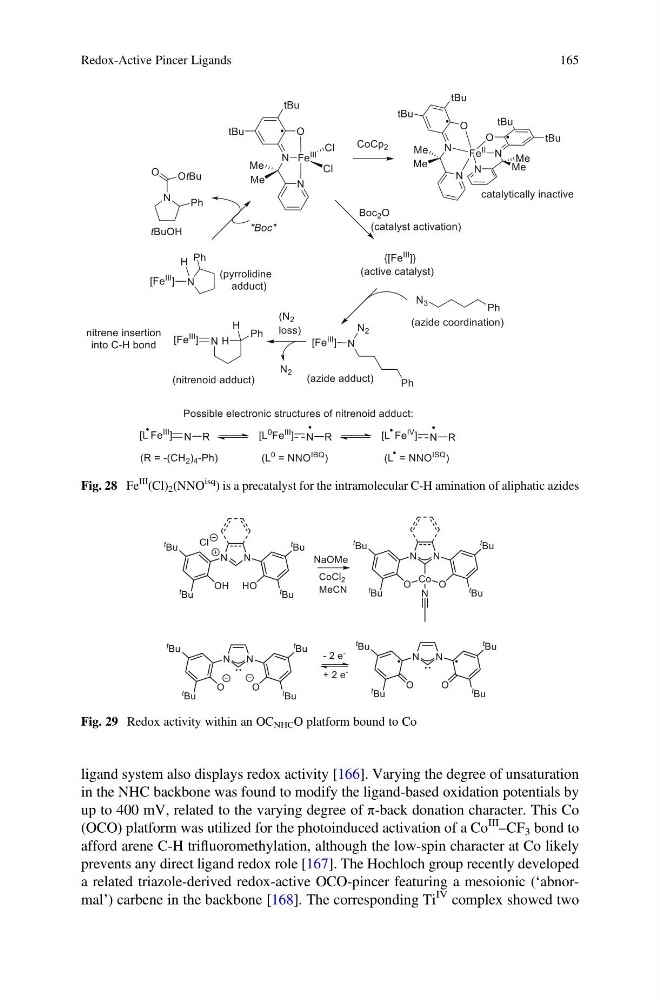
ligand system also displays redox activity [166]. Varying the degree of unsaturation
in the NHC backbone was found to modify the ligand-based oxidation potentials by
up to 400 mV, related to the varying degree of π-back donation character. This Co
(OCO) platform was utilized for the photoinduced activation of a Co
III
–CF 3 bond to
afford arene C-H trifluoromethylation, although the low-spin character at Co likely
prevents any direct ligand redox role [167]. The Hochloch group recently developed
a related triazole-derived redox-active OCO-pincer featuring a mesoionic (‘abnormal’) carbene in the backbone [168]. The corresponding Ti
IV complex showed two
Fig. 28 Fe
III
(Cl) 2 (NNO
isq ) is a precatalyst for the intramolecular C-H amination of aliphatic azides
Fig. 29 Redox activity within an OC NHC O platform bound to Co
Redox-Active Pincer Ligands
165
in the NHC backbone was found to modify the ligand-based oxidation potentials by
up to 400 mV, related to the varying degree of π-back donation character. This Co
(OCO) platform was utilized for the photoinduced activation of a Co
III
–CF 3 bond to
afford arene C-H trifluoromethylation, although the low-spin character at Co likely
prevents any direct ligand redox role [167]. The Hochloch group recently developed
a related triazole-derived redox-active OCO-pincer featuring a mesoionic (‘abnormal’) carbene in the backbone [168]. The corresponding Ti
IV complex showed two
Fig. 28 Fe
III
(Cl) 2 (NNO
isq ) is a precatalyst for the intramolecular C-H amination of aliphatic azides
Fig. 29 Redox activity within an OC NHC O platform bound to Co
Redox-Active Pincer Ligands
165