

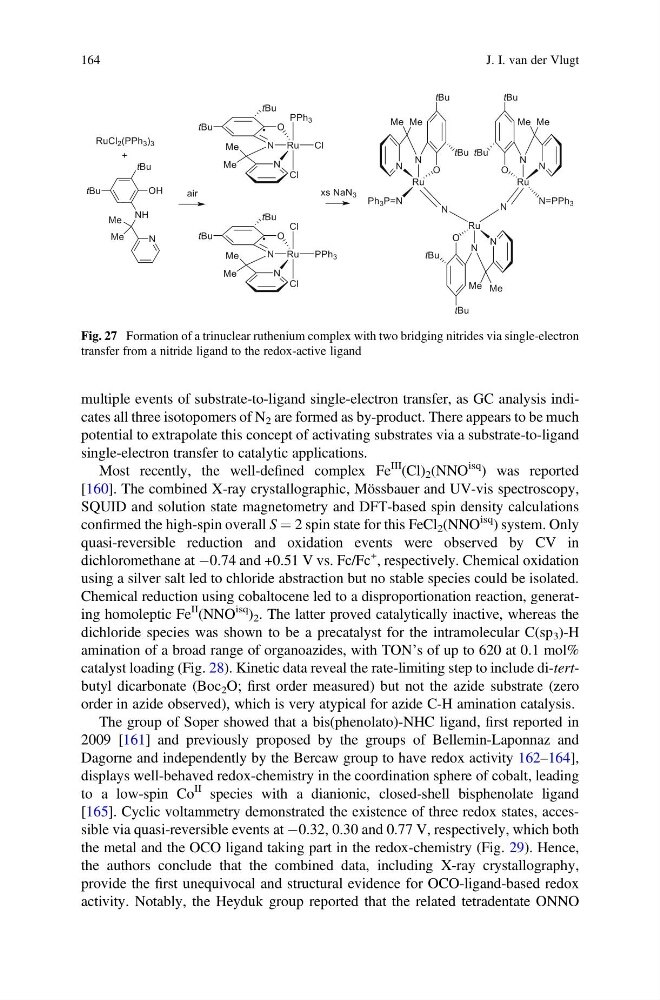
multiple events of substrate-to-ligand single-electron transfer, as GC analysis indicates all three isotopomers of N 2 are formed as by-product. There appears to be much
potential to extrapolate this concept of activating substrates via a substrate-to-ligand
single-electron transfer to catalytic applications.
Most recently, the well-defined complex Fe
III (Cl) 2 (NNO
isq
) was reported
[160]. The combined X-ray crystallographic, Mössbauer and UV-vis spectroscopy,
SQUID and solution state magnetometry and DFT-based spin density calculations
confirmed the high-spin overall S ¼ 2 spin state for this FeCl 2 (NNO
isq
) system. Only
quasi-reversible reduction and oxidation events were observed by CV in
dichloromethane at À0.74 and +0.51 V vs. Fc/Fc
+
, respectively. Chemical oxidation
using a silver salt led to chloride abstraction but no stable species could be isolated.
Chemical reduction using cobaltocene led to a disproportionation reaction, generating homoleptic Fe
II (NNO
isq
) 2 . The latter proved catalytically inactive, whereas the
dichloride species was shown to be a precatalyst for the intramolecular C(sp 3 )-H
amination of a broad range of organoazides, with TON’s of up to 620 at 0.1 mol%
catalyst loading (Fig. 28). Kinetic data reveal the rate-limiting step to include di-tertbutyl dicarbonate (Boc 2 O; first order measured) but not the azide substrate (zero
order in azide observed), which is very atypical for azide C-H amination catalysis.
The group of Soper showed that a bis(phenolato)-NHC ligand, first reported in
2009 [161] and previously proposed by the groups of Bellemin-Laponnaz and
Dagorne and independently by the Bercaw group to have redox activity 162–164],
displays well-behaved redox-chemistry in the coordination sphere of cobalt, leading
to a low-spin Co
II species with a dianionic, closed-shell bisphenolate ligand
[165]. Cyclic voltammetry demonstrated the existence of three redox states, accessible via quasi-reversible events at À0.32, 0.30 and 0.77 V, respectively, which both
the metal and the OCO ligand taking part in the redox-chemistry (Fig. 29). Hence,
the authors conclude that the combined data, including X-ray crystallography,
provide the first unequivocal and structural evidence for OCO-ligand-based redox
activity. Notably, the Heyduk group reported that the related tetradentate ONNO
Fig. 27 Formation of a trinuclear ruthenium complex with two bridging nitrides via single-electron
transfer from a nitride ligand to the redox-active ligand
164
J. I. van der Vlugt
potential to extrapolate this concept of activating substrates via a substrate-to-ligand
single-electron transfer to catalytic applications.
Most recently, the well-defined complex Fe
III (Cl) 2 (NNO
isq
) was reported
[160]. The combined X-ray crystallographic, Mössbauer and UV-vis spectroscopy,
SQUID and solution state magnetometry and DFT-based spin density calculations
confirmed the high-spin overall S ¼ 2 spin state for this FeCl 2 (NNO
isq
) system. Only
quasi-reversible reduction and oxidation events were observed by CV in
dichloromethane at À0.74 and +0.51 V vs. Fc/Fc
+
, respectively. Chemical oxidation
using a silver salt led to chloride abstraction but no stable species could be isolated.
Chemical reduction using cobaltocene led to a disproportionation reaction, generating homoleptic Fe
II (NNO
isq
) 2 . The latter proved catalytically inactive, whereas the
dichloride species was shown to be a precatalyst for the intramolecular C(sp 3 )-H
amination of a broad range of organoazides, with TON’s of up to 620 at 0.1 mol%
catalyst loading (Fig. 28). Kinetic data reveal the rate-limiting step to include di-tertbutyl dicarbonate (Boc 2 O; first order measured) but not the azide substrate (zero
order in azide observed), which is very atypical for azide C-H amination catalysis.
The group of Soper showed that a bis(phenolato)-NHC ligand, first reported in
2009 [161] and previously proposed by the groups of Bellemin-Laponnaz and
Dagorne and independently by the Bercaw group to have redox activity 162–164],
displays well-behaved redox-chemistry in the coordination sphere of cobalt, leading
to a low-spin Co
II species with a dianionic, closed-shell bisphenolate ligand
[165]. Cyclic voltammetry demonstrated the existence of three redox states, accessible via quasi-reversible events at À0.32, 0.30 and 0.77 V, respectively, which both
the metal and the OCO ligand taking part in the redox-chemistry (Fig. 29). Hence,
the authors conclude that the combined data, including X-ray crystallography,
provide the first unequivocal and structural evidence for OCO-ligand-based redox
activity. Notably, the Heyduk group reported that the related tetradentate ONNO
Fig. 27 Formation of a trinuclear ruthenium complex with two bridging nitrides via single-electron
transfer from a nitride ligand to the redox-active ligand
164
J. I. van der Vlugt