

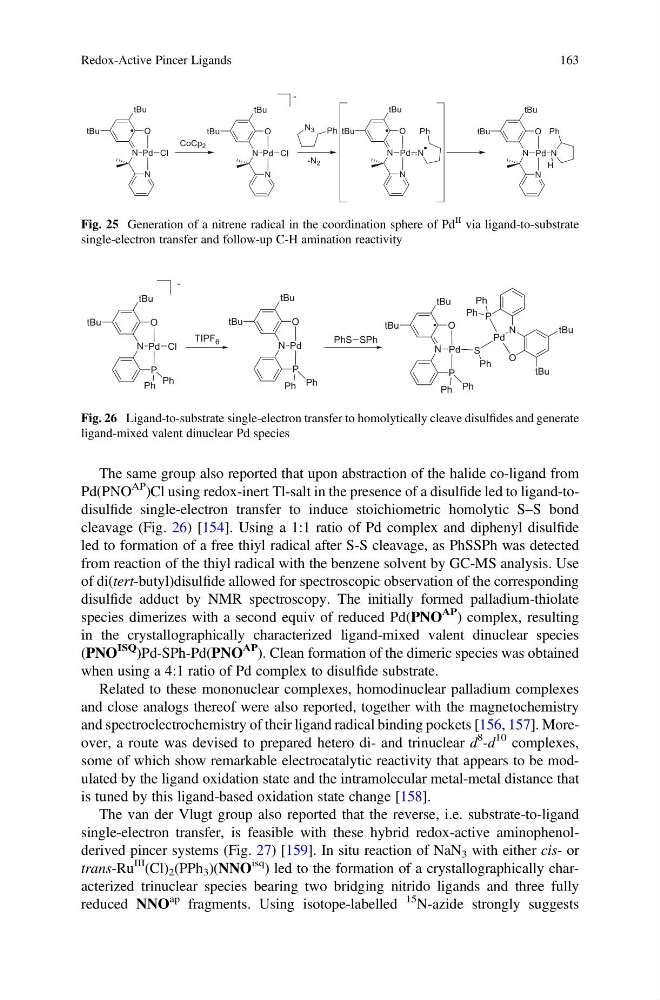
The same group also reported that upon abstraction of the halide co-ligand from
Pd(PNO
AP )Cl using redox-inert Tl-salt in the presence of a disulfide led to ligand-todisulfide single-electron transfer to induce stoichiometric homolytic S–S bond
cleavage (Fig. 26) [154]. Using a 1:1 ratio of Pd complex and diphenyl disulfide
led to formation of a free thiyl radical after S-S cleavage, as PhSSPh was detected
from reaction of the thiyl radical with the benzene solvent by GC-MS analysis. Use
of di(tert-butyl)disulfide allowed for spectroscopic observation of the corresponding
disulfide adduct by NMR spectroscopy. The initially formed palladium-thiolate
species dimerizes with a second equiv of reduced Pd(PNO
AP
) complex, resulting
in the crystallographically characterized ligand-mixed valent dinuclear species
(PNO
ISQ )Pd-SPh-Pd(PNO
AP
). Clean formation of the dimeric species was obtained
when using a 4:1 ratio of Pd complex to disulfide substrate.
Related to these mononuclear complexes, homodinuclear palladium complexes
and close analogs thereof were also reported, together with the magnetochemistry
and spectroelectrochemistry of their ligand radical binding pockets [156, 157]. Moreover, a route was devised to prepared hetero di- and trinuclear d
8 -d
10 complexes,
some of which show remarkable electrocatalytic reactivity that appears to be modulated by the ligand oxidation state and the intramolecular metal-metal distance that
is tuned by this ligand-based oxidation state change [158].
The van der Vlugt group also reported that the reverse, i.e. substrate-to-ligand
single-electron transfer, is feasible with these hybrid redox-active aminophenolderived pincer systems (Fig. 27) [159]. In situ reaction of NaN 3 with either cis- or
trans-Ru
III (Cl) 2 (PPh 3 )(NNO
isq ) led to the formation of a crystallographically characterized trinuclear species bearing two bridging nitrido ligands and three fully
reduced NNO
ap fragments. Using isotope-labelled
15 N-azide strongly suggests
Fig. 25 Generation of a nitrene radical in the coordination sphere of Pd
II via ligand-to-substrate
single-electron transfer and follow-up C-H amination reactivity
Pd
O
N
tBu
tBu
Cl
TIPF 6
Ph
Ph
Pd
O
N
tBu
tBu
Ph Ph
P
SPh
P
O
N
tBu
tBu
Ph
Ph P
Pd
O
N
P
tBu
tBu
Ph Ph
S
Ph
Pd
-
PhS
Fig. 26 Ligand-to-substrate single-electron transfer to homolytically cleave disulfides and generate
ligand-mixed valent dinuclear Pd species
Redox-Active Pincer Ligands
163
Pd(PNO
AP )Cl using redox-inert Tl-salt in the presence of a disulfide led to ligand-todisulfide single-electron transfer to induce stoichiometric homolytic S–S bond
cleavage (Fig. 26) [154]. Using a 1:1 ratio of Pd complex and diphenyl disulfide
led to formation of a free thiyl radical after S-S cleavage, as PhSSPh was detected
from reaction of the thiyl radical with the benzene solvent by GC-MS analysis. Use
of di(tert-butyl)disulfide allowed for spectroscopic observation of the corresponding
disulfide adduct by NMR spectroscopy. The initially formed palladium-thiolate
species dimerizes with a second equiv of reduced Pd(PNO
AP
) complex, resulting
in the crystallographically characterized ligand-mixed valent dinuclear species
(PNO
ISQ )Pd-SPh-Pd(PNO
AP
). Clean formation of the dimeric species was obtained
when using a 4:1 ratio of Pd complex to disulfide substrate.
Related to these mononuclear complexes, homodinuclear palladium complexes
and close analogs thereof were also reported, together with the magnetochemistry
and spectroelectrochemistry of their ligand radical binding pockets [156, 157]. Moreover, a route was devised to prepared hetero di- and trinuclear d
8 -d
10 complexes,
some of which show remarkable electrocatalytic reactivity that appears to be modulated by the ligand oxidation state and the intramolecular metal-metal distance that
is tuned by this ligand-based oxidation state change [158].
The van der Vlugt group also reported that the reverse, i.e. substrate-to-ligand
single-electron transfer, is feasible with these hybrid redox-active aminophenolderived pincer systems (Fig. 27) [159]. In situ reaction of NaN 3 with either cis- or
trans-Ru
III (Cl) 2 (PPh 3 )(NNO
isq ) led to the formation of a crystallographically characterized trinuclear species bearing two bridging nitrido ligands and three fully
reduced NNO
ap fragments. Using isotope-labelled
15 N-azide strongly suggests
Fig. 25 Generation of a nitrene radical in the coordination sphere of Pd
II via ligand-to-substrate
single-electron transfer and follow-up C-H amination reactivity
Pd
O
N
tBu
tBu
Cl
TIPF 6
Ph
Ph
Pd
O
N
tBu
tBu
Ph Ph
P
SPh
P
O
N
tBu
tBu
Ph
Ph P
Pd
O
N
P
tBu
tBu
Ph Ph
S
Ph
Pd
-
PhS
Fig. 26 Ligand-to-substrate single-electron transfer to homolytically cleave disulfides and generate
ligand-mixed valent dinuclear Pd species
Redox-Active Pincer Ligands
163