

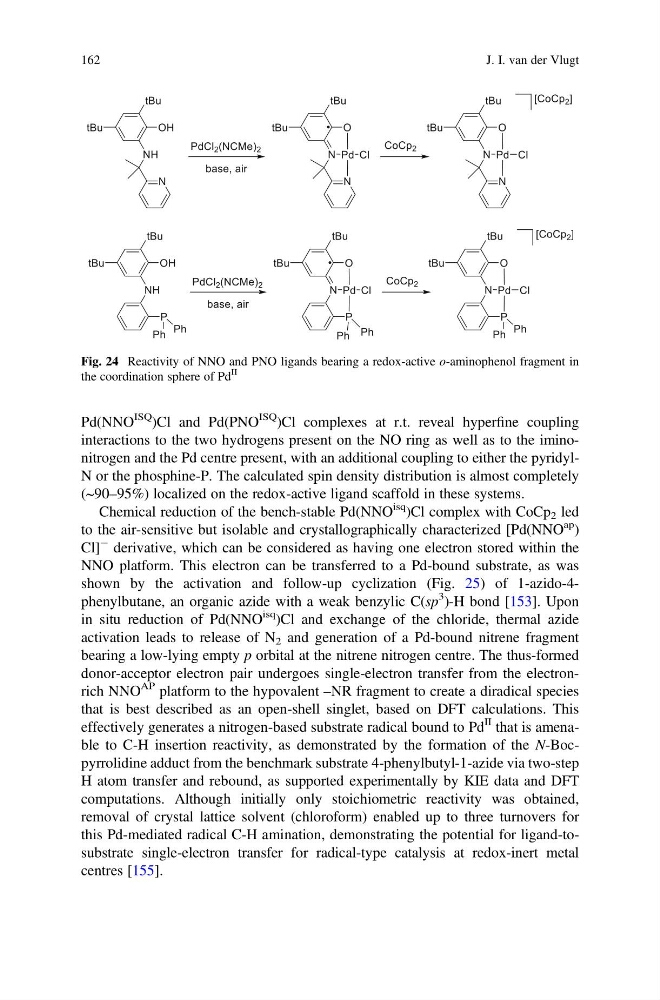
Pd(NNO
ISQ )Cl and Pd(PNO
ISQ )Cl complexes at r.t. reveal hyperfine coupling
interactions to the two hydrogens present on the NO ring as well as to the iminonitrogen and the Pd centre present, with an additional coupling to either the pyridylN or the phosphine-P. The calculated spin density distribution is almost completely
(~90–95%) localized on the redox-active ligand scaffold in these systems.
Chemical reduction of the bench-stable Pd(NNO
isq )Cl complex with CoCp 2 led
to the air-sensitive but isolable and crystallographically characterized [Pd(NNO
ap )
Cl]
À derivative, which can be considered as having one electron stored within the
NNO platform. This electron can be transferred to a Pd-bound substrate, as was
shown by the activation and follow-up cyclization (Fig. 25) of 1-azido-4phenylbutane, an organic azide with a weak benzylic C(sp
3 )-H bond [153]. Upon
in situ reduction of Pd(NNO
isq )Cl and exchange of the chloride, thermal azide
activation leads to release of N 2 and generation of a Pd-bound nitrene fragment
bearing a low-lying empty p orbital at the nitrene nitrogen centre. The thus-formed
donor-acceptor electron pair undergoes single-electron transfer from the electronrich NNO
AP platform to the hypovalent –NR fragment to create a diradical species
that is best described as an open-shell singlet, based on DFT calculations. This
effectively generates a nitrogen-based substrate radical bound to Pd
II that is amenable to C-H insertion reactivity, as demonstrated by the formation of the N-Bocpyrrolidine adduct from the benchmark substrate 4-phenylbutyl-1-azide via two-step
H atom transfer and rebound, as supported experimentally by KIE data and DFT
computations. Although initially only stoichiometric reactivity was obtained,
removal of crystal lattice solvent (chloroform) enabled up to three turnovers for
this Pd-mediated radical C-H amination, demonstrating the potential for ligand-tosubstrate single-electron transfer for radical-type catalysis at redox-inert metal
centres [155].
Fig. 24 Reactivity of NNO and PNO ligands bearing a redox-active o-aminophenol fragment in
the coordination sphere of Pd
II
162
J. I. van der Vlugt
ISQ )Cl and Pd(PNO
ISQ )Cl complexes at r.t. reveal hyperfine coupling
interactions to the two hydrogens present on the NO ring as well as to the iminonitrogen and the Pd centre present, with an additional coupling to either the pyridylN or the phosphine-P. The calculated spin density distribution is almost completely
(~90–95%) localized on the redox-active ligand scaffold in these systems.
Chemical reduction of the bench-stable Pd(NNO
isq )Cl complex with CoCp 2 led
to the air-sensitive but isolable and crystallographically characterized [Pd(NNO
ap )
Cl]
À derivative, which can be considered as having one electron stored within the
NNO platform. This electron can be transferred to a Pd-bound substrate, as was
shown by the activation and follow-up cyclization (Fig. 25) of 1-azido-4phenylbutane, an organic azide with a weak benzylic C(sp
3 )-H bond [153]. Upon
in situ reduction of Pd(NNO
isq )Cl and exchange of the chloride, thermal azide
activation leads to release of N 2 and generation of a Pd-bound nitrene fragment
bearing a low-lying empty p orbital at the nitrene nitrogen centre. The thus-formed
donor-acceptor electron pair undergoes single-electron transfer from the electronrich NNO
AP platform to the hypovalent –NR fragment to create a diradical species
that is best described as an open-shell singlet, based on DFT calculations. This
effectively generates a nitrogen-based substrate radical bound to Pd
II that is amenable to C-H insertion reactivity, as demonstrated by the formation of the N-Bocpyrrolidine adduct from the benchmark substrate 4-phenylbutyl-1-azide via two-step
H atom transfer and rebound, as supported experimentally by KIE data and DFT
computations. Although initially only stoichiometric reactivity was obtained,
removal of crystal lattice solvent (chloroform) enabled up to three turnovers for
this Pd-mediated radical C-H amination, demonstrating the potential for ligand-tosubstrate single-electron transfer for radical-type catalysis at redox-inert metal
centres [155].
Fig. 24 Reactivity of NNO and PNO ligands bearing a redox-active o-aminophenol fragment in
the coordination sphere of Pd
II
162
J. I. van der Vlugt