

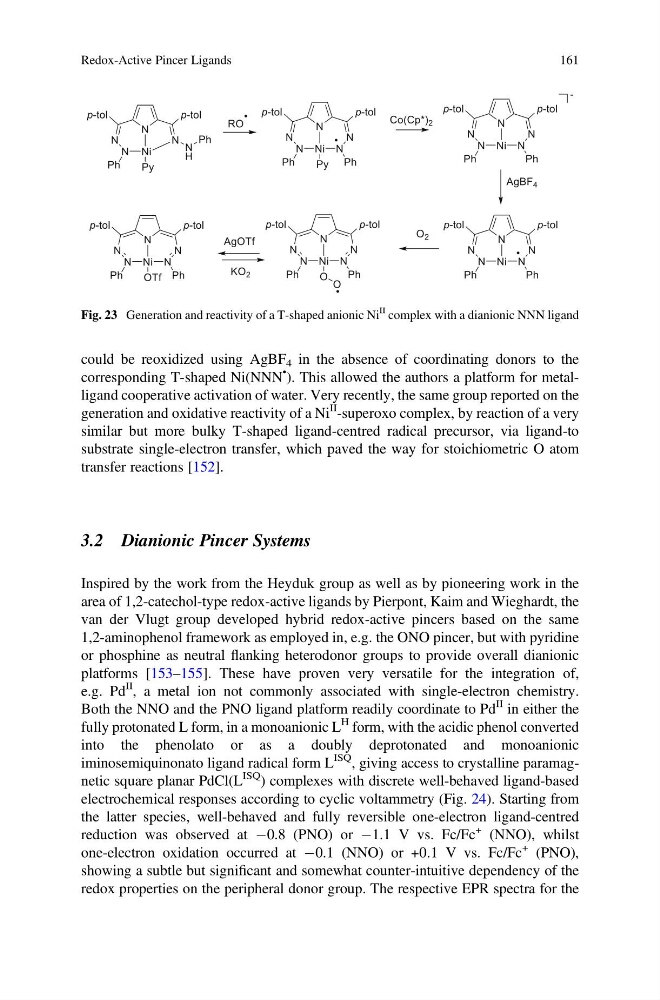
could be reoxidized using AgBF 4 in the absence of coordinating donors to the
corresponding T-shaped Ni(NNN
•
). This allowed the authors a platform for metalligand cooperative activation of water. Very recently, the same group reported on the
generation and oxidative reactivity of a Ni
II -superoxo complex, by reaction of a very
similar but more bulky T-shaped ligand-centred radical precursor, via ligand-to
substrate single-electron transfer, which paved the way for stoichiometric O atom
transfer reactions [152].
3.2 Dianionic Pincer Systems
Inspired by the work from the Heyduk group as well as by pioneering work in the
area of 1,2-catechol-type redox-active ligands by Pierpont, Kaim and Wieghardt, the
van der Vlugt group developed hybrid redox-active pincers based on the same
1,2-aminophenol framework as employed in, e.g. the ONO pincer, but with pyridine
or phosphine as neutral flanking heterodonor groups to provide overall dianionic
platforms [153–155]. These have proven very versatile for the integration of,
e.g. Pd
II , a metal ion not commonly associated with single-electron chemistry.
Both the NNO and the PNO ligand platform readily coordinate to Pd
II in either the
fully protonated L form, in a monoanionic L
H form, with the acidic phenol converted
into the phenolato or as a doubly deprotonated and monoanionic
iminosemiquinonato ligand radical form L
ISQ , giving access to crystalline paramagnetic square planar PdCl(L
ISQ ) complexes with discrete well-behaved ligand-based
electrochemical responses according to cyclic voltammetry (Fig. 24). Starting from
the latter species, well-behaved and fully reversible one-electron ligand-centred
reduction was observed at À0.8 (PNO) or À1.1 V vs. Fc/Fc
+ (NNO), whilst
one-electron oxidation occurred at À0.1 (NNO) or +0.1 V vs. Fc/Fc
+ (PNO),
showing a subtle but significant and somewhat counter-intuitive dependency of the
redox properties on the peripheral donor group. The respective EPR spectra for the
Fig. 23 Generation and reactivity of a T-shaped anionic Ni
II complex with a dianionic NNN ligand
Redox-Active Pincer Ligands
161
corresponding T-shaped Ni(NNN
•
). This allowed the authors a platform for metalligand cooperative activation of water. Very recently, the same group reported on the
generation and oxidative reactivity of a Ni
II -superoxo complex, by reaction of a very
similar but more bulky T-shaped ligand-centred radical precursor, via ligand-to
substrate single-electron transfer, which paved the way for stoichiometric O atom
transfer reactions [152].
3.2 Dianionic Pincer Systems
Inspired by the work from the Heyduk group as well as by pioneering work in the
area of 1,2-catechol-type redox-active ligands by Pierpont, Kaim and Wieghardt, the
van der Vlugt group developed hybrid redox-active pincers based on the same
1,2-aminophenol framework as employed in, e.g. the ONO pincer, but with pyridine
or phosphine as neutral flanking heterodonor groups to provide overall dianionic
platforms [153–155]. These have proven very versatile for the integration of,
e.g. Pd
II , a metal ion not commonly associated with single-electron chemistry.
Both the NNO and the PNO ligand platform readily coordinate to Pd
II in either the
fully protonated L form, in a monoanionic L
H form, with the acidic phenol converted
into the phenolato or as a doubly deprotonated and monoanionic
iminosemiquinonato ligand radical form L
ISQ , giving access to crystalline paramagnetic square planar PdCl(L
ISQ ) complexes with discrete well-behaved ligand-based
electrochemical responses according to cyclic voltammetry (Fig. 24). Starting from
the latter species, well-behaved and fully reversible one-electron ligand-centred
reduction was observed at À0.8 (PNO) or À1.1 V vs. Fc/Fc
+ (NNO), whilst
one-electron oxidation occurred at À0.1 (NNO) or +0.1 V vs. Fc/Fc
+ (PNO),
showing a subtle but significant and somewhat counter-intuitive dependency of the
redox properties on the peripheral donor group. The respective EPR spectra for the
Fig. 23 Generation and reactivity of a T-shaped anionic Ni
II complex with a dianionic NNN ligand
Redox-Active Pincer Ligands
161