

ligand-based chemo- and electro-oxidation chemistry, with all three redox states of
the ligand X-ray crystallographically characterized and the ligand radical species
exhibiting a single line centred at g ¼ 2.003 in the EPR spectrum [146]. The majority
of the spin density as well as the SOMO are localized on the central pyrrole as well as
on the C-C π system of the two pyrrolidone flanking rings. Additionally, the dione
fragments allow for H bonding to the ancillary ligand.
Follow-up work including also the structurally related Cu
II (NNN
•À
)(OH 2 ) analog
revealed that in solution, the neutral tripyrrindione complexes dimerize, based on
EPR and UV-vis spectroscopy. Variable-temperature measurements using both EPR
and absorption techniques allowed for the determination of the thermodynamic
parameters of this π-dimerization, which resembles the process occurring with
porphyrin radical cations. The inferred electronic structure, featuring coupling of
ligand-based electronic spins in the π-dimers, was supported by DFT
calculations [147].
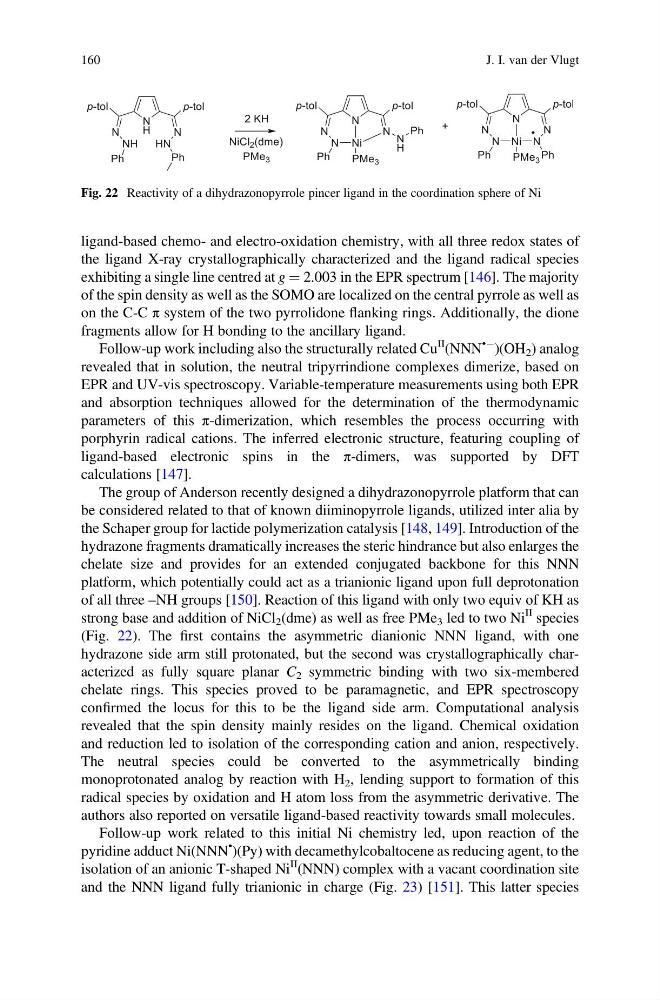
The group of Anderson recently designed a dihydrazonopyrrole platform that can
be considered related to that of known diiminopyrrole ligands, utilized inter alia by
the Schaper group for lactide polymerization catalysis [148, 149]. Introduction of the
hydrazone fragments dramatically increases the steric hindrance but also enlarges the
chelate size and provides for an extended conjugated backbone for this NNN
platform, which potentially could act as a trianionic ligand upon full deprotonation
of all three –NH groups [150]. Reaction of this ligand with only two equiv of KH as
strong base and addition of NiCl 2 (dme) as well as free PMe 3 led to two Ni
II species
(Fig. 22). The first contains the asymmetric dianionic NNN ligand, with one
hydrazone side arm still protonated, but the second was crystallographically characterized as fully square planar C 2 symmetric binding with two six-membered
chelate rings. This species proved to be paramagnetic, and EPR spectroscopy
confirmed the locus for this to be the ligand side arm. Computational analysis
revealed that the spin density mainly resides on the ligand. Chemical oxidation
and reduction led to isolation of the corresponding cation and anion, respectively.
The neutral species could be converted to the asymmetrically binding
monoprotonated analog by reaction with H 2 , lending support to formation of this
radical species by oxidation and H atom loss from the asymmetric derivative. The
authors also reported on versatile ligand-based reactivity towards small molecules.
Follow-up work related to this initial Ni chemistry led, upon reaction of the
pyridine adduct Ni(NNN
•
)(Py) with decamethylcobaltocene as reducing agent, to the
isolation of an anionic T-shaped Ni
II (NNN) complex with a vacant coordination site
and the NNN ligand fully trianionic in charge (Fig. 23) [151]. This latter species
Fig. 22 Reactivity of a dihydrazonopyrrole pincer ligand in the coordination sphere of Ni
160
J. I. van der Vlugt
the ligand X-ray crystallographically characterized and the ligand radical species
exhibiting a single line centred at g ¼ 2.003 in the EPR spectrum [146]. The majority
of the spin density as well as the SOMO are localized on the central pyrrole as well as
on the C-C π system of the two pyrrolidone flanking rings. Additionally, the dione
fragments allow for H bonding to the ancillary ligand.
Follow-up work including also the structurally related Cu
II (NNN
•À
)(OH 2 ) analog
revealed that in solution, the neutral tripyrrindione complexes dimerize, based on
EPR and UV-vis spectroscopy. Variable-temperature measurements using both EPR
and absorption techniques allowed for the determination of the thermodynamic
parameters of this π-dimerization, which resembles the process occurring with
porphyrin radical cations. The inferred electronic structure, featuring coupling of
ligand-based electronic spins in the π-dimers, was supported by DFT
calculations [147].
The group of Anderson recently designed a dihydrazonopyrrole platform that can
be considered related to that of known diiminopyrrole ligands, utilized inter alia by
the Schaper group for lactide polymerization catalysis [148, 149]. Introduction of the
hydrazone fragments dramatically increases the steric hindrance but also enlarges the
chelate size and provides for an extended conjugated backbone for this NNN
platform, which potentially could act as a trianionic ligand upon full deprotonation
of all three –NH groups [150]. Reaction of this ligand with only two equiv of KH as
strong base and addition of NiCl 2 (dme) as well as free PMe 3 led to two Ni
II species
(Fig. 22). The first contains the asymmetric dianionic NNN ligand, with one
hydrazone side arm still protonated, but the second was crystallographically characterized as fully square planar C 2 symmetric binding with two six-membered
chelate rings. This species proved to be paramagnetic, and EPR spectroscopy
confirmed the locus for this to be the ligand side arm. Computational analysis
revealed that the spin density mainly resides on the ligand. Chemical oxidation
and reduction led to isolation of the corresponding cation and anion, respectively.
The neutral species could be converted to the asymmetrically binding
monoprotonated analog by reaction with H 2 , lending support to formation of this
radical species by oxidation and H atom loss from the asymmetric derivative. The
authors also reported on versatile ligand-based reactivity towards small molecules.
Follow-up work related to this initial Ni chemistry led, upon reaction of the
pyridine adduct Ni(NNN
•
)(Py) with decamethylcobaltocene as reducing agent, to the
isolation of an anionic T-shaped Ni
II (NNN) complex with a vacant coordination site
and the NNN ligand fully trianionic in charge (Fig. 23) [151]. This latter species
Fig. 22 Reactivity of a dihydrazonopyrrole pincer ligand in the coordination sphere of Ni
160
J. I. van der Vlugt