

undergone a two-electron reduction. The authors were unable to isolate or observe
the disulfide intermediate, but they did formulate three potential mechanisms for the
reductive coupling, presuming at least one (or two) of the two thiolate fragments
initially bind(s) to iron, following proton transfer to the -N(SiMe 3 ) 2 fragment: (1) a
thiol-thiolate coupling, (2) a bimetallic pathway and (3) ligand-assisted reductive
elimination.
More recently, both the ONO and the related SNS [138] platforms were utilized to
generate (hetero)dinuclear complexes, taking advantage of the fact that phenolate
and thiolate fragments can readily bridge two metal centres. This has led to a series
of ligand-mixed valent Fe-Fe and Fe-Zn species with interesting magnetic properties
[139] as well as a W-Ni system, best formulated as W
V -Ni
I and with a direct metal–
metal bond and two bridging thiolates that proved active for the electrocatalytic
reduction of protons [140]. The Fe or W centre, respectively, is bound to two SNS
ligands, effectively creating a metalloligand fragment. Whilst the electrochemical
data suggest that one-electron reduction of the dinuclear system precedes protonation, the locus of protonation and subsequent hydrogen evolution remains unclear.
Two distinct possibilities are (1) proton reduction at the nickel centre, in analogy
with enzymatic and biomimetic NiFe-hydrogenase systems as well as monometallic
Ni analogs or (2) tungsten-centred proton reduction. Also W-Pd and W-Pt species
were described, but these featured only one rather than two bridging thiolates, as
well as a tungsten group 10 metal–metal bond [141]. Electrochemical and computational data show that the frontier orbitals in these systems are predominantly
localized on the W(SNS) 2 redox-active metalloligand. A mononuclear Ni(SNS)
complex showed very interesting H atom transfer reactivity, which would not only
be an alternative pathway of generating an SNS
isq ligand-centred radical within the
coordination sphere of, in this case, a nickel centre but also could merge the fields of
proton-responsive and redox-active ligands [142]. Trinuclear clusters featuring the
Mo(SNS)-metalloligand were also recently disclosed [143]. The group of Thomas
reported on the electrochemistry of homoleptic nine-coordinate lanthanide complexes M(ONO) 3 , with M being Eu, Gd, Yb and Lu [144].
The group of Tomat recently explored the coordination chemistry of linear
tripyrroles, which are ubiquitous in nature as precursors for the biosynthesis of
cyclic tetrapyrroles (e.g. porphyrins) or as metabolites appearing during degradation
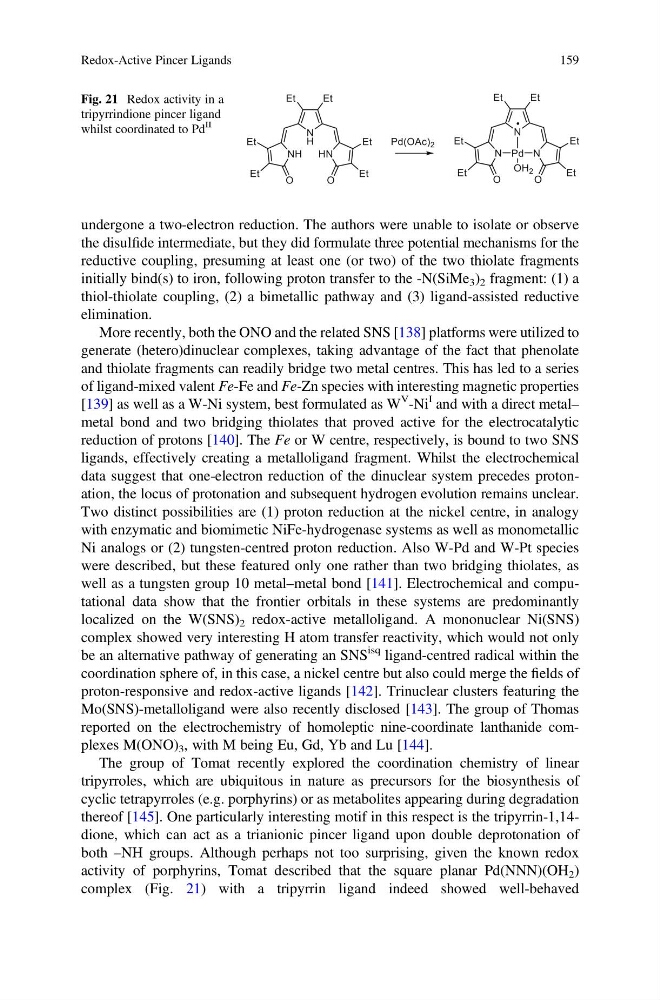
thereof [145]. One particularly interesting motif in this respect is the tripyrrin-1,14dione, which can act as a trianionic pincer ligand upon double deprotonation of
both –NH groups. Although perhaps not too surprising, given the known redox
activity of porphyrins, Tomat described that the square planar Pd(NNN)(OH 2 )
complex (Fig. 21) with a tripyrrin ligand indeed showed well-behaved
Fig. 21 Redox activity in a
tripyrrindione pincer ligand
whilst coordinated to Pd
II
Redox-Active Pincer Ligands
159
the disulfide intermediate, but they did formulate three potential mechanisms for the
reductive coupling, presuming at least one (or two) of the two thiolate fragments
initially bind(s) to iron, following proton transfer to the -N(SiMe 3 ) 2 fragment: (1) a
thiol-thiolate coupling, (2) a bimetallic pathway and (3) ligand-assisted reductive
elimination.
More recently, both the ONO and the related SNS [138] platforms were utilized to
generate (hetero)dinuclear complexes, taking advantage of the fact that phenolate
and thiolate fragments can readily bridge two metal centres. This has led to a series
of ligand-mixed valent Fe-Fe and Fe-Zn species with interesting magnetic properties
[139] as well as a W-Ni system, best formulated as W
V -Ni
I and with a direct metal–
metal bond and two bridging thiolates that proved active for the electrocatalytic
reduction of protons [140]. The Fe or W centre, respectively, is bound to two SNS
ligands, effectively creating a metalloligand fragment. Whilst the electrochemical
data suggest that one-electron reduction of the dinuclear system precedes protonation, the locus of protonation and subsequent hydrogen evolution remains unclear.
Two distinct possibilities are (1) proton reduction at the nickel centre, in analogy
with enzymatic and biomimetic NiFe-hydrogenase systems as well as monometallic
Ni analogs or (2) tungsten-centred proton reduction. Also W-Pd and W-Pt species
were described, but these featured only one rather than two bridging thiolates, as
well as a tungsten group 10 metal–metal bond [141]. Electrochemical and computational data show that the frontier orbitals in these systems are predominantly
localized on the W(SNS) 2 redox-active metalloligand. A mononuclear Ni(SNS)
complex showed very interesting H atom transfer reactivity, which would not only
be an alternative pathway of generating an SNS
isq ligand-centred radical within the
coordination sphere of, in this case, a nickel centre but also could merge the fields of
proton-responsive and redox-active ligands [142]. Trinuclear clusters featuring the
Mo(SNS)-metalloligand were also recently disclosed [143]. The group of Thomas
reported on the electrochemistry of homoleptic nine-coordinate lanthanide complexes M(ONO) 3 , with M being Eu, Gd, Yb and Lu [144].
The group of Tomat recently explored the coordination chemistry of linear
tripyrroles, which are ubiquitous in nature as precursors for the biosynthesis of
cyclic tetrapyrroles (e.g. porphyrins) or as metabolites appearing during degradation
thereof [145]. One particularly interesting motif in this respect is the tripyrrin-1,14dione, which can act as a trianionic pincer ligand upon double deprotonation of
both –NH groups. Although perhaps not too surprising, given the known redox
activity of porphyrins, Tomat described that the square planar Pd(NNN)(OH 2 )
complex (Fig. 21) with a tripyrrin ligand indeed showed well-behaved
Fig. 21 Redox activity in a
tripyrrindione pincer ligand
whilst coordinated to Pd
II
Redox-Active Pincer Ligands
159