

Electrochemical ligand-centred oxidation thus led to a species best formulated as
having a V
IV
(ONO
ibq
) configuration. DFT and TD-DFT calculations were used to
probe the electronic structure of the complexes and help verify the different electronic structures stemming from changes to the coordinated metal ion.
Five- (with phosphine co-ligands) and six-coordinate (pyridine as co-ligands)
Rh
III complexes with this ONO platform were investigated [136]. The nature of the
co-ligand strongly affected the electrochemistry of the overall system. For the
tris(pyridine) complex [Rh(ONO)(Py) 3 ], the first oxidation to convert this species
into the corresponding cation is observed at E ½
1
¼ À0.91 V, whereas for [Rh(ONO)
(PPh 3 ) 2 ], this event is shifted anodically by 640 mV to E ½
1
¼ À0.27 V. Using mixed
methylphenylphosphines or trimethylphosphine leads to less significant shifting.
However, the second oxidation event proved insensitive to both the coordination
geometry around Rh and to nature of the ancillary ligand, with a redox potential E ½
2
between +0.07 and +0.19 V. The combined experimental evidence, also including
NMR and UV-vis spectroscopy, leads to an overall S ¼ 0 spin state with no unpaired
electrons. DFT calculations have been used to clarify the precise interplay between
the ligand and metal oxidation state. For most reported Rh complexes, Rh
III with a
trianionic ONO
ap ligand is deemed the best description. However, for some of the
phosphine complexes, the ONO ligand and the rhodium centre both significantly
contribute to the π-bonding HOMO and the π-antibonding LUMO, giving rise to
unique spectroscopic properties, which led the authors to propose that Rh
II (ONO
sq )
(PR 3 ) 2 is a valid limiting resonance structure, emphasizing that the metal and ligand
share the HOMO electron pair. Rather than viewing this as a diradical, the covalent
nature of the ligand-metal interaction prohibits the description of this complex as
having an open-shell, singlet-biradical electron configuration.
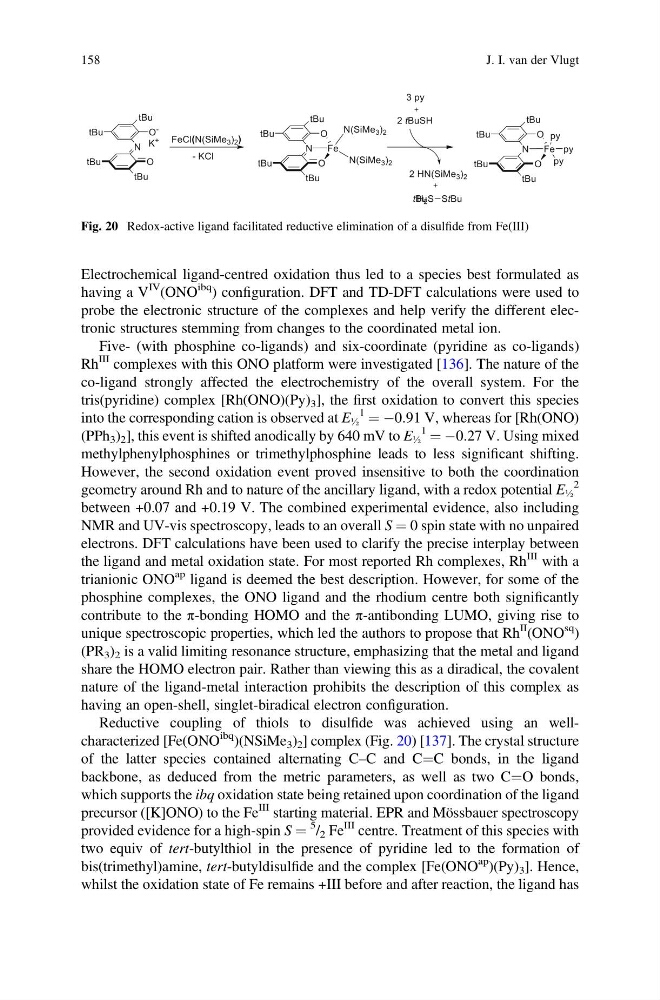
Reductive coupling of thiols to disulfide was achieved using an wellcharacterized [Fe(ONO
ibq )(NSiMe 3 ) 2 ] complex (Fig. 20) [137]. The crystal structure
of the latter species contained alternating C–C and C¼C bonds, in the ligand
backbone, as deduced from the metric parameters, as well as two C¼O bonds,
which supports the ibq oxidation state being retained upon coordination of the ligand
precursor ([K]ONO) to the Fe
III starting material. EPR and Mössbauer spectroscopy
provided evidence for a high-spin S ¼
5
/ 2 Fe
III centre. Treatment of this species with
two equiv of tert-butylthiol in the presence of pyridine led to the formation of
bis(trimethyl)amine, tert-butyldisulfide and the complex [Fe(ONO
ap )(Py) 3 ]. Hence,
whilst the oxidation state of Fe remains +III before and after reaction, the ligand has
Fig. 20 Redox-active ligand facilitated reductive elimination of a disulfide from Fe(III)
158
J. I. van der Vlugt
having a V
IV
(ONO
ibq
) configuration. DFT and TD-DFT calculations were used to
probe the electronic structure of the complexes and help verify the different electronic structures stemming from changes to the coordinated metal ion.
Five- (with phosphine co-ligands) and six-coordinate (pyridine as co-ligands)
Rh
III complexes with this ONO platform were investigated [136]. The nature of the
co-ligand strongly affected the electrochemistry of the overall system. For the
tris(pyridine) complex [Rh(ONO)(Py) 3 ], the first oxidation to convert this species
into the corresponding cation is observed at E ½
1
¼ À0.91 V, whereas for [Rh(ONO)
(PPh 3 ) 2 ], this event is shifted anodically by 640 mV to E ½
1
¼ À0.27 V. Using mixed
methylphenylphosphines or trimethylphosphine leads to less significant shifting.
However, the second oxidation event proved insensitive to both the coordination
geometry around Rh and to nature of the ancillary ligand, with a redox potential E ½
2
between +0.07 and +0.19 V. The combined experimental evidence, also including
NMR and UV-vis spectroscopy, leads to an overall S ¼ 0 spin state with no unpaired
electrons. DFT calculations have been used to clarify the precise interplay between
the ligand and metal oxidation state. For most reported Rh complexes, Rh
III with a
trianionic ONO
ap ligand is deemed the best description. However, for some of the
phosphine complexes, the ONO ligand and the rhodium centre both significantly
contribute to the π-bonding HOMO and the π-antibonding LUMO, giving rise to
unique spectroscopic properties, which led the authors to propose that Rh
II (ONO
sq )
(PR 3 ) 2 is a valid limiting resonance structure, emphasizing that the metal and ligand
share the HOMO electron pair. Rather than viewing this as a diradical, the covalent
nature of the ligand-metal interaction prohibits the description of this complex as
having an open-shell, singlet-biradical electron configuration.
Reductive coupling of thiols to disulfide was achieved using an wellcharacterized [Fe(ONO
ibq )(NSiMe 3 ) 2 ] complex (Fig. 20) [137]. The crystal structure
of the latter species contained alternating C–C and C¼C bonds, in the ligand
backbone, as deduced from the metric parameters, as well as two C¼O bonds,
which supports the ibq oxidation state being retained upon coordination of the ligand
precursor ([K]ONO) to the Fe
III starting material. EPR and Mössbauer spectroscopy
provided evidence for a high-spin S ¼
5
/ 2 Fe
III centre. Treatment of this species with
two equiv of tert-butylthiol in the presence of pyridine led to the formation of
bis(trimethyl)amine, tert-butyldisulfide and the complex [Fe(ONO
ap )(Py) 3 ]. Hence,
whilst the oxidation state of Fe remains +III before and after reaction, the ligand has
Fig. 20 Redox-active ligand facilitated reductive elimination of a disulfide from Fe(III)
158
J. I. van der Vlugt