

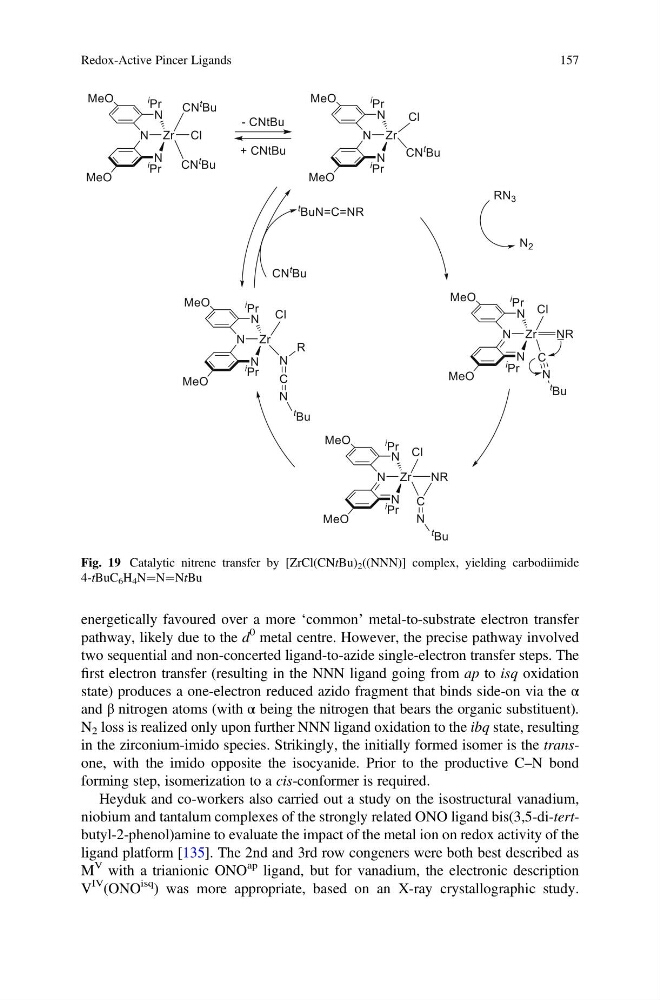
energetically favoured over a more ‘common’ metal-to-substrate electron transfer
pathway, likely due to the d
0 metal centre. However, the precise pathway involved
two sequential and non-concerted ligand-to-azide single-electron transfer steps. The
first electron transfer (resulting in the NNN ligand going from ap to isq oxidation
state) produces a one-electron reduced azido fragment that binds side-on via the α
and β nitrogen atoms (with α being the nitrogen that bears the organic substituent).
N 2 loss is realized only upon further NNN ligand oxidation to the ibq state, resulting
in the zirconium-imido species. Strikingly, the initially formed isomer is the transone, with the imido opposite the isocyanide. Prior to the productive C–N bond
forming step, isomerization to a cis-conformer is required.
Heyduk and co-workers also carried out a study on the isostructural vanadium,
niobium and tantalum complexes of the strongly related ONO ligand bis(3,5-di-tertbutyl-2-phenol)amine to evaluate the impact of the metal ion on redox activity of the
ligand platform [135]. The 2nd and 3rd row congeners were both best described as
M
V with a trianionic ONO
ap ligand, but for vanadium, the electronic description
V
IV
(ONO
isq ) was more appropriate, based on an X-ray crystallographic study.
Fig. 19 Catalytic nitrene transfer by [ZrCl(CNtBu) 2 ((NNN)] complex, yielding carbodiimide
4-tBuC 6 H 4 N¼N¼NtBu
Redox-Active Pincer Ligands
157
pathway, likely due to the d
0 metal centre. However, the precise pathway involved
two sequential and non-concerted ligand-to-azide single-electron transfer steps. The
first electron transfer (resulting in the NNN ligand going from ap to isq oxidation
state) produces a one-electron reduced azido fragment that binds side-on via the α
and β nitrogen atoms (with α being the nitrogen that bears the organic substituent).
N 2 loss is realized only upon further NNN ligand oxidation to the ibq state, resulting
in the zirconium-imido species. Strikingly, the initially formed isomer is the transone, with the imido opposite the isocyanide. Prior to the productive C–N bond
forming step, isomerization to a cis-conformer is required.
Heyduk and co-workers also carried out a study on the isostructural vanadium,
niobium and tantalum complexes of the strongly related ONO ligand bis(3,5-di-tertbutyl-2-phenol)amine to evaluate the impact of the metal ion on redox activity of the
ligand platform [135]. The 2nd and 3rd row congeners were both best described as
M
V with a trianionic ONO
ap ligand, but for vanadium, the electronic description
V
IV
(ONO
isq ) was more appropriate, based on an X-ray crystallographic study.
Fig. 19 Catalytic nitrene transfer by [ZrCl(CNtBu) 2 ((NNN)] complex, yielding carbodiimide
4-tBuC 6 H 4 N¼N¼NtBu
Redox-Active Pincer Ligands
157