

This has enabled for instance stoichiometric nitrene transfer reactions on Ta
V [130],
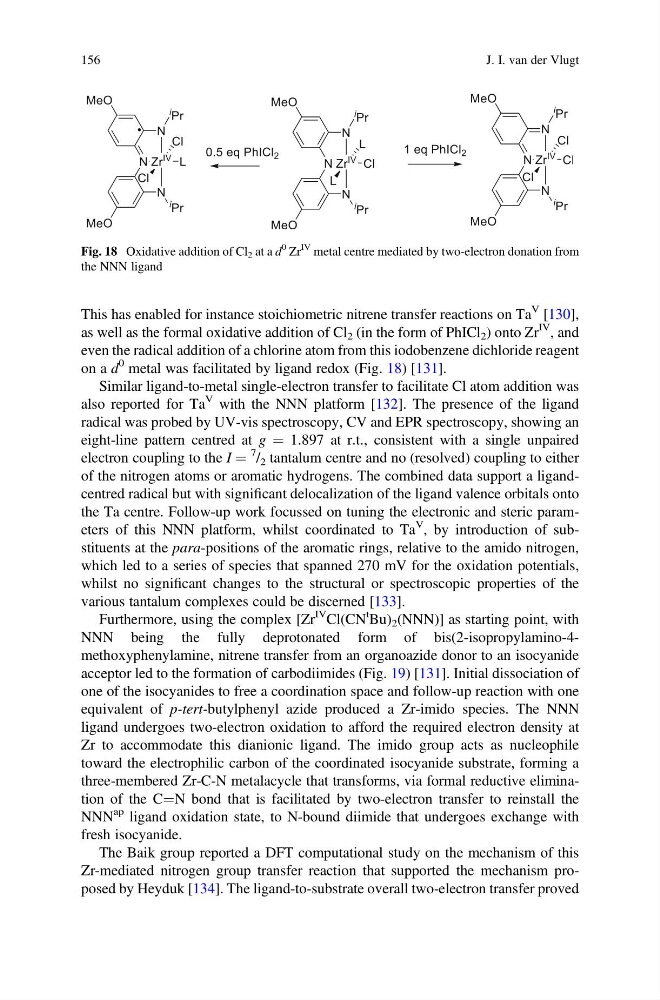
as well as the formal oxidative addition of Cl 2 (in the form of PhICl 2 ) onto Zr
IV , and
even the radical addition of a chlorine atom from this iodobenzene dichloride reagent
on a d
0 metal was facilitated by ligand redox (Fig. 18) [131].
Similar ligand-to-metal single-electron transfer to facilitate Cl atom addition was
also reported for Ta
V with the NNN platform [132]. The presence of the ligand
radical was probed by UV-vis spectroscopy, CV and EPR spectroscopy, showing an
eight-line pattern centred at g ¼ 1.897 at r.t., consistent with a single unpaired
electron coupling to the I ¼
7 / 2 tantalum centre and no (resolved) coupling to either
of the nitrogen atoms or aromatic hydrogens. The combined data support a ligandcentred radical but with significant delocalization of the ligand valence orbitals onto
the Ta centre. Follow-up work focussed on tuning the electronic and steric parameters of this NNN platform, whilst coordinated to Ta
V , by introduction of substituents at the para-positions of the aromatic rings, relative to the amido nitrogen,
which led to a series of species that spanned 270 mV for the oxidation potentials,
whilst no significant changes to the structural or spectroscopic properties of the
various tantalum complexes could be discerned [133].
Furthermore, using the complex [Zr
IV
Cl(CN
t Bu) 2 (NNN)] as starting point, with
NNN being the fully deprotonated form of bis(2-isopropylamino-4methoxyphenylamine, nitrene transfer from an organoazide donor to an isocyanide
acceptor led to the formation of carbodiimides (Fig. 19) [131]. Initial dissociation of
one of the isocyanides to free a coordination space and follow-up reaction with one
equivalent of p-tert-butylphenyl azide produced a Zr-imido species. The NNN
ligand undergoes two-electron oxidation to afford the required electron density at
Zr to accommodate this dianionic ligand. The imido group acts as nucleophile
toward the electrophilic carbon of the coordinated isocyanide substrate, forming a
three-membered Zr-C-N metalacycle that transforms, via formal reductive elimination of the C¼N bond that is facilitated by two-electron transfer to reinstall the
NNN
ap ligand oxidation state, to N-bound diimide that undergoes exchange with
fresh isocyanide.
The Baik group reported a DFT computational study on the mechanism of this
Zr-mediated nitrogen group transfer reaction that supported the mechanism proposed by Heyduk [134]. The ligand-to-substrate overall two-electron transfer proved
Fig. 18 Oxidative addition of Cl 2 at a d
0 Zr
IV metal centre mediated by two-electron donation from
the NNN ligand
156
J. I. van der Vlugt
V [130],
as well as the formal oxidative addition of Cl 2 (in the form of PhICl 2 ) onto Zr
IV , and
even the radical addition of a chlorine atom from this iodobenzene dichloride reagent
on a d
0 metal was facilitated by ligand redox (Fig. 18) [131].
Similar ligand-to-metal single-electron transfer to facilitate Cl atom addition was
also reported for Ta
V with the NNN platform [132]. The presence of the ligand
radical was probed by UV-vis spectroscopy, CV and EPR spectroscopy, showing an
eight-line pattern centred at g ¼ 1.897 at r.t., consistent with a single unpaired
electron coupling to the I ¼
7 / 2 tantalum centre and no (resolved) coupling to either
of the nitrogen atoms or aromatic hydrogens. The combined data support a ligandcentred radical but with significant delocalization of the ligand valence orbitals onto
the Ta centre. Follow-up work focussed on tuning the electronic and steric parameters of this NNN platform, whilst coordinated to Ta
V , by introduction of substituents at the para-positions of the aromatic rings, relative to the amido nitrogen,
which led to a series of species that spanned 270 mV for the oxidation potentials,
whilst no significant changes to the structural or spectroscopic properties of the
various tantalum complexes could be discerned [133].
Furthermore, using the complex [Zr
IV
Cl(CN
t Bu) 2 (NNN)] as starting point, with
NNN being the fully deprotonated form of bis(2-isopropylamino-4methoxyphenylamine, nitrene transfer from an organoazide donor to an isocyanide
acceptor led to the formation of carbodiimides (Fig. 19) [131]. Initial dissociation of
one of the isocyanides to free a coordination space and follow-up reaction with one
equivalent of p-tert-butylphenyl azide produced a Zr-imido species. The NNN
ligand undergoes two-electron oxidation to afford the required electron density at
Zr to accommodate this dianionic ligand. The imido group acts as nucleophile
toward the electrophilic carbon of the coordinated isocyanide substrate, forming a
three-membered Zr-C-N metalacycle that transforms, via formal reductive elimination of the C¼N bond that is facilitated by two-electron transfer to reinstall the
NNN
ap ligand oxidation state, to N-bound diimide that undergoes exchange with
fresh isocyanide.
The Baik group reported a DFT computational study on the mechanism of this
Zr-mediated nitrogen group transfer reaction that supported the mechanism proposed by Heyduk [134]. The ligand-to-substrate overall two-electron transfer proved
Fig. 18 Oxidative addition of Cl 2 at a d
0 Zr
IV metal centre mediated by two-electron donation from
the NNN ligand
156
J. I. van der Vlugt