

3 Pincer Ligands That Undergo Oxidative Chemistry
Two overarching or underlying motifs that guide oxidative ligand-centred redoxreactivity are the 1,2-aminophenol and ortho-phenylene diamine frameworks [121],
which bear strong similarity with 1,2-catechol [122, 123] as well as 1,2-dithiolene
scaffolds [124–126] that are well-established redox-active moieties in their own
right (albeit not in the context of pincer chemistry). Upon deprotonation and
coordination of the 1,2-aminophenol (and sometimes even as free organic fragment),
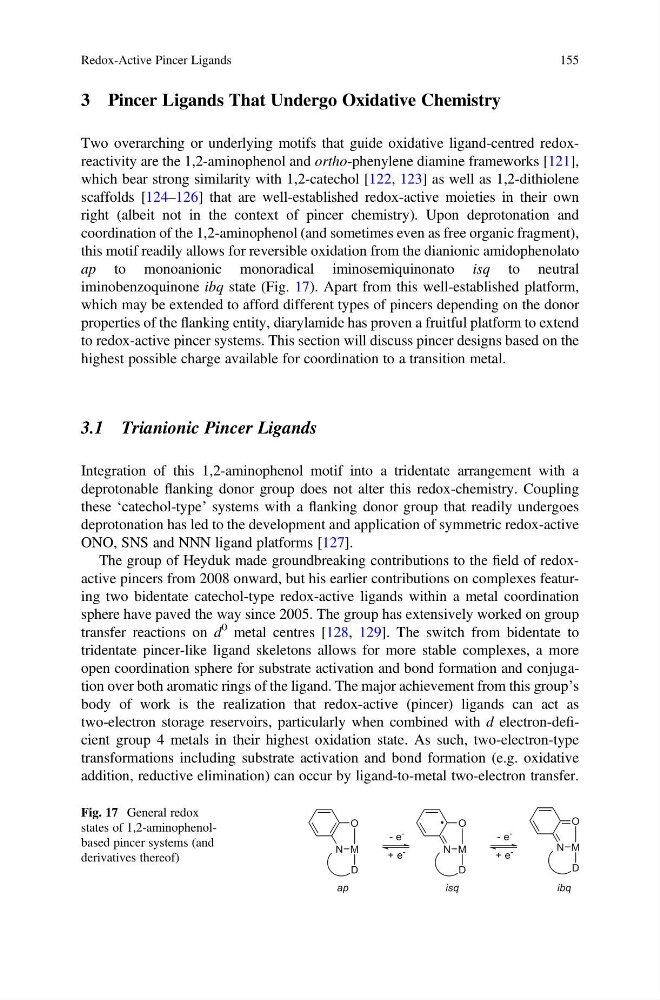
this motif readily allows for reversible oxidation from the dianionic amidophenolato
ap to monoanionic monoradical iminosemiquinonato isq to neutral
iminobenzoquinone ibq state (Fig. 17). Apart from this well-established platform,
which may be extended to afford different types of pincers depending on the donor
properties of the flanking entity, diarylamide has proven a fruitful platform to extend
to redox-active pincer systems. This section will discuss pincer designs based on the
highest possible charge available for coordination to a transition metal.
3.1 Trianionic Pincer Ligands
Integration of this 1,2-aminophenol motif into a tridentate arrangement with a
deprotonable flanking donor group does not alter this redox-chemistry. Coupling
these ‘catechol-type’ systems with a flanking donor group that readily undergoes
deprotonation has led to the development and application of symmetric redox-active
ONO, SNS and NNN ligand platforms [127].
The group of Heyduk made groundbreaking contributions to the field of redoxactive pincers from 2008 onward, but his earlier contributions on complexes featuring two bidentate catechol-type redox-active ligands within a metal coordination
sphere have paved the way since 2005. The group has extensively worked on group
transfer reactions on d
0 metal centres [128, 129]. The switch from bidentate to
tridentate pincer-like ligand skeletons allows for more stable complexes, a more
open coordination sphere for substrate activation and bond formation and conjugation over both aromatic rings of the ligand. The major achievement from this group’s
body of work is the realization that redox-active (pincer) ligands can act as
two-electron storage reservoirs, particularly when combined with d electron-deficient group 4 metals in their highest oxidation state. As such, two-electron-type
transformations including substrate activation and bond formation (e.g. oxidative
addition, reductive elimination) can occur by ligand-to-metal two-electron transfer.
Fig. 17 General redox
states of 1,2-aminophenolbased pincer systems (and
derivatives thereof)
Redox-Active Pincer Ligands
155
Two overarching or underlying motifs that guide oxidative ligand-centred redoxreactivity are the 1,2-aminophenol and ortho-phenylene diamine frameworks [121],
which bear strong similarity with 1,2-catechol [122, 123] as well as 1,2-dithiolene
scaffolds [124–126] that are well-established redox-active moieties in their own
right (albeit not in the context of pincer chemistry). Upon deprotonation and
coordination of the 1,2-aminophenol (and sometimes even as free organic fragment),
this motif readily allows for reversible oxidation from the dianionic amidophenolato
ap to monoanionic monoradical iminosemiquinonato isq to neutral
iminobenzoquinone ibq state (Fig. 17). Apart from this well-established platform,
which may be extended to afford different types of pincers depending on the donor
properties of the flanking entity, diarylamide has proven a fruitful platform to extend
to redox-active pincer systems. This section will discuss pincer designs based on the
highest possible charge available for coordination to a transition metal.
3.1 Trianionic Pincer Ligands
Integration of this 1,2-aminophenol motif into a tridentate arrangement with a
deprotonable flanking donor group does not alter this redox-chemistry. Coupling
these ‘catechol-type’ systems with a flanking donor group that readily undergoes
deprotonation has led to the development and application of symmetric redox-active
ONO, SNS and NNN ligand platforms [127].
The group of Heyduk made groundbreaking contributions to the field of redoxactive pincers from 2008 onward, but his earlier contributions on complexes featuring two bidentate catechol-type redox-active ligands within a metal coordination
sphere have paved the way since 2005. The group has extensively worked on group
transfer reactions on d
0 metal centres [128, 129]. The switch from bidentate to
tridentate pincer-like ligand skeletons allows for more stable complexes, a more
open coordination sphere for substrate activation and bond formation and conjugation over both aromatic rings of the ligand. The major achievement from this group’s
body of work is the realization that redox-active (pincer) ligands can act as
two-electron storage reservoirs, particularly when combined with d electron-deficient group 4 metals in their highest oxidation state. As such, two-electron-type
transformations including substrate activation and bond formation (e.g. oxidative
addition, reductive elimination) can occur by ligand-to-metal two-electron transfer.
Fig. 17 General redox
states of 1,2-aminophenolbased pincer systems (and
derivatives thereof)
Redox-Active Pincer Ligands
155