

led to the bis-dinitrogen adduct [Fe(CNC)(N 2 ) 2 ], which was crystallographically
characterized [116]. With small methyl substituents of the flanking NHC-fragment,
dimerization occurred in the solid state (with one linear bridging N 2 ligand), but
solution state IR spectroscopy indicated only mononuclear species to be present in
toluene at r.t. These reduced Fe species proved effective for the hydrogenation of
unfunctionalized, hindered alkenes. A combined spectroscopic and computational
study revealed that in the coordination sphere of Fe, this CNC framework behaves as
a redox-noninnocent ligand but not strictly as a redox-active one [117]. This means
that extensive π-backbonding results in an electronic structure that is a hybrid of Fe
0
and Fe
II but without concrete radical spin density located within the CNC scaffold.
The same picture arose upon substitution of the N 2 ligands for the diene N,N-diallyltert-butylamine, to which this Fe species proved catalytically inactive, whilst it was
previously shown to undergo 2π + 2π cycloaddition mediated by Fe species with
ligand-centred radical-based character.
The corresponding Co
II -methyl complex with this bis(arylimidazol-2-ylidene)
pyridine CNC ligand was shown to be one of the most catalytically active Co
systems for the hydrogenation of sterically hindered, unactivated alkenes. The
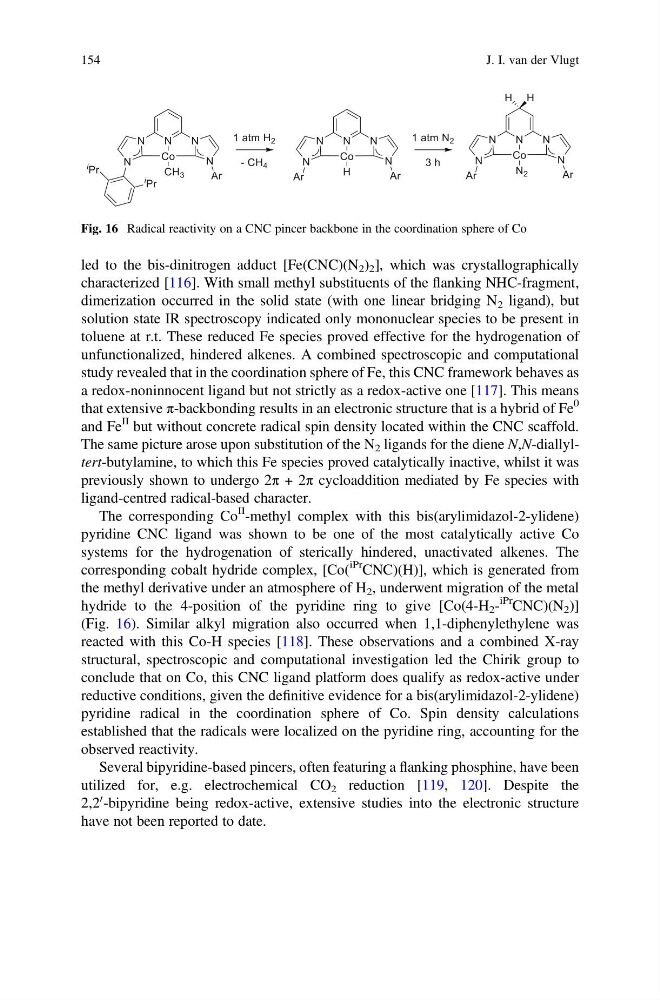
corresponding cobalt hydride complex, [Co(
iPr CNC)(H)], which is generated from
the methyl derivative under an atmosphere of H 2 , underwent migration of the metal
hydride to the 4-position of the pyridine ring to give [Co(4-H 2 -
iPr CNC)(N 2 )]
(Fig. 16). Similar alkyl migration also occurred when 1,1-diphenylethylene was
reacted with this Co-H species [118]. These observations and a combined X-ray
structural, spectroscopic and computational investigation led the Chirik group to
conclude that on Co, this CNC ligand platform does qualify as redox-active under
reductive conditions, given the definitive evidence for a bis(arylimidazol-2-ylidene)
pyridine radical in the coordination sphere of Co. Spin density calculations
established that the radicals were localized on the pyridine ring, accounting for the
observed reactivity.
Several bipyridine-based pincers, often featuring a flanking phosphine, have been
utilized for, e.g. electrochemical CO 2 reduction [119, 120]. Despite the
2,2
0 -bipyridine being redox-active, extensive studies into the electronic structure
have not been reported to date.
Fig. 16 Radical reactivity on a CNC pincer backbone in the coordination sphere of Co
154
J. I. van der Vlugt
characterized [116]. With small methyl substituents of the flanking NHC-fragment,
dimerization occurred in the solid state (with one linear bridging N 2 ligand), but
solution state IR spectroscopy indicated only mononuclear species to be present in
toluene at r.t. These reduced Fe species proved effective for the hydrogenation of
unfunctionalized, hindered alkenes. A combined spectroscopic and computational
study revealed that in the coordination sphere of Fe, this CNC framework behaves as
a redox-noninnocent ligand but not strictly as a redox-active one [117]. This means
that extensive π-backbonding results in an electronic structure that is a hybrid of Fe
0
and Fe
II but without concrete radical spin density located within the CNC scaffold.
The same picture arose upon substitution of the N 2 ligands for the diene N,N-diallyltert-butylamine, to which this Fe species proved catalytically inactive, whilst it was
previously shown to undergo 2π + 2π cycloaddition mediated by Fe species with
ligand-centred radical-based character.
The corresponding Co
II -methyl complex with this bis(arylimidazol-2-ylidene)
pyridine CNC ligand was shown to be one of the most catalytically active Co
systems for the hydrogenation of sterically hindered, unactivated alkenes. The
corresponding cobalt hydride complex, [Co(
iPr CNC)(H)], which is generated from
the methyl derivative under an atmosphere of H 2 , underwent migration of the metal
hydride to the 4-position of the pyridine ring to give [Co(4-H 2 -
iPr CNC)(N 2 )]
(Fig. 16). Similar alkyl migration also occurred when 1,1-diphenylethylene was
reacted with this Co-H species [118]. These observations and a combined X-ray
structural, spectroscopic and computational investigation led the Chirik group to
conclude that on Co, this CNC ligand platform does qualify as redox-active under
reductive conditions, given the definitive evidence for a bis(arylimidazol-2-ylidene)
pyridine radical in the coordination sphere of Co. Spin density calculations
established that the radicals were localized on the pyridine ring, accounting for the
observed reactivity.
Several bipyridine-based pincers, often featuring a flanking phosphine, have been
utilized for, e.g. electrochemical CO 2 reduction [119, 120]. Despite the
2,2
0 -bipyridine being redox-active, extensive studies into the electronic structure
have not been reported to date.
Fig. 16 Radical reactivity on a CNC pincer backbone in the coordination sphere of Co
154
J. I. van der Vlugt