

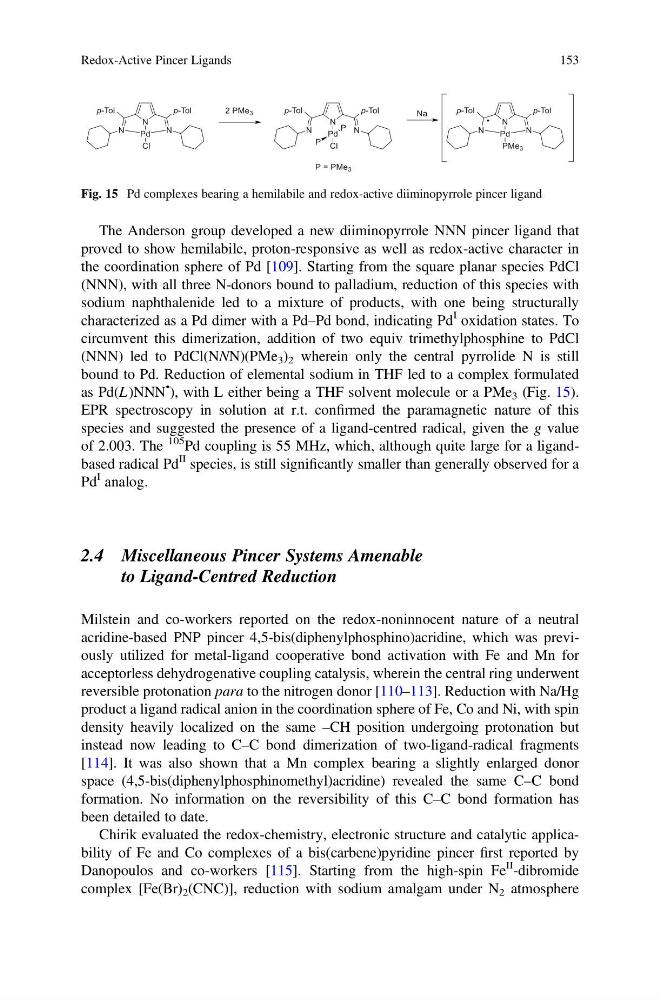
The Anderson group developed a new diiminopyrrole NNN pincer ligand that
proved to show hemilabile, proton-responsive as well as redox-active character in
the coordination sphere of Pd [109]. Starting from the square planar species PdCl
(NNN), with all three N-donors bound to palladium, reduction of this species with
sodium naphthalenide led to a mixture of products, with one being structurally
characterized as a Pd dimer with a Pd–Pd bond, indicating Pd
I oxidation states. To
circumvent this dimerization, addition of two equiv trimethylphosphine to PdCl
(NNN) led to PdCl(NNN)(PMe 3 ) 2 wherein only the central pyrrolide N is still
bound to Pd. Reduction of elemental sodium in THF led to a complex formulated
as Pd(L )NNN
•
), with L either being a THF solvent molecule or a PMe 3 (Fig. 15).
EPR spectroscopy in solution at r.t. confirmed the paramagnetic nature of this
species and suggested the presence of a ligand-centred radical, given the g value
of 2.003. The
105
Pd coupling is 55 MHz, which, although quite large for a ligandbased radical Pd
II species, is still significantly smaller than generally observed for a
Pd
I analog.
2.4 Miscellaneous Pincer Systems Amenable
to Ligand-Centred Reduction
Milstein and co-workers reported on the redox-noninnocent nature of a neutral
acridine-based PNP pincer 4,5-bis(diphenylphosphino)acridine, which was previously utilized for metal-ligand cooperative bond activation with Fe and Mn for
acceptorless dehydrogenative coupling catalysis, wherein the central ring underwent
reversible protonation para to the nitrogen donor [110–113]. Reduction with Na/Hg
product a ligand radical anion in the coordination sphere of Fe, Co and Ni, with spin
density heavily localized on the same –CH position undergoing protonation but
instead now leading to C–C bond dimerization of two-ligand-radical fragments
[114]. It was also shown that a Mn complex bearing a slightly enlarged donor
space (4,5-bis(diphenylphosphinomethyl)acridine) revealed the same C–C bond
formation. No information on the reversibility of this C–C bond formation has
been detailed to date.
Chirik evaluated the redox-chemistry, electronic structure and catalytic applicability of Fe and Co complexes of a bis(carbene)pyridine pincer first reported by
Danopoulos and co-workers [115]. Starting from the high-spin Fe
II -dibromide
complex [Fe(Br) 2 (CNC)], reduction with sodium amalgam under N 2 atmosphere
Fig. 15 Pd complexes bearing a hemilabile and redox-active diiminopyrrole pincer ligand
Redox-Active Pincer Ligands
153
proved to show hemilabile, proton-responsive as well as redox-active character in
the coordination sphere of Pd [109]. Starting from the square planar species PdCl
(NNN), with all three N-donors bound to palladium, reduction of this species with
sodium naphthalenide led to a mixture of products, with one being structurally
characterized as a Pd dimer with a Pd–Pd bond, indicating Pd
I oxidation states. To
circumvent this dimerization, addition of two equiv trimethylphosphine to PdCl
(NNN) led to PdCl(NNN)(PMe 3 ) 2 wherein only the central pyrrolide N is still
bound to Pd. Reduction of elemental sodium in THF led to a complex formulated
as Pd(L )NNN
•
), with L either being a THF solvent molecule or a PMe 3 (Fig. 15).
EPR spectroscopy in solution at r.t. confirmed the paramagnetic nature of this
species and suggested the presence of a ligand-centred radical, given the g value
of 2.003. The
105
Pd coupling is 55 MHz, which, although quite large for a ligandbased radical Pd
II species, is still significantly smaller than generally observed for a
Pd
I analog.
2.4 Miscellaneous Pincer Systems Amenable
to Ligand-Centred Reduction
Milstein and co-workers reported on the redox-noninnocent nature of a neutral
acridine-based PNP pincer 4,5-bis(diphenylphosphino)acridine, which was previously utilized for metal-ligand cooperative bond activation with Fe and Mn for
acceptorless dehydrogenative coupling catalysis, wherein the central ring underwent
reversible protonation para to the nitrogen donor [110–113]. Reduction with Na/Hg
product a ligand radical anion in the coordination sphere of Fe, Co and Ni, with spin
density heavily localized on the same –CH position undergoing protonation but
instead now leading to C–C bond dimerization of two-ligand-radical fragments
[114]. It was also shown that a Mn complex bearing a slightly enlarged donor
space (4,5-bis(diphenylphosphinomethyl)acridine) revealed the same C–C bond
formation. No information on the reversibility of this C–C bond formation has
been detailed to date.
Chirik evaluated the redox-chemistry, electronic structure and catalytic applicability of Fe and Co complexes of a bis(carbene)pyridine pincer first reported by
Danopoulos and co-workers [115]. Starting from the high-spin Fe
II -dibromide
complex [Fe(Br) 2 (CNC)], reduction with sodium amalgam under N 2 atmosphere
Fig. 15 Pd complexes bearing a hemilabile and redox-active diiminopyrrole pincer ligand
Redox-Active Pincer Ligands
153