

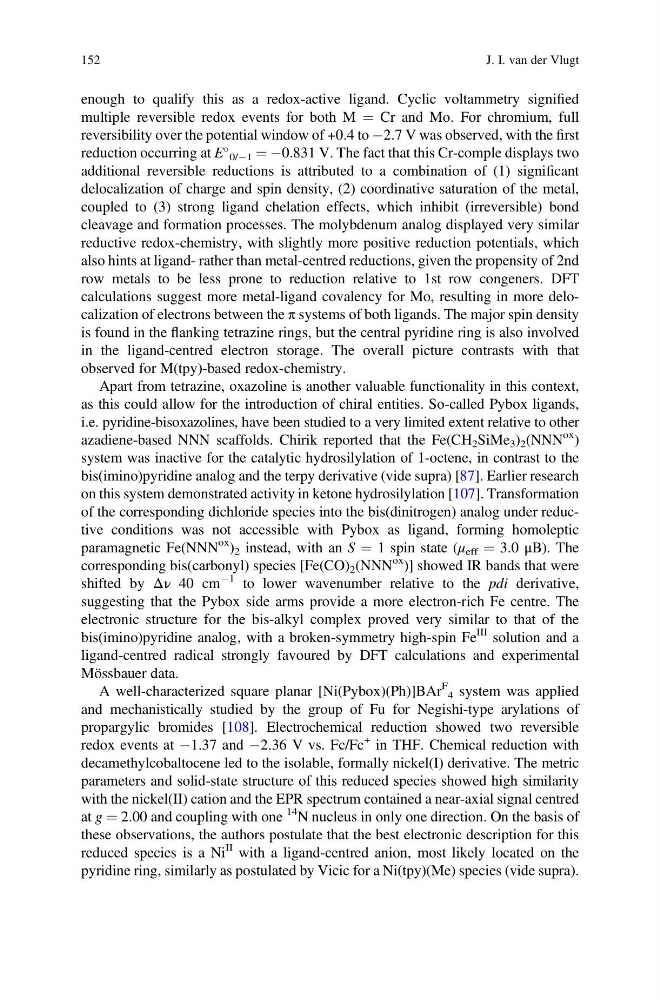
enough to qualify this as a redox-active ligand. Cyclic voltammetry signified
multiple reversible redox events for both M ¼ Cr and Mo. For chromium, full
reversibility over the potential window of +0.4 to À2.7 V was observed, with the first
reduction occurring at E
0/À1 ¼ À0.831 V. The fact that this Cr-comple displays two
additional reversible reductions is attributed to a combination of (1) significant
delocalization of charge and spin density, (2) coordinative saturation of the metal,
coupled to (3) strong ligand chelation effects, which inhibit (irreversible) bond
cleavage and formation processes. The molybdenum analog displayed very similar
reductive redox-chemistry, with slightly more positive reduction potentials, which
also hints at ligand- rather than metal-centred reductions, given the propensity of 2nd
row metals to be less prone to reduction relative to 1st row congeners. DFT
calculations suggest more metal-ligand covalency for Mo, resulting in more delocalization of electrons between the π systems of both ligands. The major spin density
is found in the flanking tetrazine rings, but the central pyridine ring is also involved
in the ligand-centred electron storage. The overall picture contrasts with that
observed for M(tpy)-based redox-chemistry.
Apart from tetrazine, oxazoline is another valuable functionality in this context,
as this could allow for the introduction of chiral entities. So-called Pybox ligands,
i.e. pyridine-bisoxazolines, have been studied to a very limited extent relative to other
azadiene-based NNN scaffolds. Chirik reported that the Fe(CH 2 SiMe 3 ) 2 (NNN
ox )
system was inactive for the catalytic hydrosilylation of 1-octene, in contrast to the
bis(imino)pyridine analog and the terpy derivative (vide supra) [87]. Earlier research
on this system demonstrated activity in ketone hydrosilylation [107]. Transformation
of the corresponding dichloride species into the bis(dinitrogen) analog under reductive conditions was not accessible with Pybox as ligand, forming homoleptic
paramagnetic Fe(NNN
ox ) 2 instead, with an S ¼ 1 spin state (μ eff ¼ 3.0 μB). The
corresponding bis(carbonyl) species [Fe(CO) 2 (NNN
ox )] showed IR bands that were
shifted by Δν 40 cm
À1 to lower wavenumber relative to the pdi derivative,
suggesting that the Pybox side arms provide a more electron-rich Fe centre. The
electronic structure for the bis-alkyl complex proved very similar to that of the
bis(imino)pyridine analog, with a broken-symmetry high-spin Fe
III solution and a
ligand-centred radical strongly favoured by DFT calculations and experimental
Mössbauer data.
A well-characterized square planar [Ni(Pybox)(Ph)]BAr
F
4 system was applied
and mechanistically studied by the group of Fu for Negishi-type arylations of
propargylic bromides [108]. Electrochemical reduction showed two reversible
redox events at À1.37 and À2.36 V vs. Fc/Fc
+ in THF. Chemical reduction with
decamethylcobaltocene led to the isolable, formally nickel(I) derivative. The metric
parameters and solid-state structure of this reduced species showed high similarity
with the nickel(II) cation and the EPR spectrum contained a near-axial signal centred
at g ¼ 2.00 and coupling with one
14 N nucleus in only one direction. On the basis of
these observations, the authors postulate that the best electronic description for this
reduced species is a Ni
II with a ligand-centred anion, most likely located on the
pyridine ring, similarly as postulated by Vicic for a Ni(tpy)(Me) species (vide supra).
152
J. I. van der Vlugt
multiple reversible redox events for both M ¼ Cr and Mo. For chromium, full
reversibility over the potential window of +0.4 to À2.7 V was observed, with the first
reduction occurring at E
0/À1 ¼ À0.831 V. The fact that this Cr-comple displays two
additional reversible reductions is attributed to a combination of (1) significant
delocalization of charge and spin density, (2) coordinative saturation of the metal,
coupled to (3) strong ligand chelation effects, which inhibit (irreversible) bond
cleavage and formation processes. The molybdenum analog displayed very similar
reductive redox-chemistry, with slightly more positive reduction potentials, which
also hints at ligand- rather than metal-centred reductions, given the propensity of 2nd
row metals to be less prone to reduction relative to 1st row congeners. DFT
calculations suggest more metal-ligand covalency for Mo, resulting in more delocalization of electrons between the π systems of both ligands. The major spin density
is found in the flanking tetrazine rings, but the central pyridine ring is also involved
in the ligand-centred electron storage. The overall picture contrasts with that
observed for M(tpy)-based redox-chemistry.
Apart from tetrazine, oxazoline is another valuable functionality in this context,
as this could allow for the introduction of chiral entities. So-called Pybox ligands,
i.e. pyridine-bisoxazolines, have been studied to a very limited extent relative to other
azadiene-based NNN scaffolds. Chirik reported that the Fe(CH 2 SiMe 3 ) 2 (NNN
ox )
system was inactive for the catalytic hydrosilylation of 1-octene, in contrast to the
bis(imino)pyridine analog and the terpy derivative (vide supra) [87]. Earlier research
on this system demonstrated activity in ketone hydrosilylation [107]. Transformation
of the corresponding dichloride species into the bis(dinitrogen) analog under reductive conditions was not accessible with Pybox as ligand, forming homoleptic
paramagnetic Fe(NNN
ox ) 2 instead, with an S ¼ 1 spin state (μ eff ¼ 3.0 μB). The
corresponding bis(carbonyl) species [Fe(CO) 2 (NNN
ox )] showed IR bands that were
shifted by Δν 40 cm
À1 to lower wavenumber relative to the pdi derivative,
suggesting that the Pybox side arms provide a more electron-rich Fe centre. The
electronic structure for the bis-alkyl complex proved very similar to that of the
bis(imino)pyridine analog, with a broken-symmetry high-spin Fe
III solution and a
ligand-centred radical strongly favoured by DFT calculations and experimental
Mössbauer data.
A well-characterized square planar [Ni(Pybox)(Ph)]BAr
F
4 system was applied
and mechanistically studied by the group of Fu for Negishi-type arylations of
propargylic bromides [108]. Electrochemical reduction showed two reversible
redox events at À1.37 and À2.36 V vs. Fc/Fc
+ in THF. Chemical reduction with
decamethylcobaltocene led to the isolable, formally nickel(I) derivative. The metric
parameters and solid-state structure of this reduced species showed high similarity
with the nickel(II) cation and the EPR spectrum contained a near-axial signal centred
at g ¼ 2.00 and coupling with one
14 N nucleus in only one direction. On the basis of
these observations, the authors postulate that the best electronic description for this
reduced species is a Ni
II with a ligand-centred anion, most likely located on the
pyridine ring, similarly as postulated by Vicic for a Ni(tpy)(Me) species (vide supra).
152
J. I. van der Vlugt