

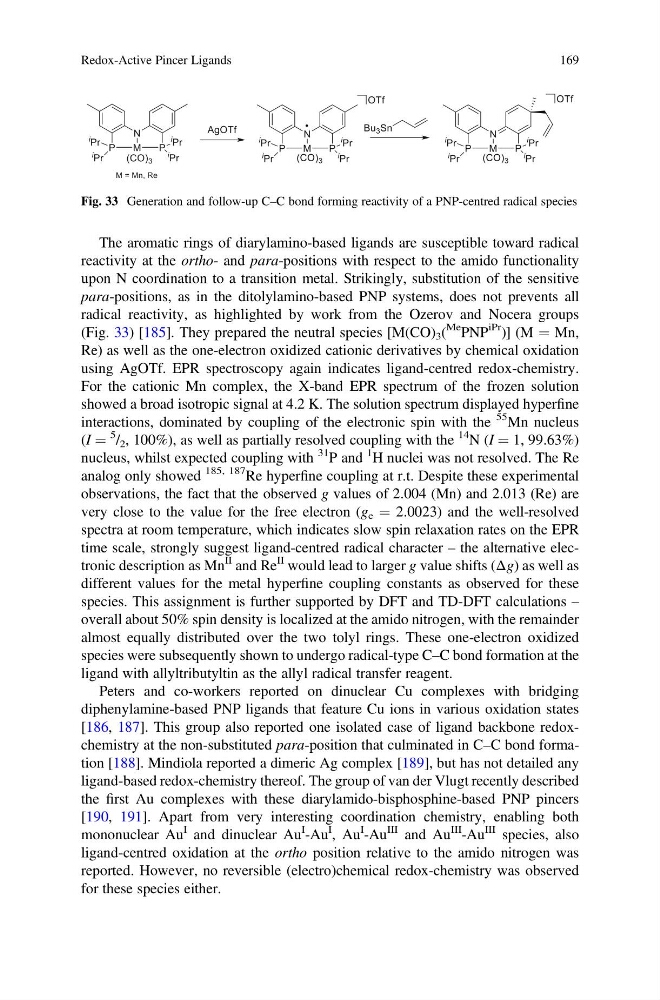
The aromatic rings of diarylamino-based ligands are susceptible toward radical
reactivity at the ortho- and para-positions with respect to the amido functionality
upon N coordination to a transition metal. Strikingly, substitution of the sensitive
para-positions, as in the ditolylamino-based PNP systems, does not prevents all
radical reactivity, as highlighted by work from the Ozerov and Nocera groups
(Fig. 33) [185]. They prepared the neutral species [M(CO) 3 (
Me PNP
iPr )] (M ¼ Mn,
Re) as well as the one-electron oxidized cationic derivatives by chemical oxidation
using AgOTf. EPR spectroscopy again indicates ligand-centred redox-chemistry.
For the cationic Mn complex, the X-band EPR spectrum of the frozen solution
showed a broad isotropic signal at 4.2 K. The solution spectrum displayed hyperfine
interactions, dominated by coupling of the electronic spin with the
55 Mn nucleus
(I ¼
5 / 2 , 100%), as well as partially resolved coupling with the
14 N (I ¼ 1, 99.63%)
nucleus, whilst expected coupling with
31 P and
1 H nuclei was not resolved. The Re
analog only showed
185, 187 Re hyperfine coupling at r.t. Despite these experimental
observations, the fact that the observed g values of 2.004 (Mn) and 2.013 (Re) are
very close to the value for the free electron (g e ¼ 2.0023) and the well-resolved
spectra at room temperature, which indicates slow spin relaxation rates on the EPR
time scale, strongly suggest ligand-centred radical character – the alternative electronic description as Mn
II and Re
II would lead to larger g value shifts (Δg) as well as
different values for the metal hyperfine coupling constants as observed for these
species. This assignment is further supported by DFT and TD-DFT calculations –
overall about 50% spin density is localized at the amido nitrogen, with the remainder
almost equally distributed over the two tolyl rings. These one-electron oxidized
species were subsequently shown to undergo radical-type C–C bond formation at the
ligand with allyltributyltin as the allyl radical transfer reagent.
Peters and co-workers reported on dinuclear Cu complexes with bridging
diphenylamine-based PNP ligands that feature Cu ions in various oxidation states
[186, 187]. This group also reported one isolated case of ligand backbone redoxchemistry at the non-substituted para-position that culminated in C–C bond formation [188]. Mindiola reported a dimeric Ag complex [189], but has not detailed any
ligand-based redox-chemistry thereof. The group of van der Vlugt recently described
the first Au complexes with these diarylamido-bisphosphine-based PNP pincers
[190, 191]. Apart from very interesting coordination chemistry, enabling both
mononuclear Au
I and dinuclear Au
I -Au
I , Au
I
-Au
III and Au
III -Au
III species, also
ligand-centred oxidation at the ortho position relative to the amido nitrogen was
reported. However, no reversible (electro)chemical redox-chemistry was observed
for these species either.
Fig. 33 Generation and follow-up C–C bond forming reactivity of a PNP-centred radical species
Redox-Active Pincer Ligands
169
reactivity at the ortho- and para-positions with respect to the amido functionality
upon N coordination to a transition metal. Strikingly, substitution of the sensitive
para-positions, as in the ditolylamino-based PNP systems, does not prevents all
radical reactivity, as highlighted by work from the Ozerov and Nocera groups
(Fig. 33) [185]. They prepared the neutral species [M(CO) 3 (
Me PNP
iPr )] (M ¼ Mn,
Re) as well as the one-electron oxidized cationic derivatives by chemical oxidation
using AgOTf. EPR spectroscopy again indicates ligand-centred redox-chemistry.
For the cationic Mn complex, the X-band EPR spectrum of the frozen solution
showed a broad isotropic signal at 4.2 K. The solution spectrum displayed hyperfine
interactions, dominated by coupling of the electronic spin with the
55 Mn nucleus
(I ¼
5 / 2 , 100%), as well as partially resolved coupling with the
14 N (I ¼ 1, 99.63%)
nucleus, whilst expected coupling with
31 P and
1 H nuclei was not resolved. The Re
analog only showed
185, 187 Re hyperfine coupling at r.t. Despite these experimental
observations, the fact that the observed g values of 2.004 (Mn) and 2.013 (Re) are
very close to the value for the free electron (g e ¼ 2.0023) and the well-resolved
spectra at room temperature, which indicates slow spin relaxation rates on the EPR
time scale, strongly suggest ligand-centred radical character – the alternative electronic description as Mn
II and Re
II would lead to larger g value shifts (Δg) as well as
different values for the metal hyperfine coupling constants as observed for these
species. This assignment is further supported by DFT and TD-DFT calculations –
overall about 50% spin density is localized at the amido nitrogen, with the remainder
almost equally distributed over the two tolyl rings. These one-electron oxidized
species were subsequently shown to undergo radical-type C–C bond formation at the
ligand with allyltributyltin as the allyl radical transfer reagent.
Peters and co-workers reported on dinuclear Cu complexes with bridging
diphenylamine-based PNP ligands that feature Cu ions in various oxidation states
[186, 187]. This group also reported one isolated case of ligand backbone redoxchemistry at the non-substituted para-position that culminated in C–C bond formation [188]. Mindiola reported a dimeric Ag complex [189], but has not detailed any
ligand-based redox-chemistry thereof. The group of van der Vlugt recently described
the first Au complexes with these diarylamido-bisphosphine-based PNP pincers
[190, 191]. Apart from very interesting coordination chemistry, enabling both
mononuclear Au
I and dinuclear Au
I -Au
I , Au
I
-Au
III and Au
III -Au
III species, also
ligand-centred oxidation at the ortho position relative to the amido nitrogen was
reported. However, no reversible (electro)chemical redox-chemistry was observed
for these species either.
Fig. 33 Generation and follow-up C–C bond forming reactivity of a PNP-centred radical species
Redox-Active Pincer Ligands
169