

redox potentials of À0.7 and +0.25 V for reduction and oxidation, respectively, of
the azo radical [96]. The corresponding ligand radical complexes are intensely
coloured, with multiple transitions occurring in the visible spectrum, many involving
intra-ligand electron transfer as deduced from TD-DFT calculations. The mechanism
for the ligand functionalization proposedly involves initial reduction of the
azo-fragment to generate an anionic Pd
II species wherein the chloride co-ligands
are labilized. Exchange for the amine thus enables subsequent intra-ligand electron
transfer to create an aminyl radical (following N–H or N–C bond cleavage) in the
coordination sphere of Pd
II . This activates the aryl ring via a radical coupling step,
creating a Pd-aryl fragment that subsequently undergoes C–N bond coupling, with
electron-redistribution to regenerate the azo radical anion.
This finding, together with the extensive work already performed on
arylazopyridines, and the analogy to bis(imino)pyridine guided the chemistry of
bis(phenylazo)pyridine pincers, which have moderately low-lying and energetically
favourable π
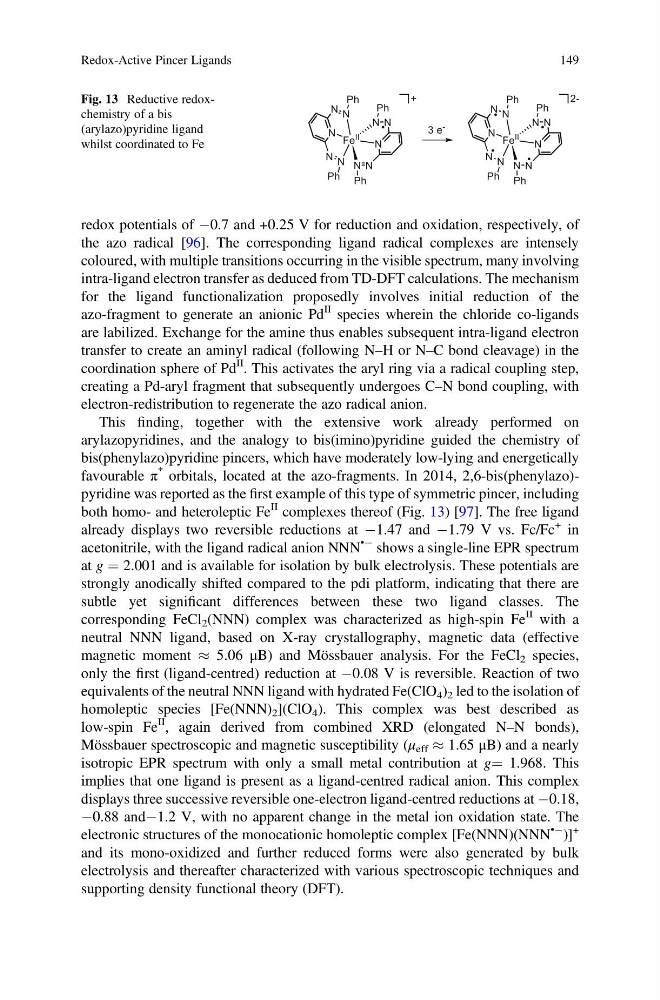
* orbitals, located at the azo-fragments. In 2014, 2,6-bis(phenylazo)pyridine was reported as the first example of this type of symmetric pincer, including
both homo- and heteroleptic Fe
II complexes thereof (Fig. 13) [97]. The free ligand
already displays two reversible reductions at À1.47 and À1.79 V vs. Fc/Fc
+ in
acetonitrile, with the ligand radical anion NNN
•À shows a single-line EPR spectrum
at g ¼ 2.001 and is available for isolation by bulk electrolysis. These potentials are
strongly anodically shifted compared to the pdi platform, indicating that there are
subtle yet significant differences between these two ligand classes. The
corresponding FeCl 2 (NNN) complex was characterized as high-spin Fe
II with a
neutral NNN ligand, based on X-ray crystallography, magnetic data (effective
magnetic moment % 5.06 μB) and Mössbauer analysis. For the FeCl 2 species,
only the first (ligand-centred) reduction at À0.08 V is reversible. Reaction of two
equivalents of the neutral NNN ligand with hydrated Fe(ClO 4 ) 2 led to the isolation of
homoleptic species [Fe(NNN) 2 ](ClO 4 ). This complex was best described as
low-spin Fe
II , again derived from combined XRD (elongated N–N bonds),
Mössbauer spectroscopic and magnetic susceptibility (μ eff % 1.65 μB) and a nearly
isotropic EPR spectrum with only a small metal contribution at g¼ 1.968. This
implies that one ligand is present as a ligand-centred radical anion. This complex
displays three successive reversible one-electron ligand-centred reductions at À0.18,
À0.88 andÀ1.2 V, with no apparent change in the metal ion oxidation state. The
electronic structures of the monocationic homoleptic complex [Fe(NNN)(NNN
•À )]
+
and its mono-oxidized and further reduced forms were also generated by bulk
electrolysis and thereafter characterized with various spectroscopic techniques and
supporting density functional theory (DFT).
Fig. 13 Reductive redoxchemistry of a bis
(arylazo)pyridine ligand
whilst coordinated to Fe
Redox-Active Pincer Ligands
149
the azo radical [96]. The corresponding ligand radical complexes are intensely
coloured, with multiple transitions occurring in the visible spectrum, many involving
intra-ligand electron transfer as deduced from TD-DFT calculations. The mechanism
for the ligand functionalization proposedly involves initial reduction of the
azo-fragment to generate an anionic Pd
II species wherein the chloride co-ligands
are labilized. Exchange for the amine thus enables subsequent intra-ligand electron
transfer to create an aminyl radical (following N–H or N–C bond cleavage) in the
coordination sphere of Pd
II . This activates the aryl ring via a radical coupling step,
creating a Pd-aryl fragment that subsequently undergoes C–N bond coupling, with
electron-redistribution to regenerate the azo radical anion.
This finding, together with the extensive work already performed on
arylazopyridines, and the analogy to bis(imino)pyridine guided the chemistry of
bis(phenylazo)pyridine pincers, which have moderately low-lying and energetically
favourable π
* orbitals, located at the azo-fragments. In 2014, 2,6-bis(phenylazo)pyridine was reported as the first example of this type of symmetric pincer, including
both homo- and heteroleptic Fe
II complexes thereof (Fig. 13) [97]. The free ligand
already displays two reversible reductions at À1.47 and À1.79 V vs. Fc/Fc
+ in
acetonitrile, with the ligand radical anion NNN
•À shows a single-line EPR spectrum
at g ¼ 2.001 and is available for isolation by bulk electrolysis. These potentials are
strongly anodically shifted compared to the pdi platform, indicating that there are
subtle yet significant differences between these two ligand classes. The
corresponding FeCl 2 (NNN) complex was characterized as high-spin Fe
II with a
neutral NNN ligand, based on X-ray crystallography, magnetic data (effective
magnetic moment % 5.06 μB) and Mössbauer analysis. For the FeCl 2 species,
only the first (ligand-centred) reduction at À0.08 V is reversible. Reaction of two
equivalents of the neutral NNN ligand with hydrated Fe(ClO 4 ) 2 led to the isolation of
homoleptic species [Fe(NNN) 2 ](ClO 4 ). This complex was best described as
low-spin Fe
II , again derived from combined XRD (elongated N–N bonds),
Mössbauer spectroscopic and magnetic susceptibility (μ eff % 1.65 μB) and a nearly
isotropic EPR spectrum with only a small metal contribution at g¼ 1.968. This
implies that one ligand is present as a ligand-centred radical anion. This complex
displays three successive reversible one-electron ligand-centred reductions at À0.18,
À0.88 andÀ1.2 V, with no apparent change in the metal ion oxidation state. The
electronic structures of the monocationic homoleptic complex [Fe(NNN)(NNN
•À )]
+
and its mono-oxidized and further reduced forms were also generated by bulk
electrolysis and thereafter characterized with various spectroscopic techniques and
supporting density functional theory (DFT).
Fig. 13 Reductive redoxchemistry of a bis
(arylazo)pyridine ligand
whilst coordinated to Fe
Redox-Active Pincer Ligands
149