

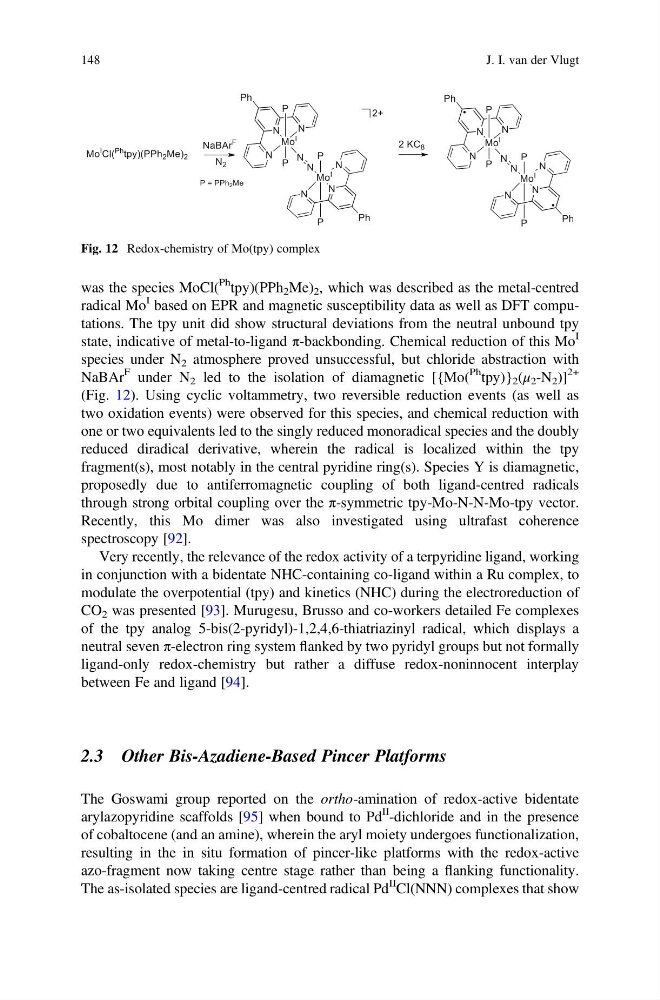
was the species MoCl(
Ph
tpy)(PPh 2 Me) 2 , which was described as the metal-centred
radical Mo
I based on EPR and magnetic susceptibility data as well as DFT computations. The tpy unit did show structural deviations from the neutral unbound tpy
state, indicative of metal-to-ligand π-backbonding. Chemical reduction of this Mo
I
species under N 2 atmosphere proved unsuccessful, but chloride abstraction with
NaBAr
F under N 2 led to the isolation of diamagnetic [{Mo(
Ph tpy)} 2 (μ 2 -N 2 )]
2+
(Fig. 12). Using cyclic voltammetry, two reversible reduction events (as well as
two oxidation events) were observed for this species, and chemical reduction with
one or two equivalents led to the singly reduced monoradical species and the doubly
reduced diradical derivative, wherein the radical is localized within the tpy
fragment(s), most notably in the central pyridine ring(s). Species Y is diamagnetic,
proposedly due to antiferromagnetic coupling of both ligand-centred radicals
through strong orbital coupling over the π-symmetric tpy-Mo-N-N-Mo-tpy vector.
Recently, this Mo dimer was also investigated using ultrafast coherence
spectroscopy [92].
Very recently, the relevance of the redox activity of a terpyridine ligand, working
in conjunction with a bidentate NHC-containing co-ligand within a Ru complex, to
modulate the overpotential (tpy) and kinetics (NHC) during the electroreduction of
CO 2 was presented [93]. Murugesu, Brusso and co-workers detailed Fe complexes
of the tpy analog 5-bis(2-pyridyl)-1,2,4,6-thiatriazinyl radical, which displays a
neutral seven π-electron ring system flanked by two pyridyl groups but not formally
ligand-only redox-chemistry but rather a diffuse redox-noninnocent interplay
between Fe and ligand [94].
2.3 Other Bis-Azadiene-Based Pincer Platforms
The Goswami group reported on the ortho-amination of redox-active bidentate
arylazopyridine scaffolds [95] when bound to Pd
II -dichloride and in the presence
of cobaltocene (and an amine), wherein the aryl moiety undergoes functionalization,
resulting in the in situ formation of pincer-like platforms with the redox-active
azo-fragment now taking centre stage rather than being a flanking functionality.
The as-isolated species are ligand-centred radical Pd
II Cl(NNN) complexes that show
Fig. 12 Redox-chemistry of Mo(tpy) complex
148
J. I. van der Vlugt
Ph
tpy)(PPh 2 Me) 2 , which was described as the metal-centred
radical Mo
I based on EPR and magnetic susceptibility data as well as DFT computations. The tpy unit did show structural deviations from the neutral unbound tpy
state, indicative of metal-to-ligand π-backbonding. Chemical reduction of this Mo
I
species under N 2 atmosphere proved unsuccessful, but chloride abstraction with
NaBAr
F under N 2 led to the isolation of diamagnetic [{Mo(
Ph tpy)} 2 (μ 2 -N 2 )]
2+
(Fig. 12). Using cyclic voltammetry, two reversible reduction events (as well as
two oxidation events) were observed for this species, and chemical reduction with
one or two equivalents led to the singly reduced monoradical species and the doubly
reduced diradical derivative, wherein the radical is localized within the tpy
fragment(s), most notably in the central pyridine ring(s). Species Y is diamagnetic,
proposedly due to antiferromagnetic coupling of both ligand-centred radicals
through strong orbital coupling over the π-symmetric tpy-Mo-N-N-Mo-tpy vector.
Recently, this Mo dimer was also investigated using ultrafast coherence
spectroscopy [92].
Very recently, the relevance of the redox activity of a terpyridine ligand, working
in conjunction with a bidentate NHC-containing co-ligand within a Ru complex, to
modulate the overpotential (tpy) and kinetics (NHC) during the electroreduction of
CO 2 was presented [93]. Murugesu, Brusso and co-workers detailed Fe complexes
of the tpy analog 5-bis(2-pyridyl)-1,2,4,6-thiatriazinyl radical, which displays a
neutral seven π-electron ring system flanked by two pyridyl groups but not formally
ligand-only redox-chemistry but rather a diffuse redox-noninnocent interplay
between Fe and ligand [94].
2.3 Other Bis-Azadiene-Based Pincer Platforms
The Goswami group reported on the ortho-amination of redox-active bidentate
arylazopyridine scaffolds [95] when bound to Pd
II -dichloride and in the presence
of cobaltocene (and an amine), wherein the aryl moiety undergoes functionalization,
resulting in the in situ formation of pincer-like platforms with the redox-active
azo-fragment now taking centre stage rather than being a flanking functionality.
The as-isolated species are ligand-centred radical Pd
II Cl(NNN) complexes that show
Fig. 12 Redox-chemistry of Mo(tpy) complex
148
J. I. van der Vlugt