

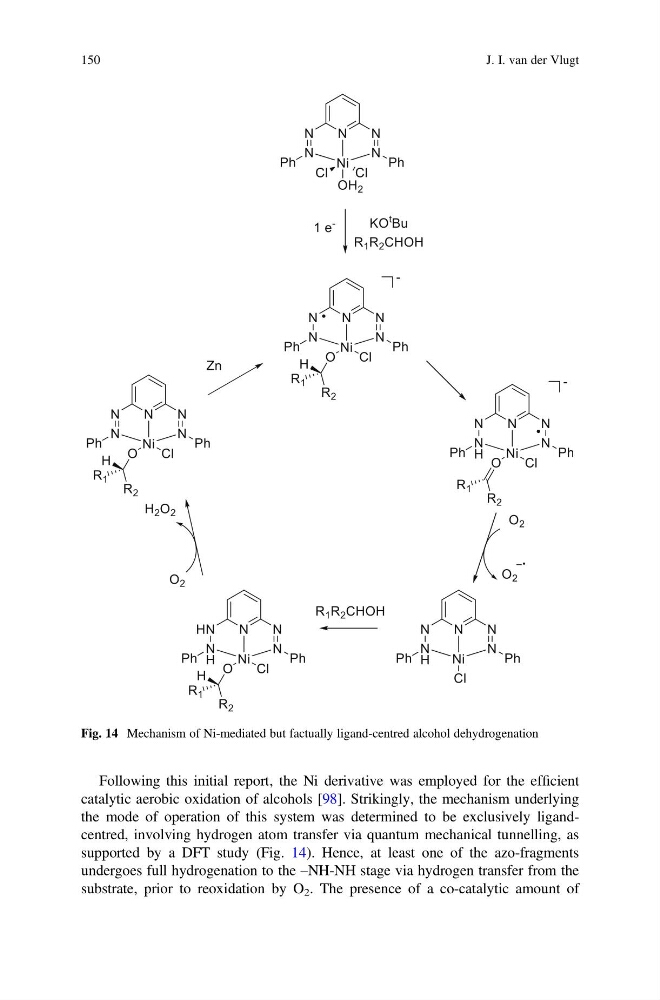
Following this initial report, the Ni derivative was employed for the efficient
catalytic aerobic oxidation of alcohols [98]. Strikingly, the mechanism underlying
the mode of operation of this system was determined to be exclusively ligandcentred, involving hydrogen atom transfer via quantum mechanical tunnelling, as
supported by a DFT study (Fig. 14). Hence, at least one of the azo-fragments
undergoes full hydrogenation to the –NH-NH stage via hydrogen transfer from the
substrate, prior to reoxidation by O 2 . The presence of a co-catalytic amount of
Fig. 14 Mechanism of Ni-mediated but factually ligand-centred alcohol dehydrogenation
150
J. I. van der Vlugt
catalytic aerobic oxidation of alcohols [98]. Strikingly, the mechanism underlying
the mode of operation of this system was determined to be exclusively ligandcentred, involving hydrogen atom transfer via quantum mechanical tunnelling, as
supported by a DFT study (Fig. 14). Hence, at least one of the azo-fragments
undergoes full hydrogenation to the –NH-NH stage via hydrogen transfer from the
substrate, prior to reoxidation by O 2 . The presence of a co-catalytic amount of
Fig. 14 Mechanism of Ni-mediated but factually ligand-centred alcohol dehydrogenation
150
J. I. van der Vlugt