

described as low-spin Mn
II with a dianionic closed-shell pdi
2À ligand, based on EPR
spectroscopy by double reduction of the pdi-skeleton. Subsequent mechanistic
investigations, including also ester hydrosilylation mediated by the Mn-hydride
derivative that was formulated as a doubly reduced closed-shell pdi
2– ligand
bound to low-spin Mn
III (by virtue of the strong ligand field induced by the hydride
and both phosphines) and supported by DFT calculations, led to reformulation of the
non-hydride species Mn(pdi_diphosphine) responsible for ketone hydrosilylation as
an intermediate-spin Mn
II centre that is antiferromagnetically coupled to a triplet
pdi
2•- diradical backbone [65]. This assignment also best corresponds to the obtained
structural parameters from X-ray crystallography.
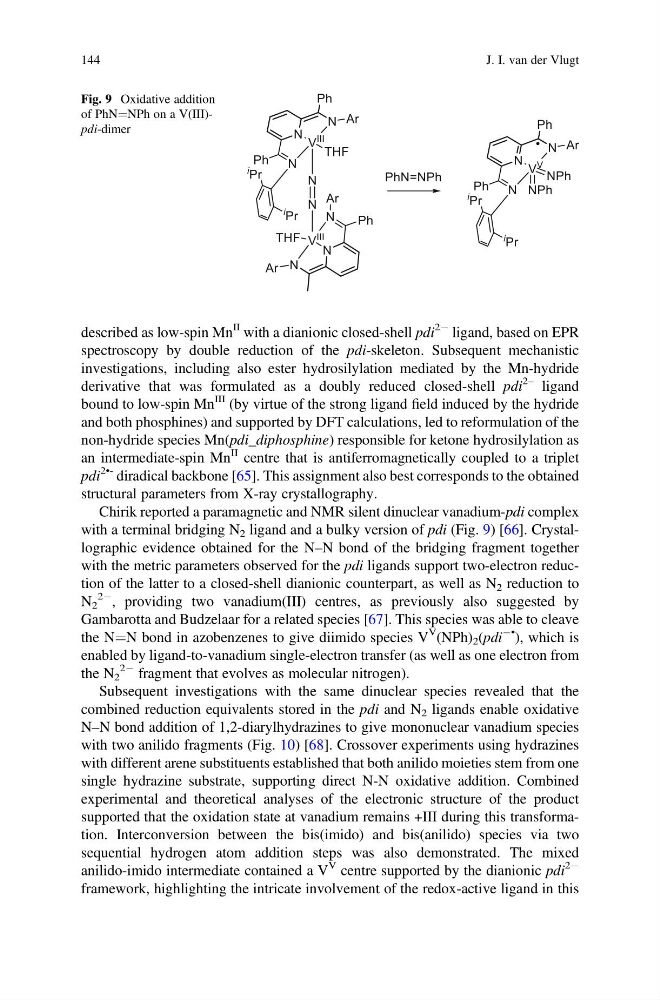
Chirik reported a paramagnetic and NMR silent dinuclear vanadium-pdi complex
with a terminal bridging N 2 ligand and a bulky version of pdi (Fig. 9) [66]. Crystallographic evidence obtained for the N–N bond of the bridging fragment together
with the metric parameters observed for the pdi ligands support two-electron reduction of the latter to a closed-shell dianionic counterpart, as well as N 2 reduction to
N 2
2À , providing two vanadium(III) centres, as previously also suggested by
Gambarotta and Budzelaar for a related species [67]. This species was able to cleave
the N¼N bond in azobenzenes to give diimido species V
V (NPh) 2 (pdi
À•
), which is
enabled by ligand-to-vanadium single-electron transfer (as well as one electron from
the N 2
2À fragment that evolves as molecular nitrogen).
Subsequent investigations with the same dinuclear species revealed that the
combined reduction equivalents stored in the pdi and N 2 ligands enable oxidative
N–N bond addition of 1,2-diarylhydrazines to give mononuclear vanadium species
with two anilido fragments (Fig. 10) [68]. Crossover experiments using hydrazines
with different arene substituents established that both anilido moieties stem from one
single hydrazine substrate, supporting direct N-N oxidative addition. Combined
experimental and theoretical analyses of the electronic structure of the product
supported that the oxidation state at vanadium remains +III during this transformation. Interconversion between the bis(imido) and bis(anilido) species via two
sequential hydrogen atom addition steps was also demonstrated. The mixed
anilido-imido intermediate contained a V
V centre supported by the dianionic pdi
2À
framework, highlighting the intricate involvement of the redox-active ligand in this
Fig. 9 Oxidative addition
of PhN¼NPh on a V(III)pdi-dimer
144
J. I. van der Vlugt
II with a dianionic closed-shell pdi
2À ligand, based on EPR
spectroscopy by double reduction of the pdi-skeleton. Subsequent mechanistic
investigations, including also ester hydrosilylation mediated by the Mn-hydride
derivative that was formulated as a doubly reduced closed-shell pdi
2– ligand
bound to low-spin Mn
III (by virtue of the strong ligand field induced by the hydride
and both phosphines) and supported by DFT calculations, led to reformulation of the
non-hydride species Mn(pdi_diphosphine) responsible for ketone hydrosilylation as
an intermediate-spin Mn
II centre that is antiferromagnetically coupled to a triplet
pdi
2•- diradical backbone [65]. This assignment also best corresponds to the obtained
structural parameters from X-ray crystallography.
Chirik reported a paramagnetic and NMR silent dinuclear vanadium-pdi complex
with a terminal bridging N 2 ligand and a bulky version of pdi (Fig. 9) [66]. Crystallographic evidence obtained for the N–N bond of the bridging fragment together
with the metric parameters observed for the pdi ligands support two-electron reduction of the latter to a closed-shell dianionic counterpart, as well as N 2 reduction to
N 2
2À , providing two vanadium(III) centres, as previously also suggested by
Gambarotta and Budzelaar for a related species [67]. This species was able to cleave
the N¼N bond in azobenzenes to give diimido species V
V (NPh) 2 (pdi
À•
), which is
enabled by ligand-to-vanadium single-electron transfer (as well as one electron from
the N 2
2À fragment that evolves as molecular nitrogen).
Subsequent investigations with the same dinuclear species revealed that the
combined reduction equivalents stored in the pdi and N 2 ligands enable oxidative
N–N bond addition of 1,2-diarylhydrazines to give mononuclear vanadium species
with two anilido fragments (Fig. 10) [68]. Crossover experiments using hydrazines
with different arene substituents established that both anilido moieties stem from one
single hydrazine substrate, supporting direct N-N oxidative addition. Combined
experimental and theoretical analyses of the electronic structure of the product
supported that the oxidation state at vanadium remains +III during this transformation. Interconversion between the bis(imido) and bis(anilido) species via two
sequential hydrogen atom addition steps was also demonstrated. The mixed
anilido-imido intermediate contained a V
V centre supported by the dianionic pdi
2À
framework, highlighting the intricate involvement of the redox-active ligand in this
Fig. 9 Oxidative addition
of PhN¼NPh on a V(III)pdi-dimer
144
J. I. van der Vlugt