

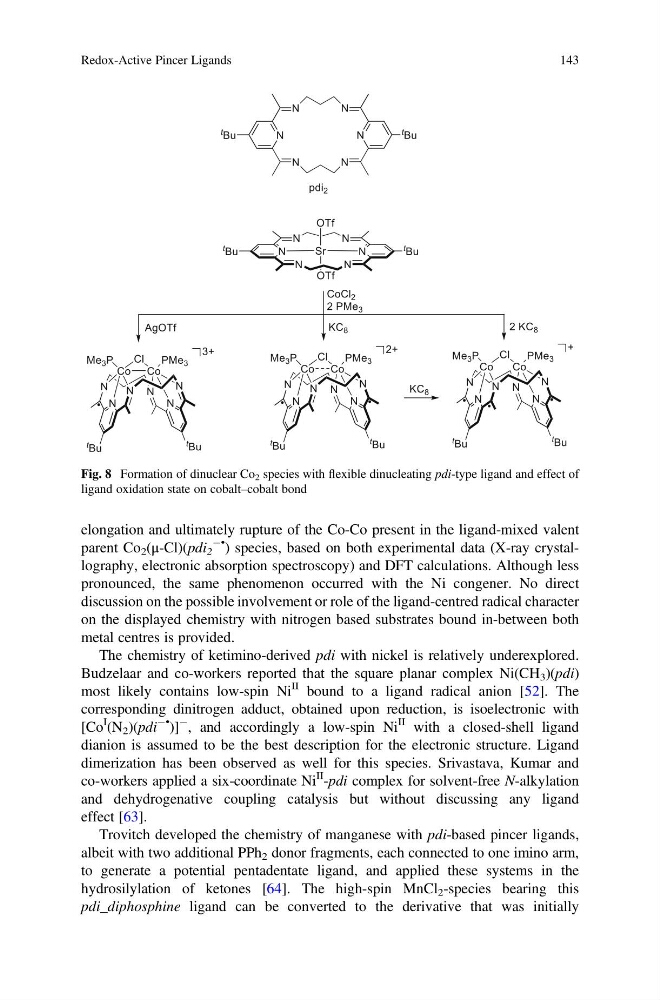
elongation and ultimately rupture of the Co-Co present in the ligand-mixed valent
parent Co 2 (μ-Cl)(pdi 2
À• ) species, based on both experimental data (X-ray crystallography, electronic absorption spectroscopy) and DFT calculations. Although less
pronounced, the same phenomenon occurred with the Ni congener. No direct
discussion on the possible involvement or role of the ligand-centred radical character
on the displayed chemistry with nitrogen based substrates bound in-between both
metal centres is provided.
The chemistry of ketimino-derived pdi with nickel is relatively underexplored.
Budzelaar and co-workers reported that the square planar complex Ni(CH 3 )(pdi)
most likely contains low-spin Ni
II bound to a ligand radical anion [52]. The
corresponding dinitrogen adduct, obtained upon reduction, is isoelectronic with
[Co
I (N 2 )(pdi
À• )]
À , and accordingly a low-spin Ni
II with a closed-shell ligand
dianion is assumed to be the best description for the electronic structure. Ligand
dimerization has been observed as well for this species. Srivastava, Kumar and
co-workers applied a six-coordinate Ni
II -pdi complex for solvent-free N-alkylation
and dehydrogenative coupling catalysis but without discussing any ligand
effect [63].
Trovitch developed the chemistry of manganese with pdi-based pincer ligands,
albeit with two additional PPh 2 donor fragments, each connected to one imino arm,
to generate a potential pentadentate ligand, and applied these systems in the
hydrosilylation of ketones [64]. The high-spin MnCl 2 -species bearing this
pdi_diphosphine ligand can be converted to the derivative that was initially
Fig. 8 Formation of dinuclear Co 2 species with flexible dinucleating pdi-type ligand and effect of
ligand oxidation state on cobalt–cobalt bond
Redox-Active Pincer Ligands
143
parent Co 2 (μ-Cl)(pdi 2
À• ) species, based on both experimental data (X-ray crystallography, electronic absorption spectroscopy) and DFT calculations. Although less
pronounced, the same phenomenon occurred with the Ni congener. No direct
discussion on the possible involvement or role of the ligand-centred radical character
on the displayed chemistry with nitrogen based substrates bound in-between both
metal centres is provided.
The chemistry of ketimino-derived pdi with nickel is relatively underexplored.
Budzelaar and co-workers reported that the square planar complex Ni(CH 3 )(pdi)
most likely contains low-spin Ni
II bound to a ligand radical anion [52]. The
corresponding dinitrogen adduct, obtained upon reduction, is isoelectronic with
[Co
I (N 2 )(pdi
À• )]
À , and accordingly a low-spin Ni
II with a closed-shell ligand
dianion is assumed to be the best description for the electronic structure. Ligand
dimerization has been observed as well for this species. Srivastava, Kumar and
co-workers applied a six-coordinate Ni
II -pdi complex for solvent-free N-alkylation
and dehydrogenative coupling catalysis but without discussing any ligand
effect [63].
Trovitch developed the chemistry of manganese with pdi-based pincer ligands,
albeit with two additional PPh 2 donor fragments, each connected to one imino arm,
to generate a potential pentadentate ligand, and applied these systems in the
hydrosilylation of ketones [64]. The high-spin MnCl 2 -species bearing this
pdi_diphosphine ligand can be converted to the derivative that was initially
Fig. 8 Formation of dinuclear Co 2 species with flexible dinucleating pdi-type ligand and effect of
ligand oxidation state on cobalt–cobalt bond
Redox-Active Pincer Ligands
143